
FPE #4: The economics behind why your roommates avoid chores
In today’s Finshots Pocket Economics edition, we break down game theory and tell you how everyday life often revolves around it.
But before we begin, here’s a quick recap of what we wrote over the past week. On Monday, we wrote about why the AI boom may be on the verge of creating its own FinOps moment. On Tuesday, we looked at a court ruling that could reshape one of the internet’s most important business models. On Wednesday, we gave an oversimplified breakdown of the Index of Industrial Production (IIP) and what to make of it. On Thursday, we talked about India’s first homegrown drug and why it took Indian pharma so long to get here. And yesterday, we broke down what SEBI believes may have gone wrong at Rajesh Exports.
With that out of the way, let’s dive into FPE, Edition #4.
Hey folks!
A few years ago, a friend of mine lived in an apartment in Bengaluru with three other roommates. And she had one constant complaint. “They cook, leave the kitchen messy, and never clean up. Somehow, I end up doing the dishes every single time whether they cook or I cook.”
If you’ve ever shared a flat with friends, this probably sounds familiar. You want to avoid conflict because, well, they’re your friends. So instead of confronting each other, most people just call another friend and vent. In this case, that unlucky friend was me.
I’d always tell her, “Just be frank and ask them to clean up after cooking.”
But she had a fear. “What if they stop cooking altogether and I end up doing everything alone?”
And to be fair, that was a valid concern. This was nearly a decade ago, when starting salaries straight out of college barely covered rent and groceries, let alone the luxury of hiring a househelp.
But had I known back then that an economic concept called game theory could explain exactly why her roommates never bothered with the dishes and, more importantly, how to fix it with a surprisingly simple solution, I’d definitely have recommended it to her.
It’s a good thing we have FPE for that. But before we get there, we first need to understand what game theory actually is.
In very simple terms, game theory is the study of decision-making. More specifically, it looks at how people, companies, governments, animals, or even computers make choices when the outcome depends not just on what they do, but on what others do too.
Like if you’re deciding whether to carry an umbrella to work on a cloudy day, you don't need to think about anyone else. But imagine we’re playing stone, paper, scissors, and you know I always pick stone. Suddenly, there’s a whole mental match happening between us.
You think, “She always picks stone. I should go with paper.”
But I know you’re thinking that. So maybe this time, I switch things up and play scissors instead.
That’s essentially what game theory tries to understand. It’s a way of thinking through decisions when two sides are constantly trying to outsmart each other. It asks a simple question, “Given what the other side might do, what’s the smartest move for me?”
And perhaps the most famous idea in game theory, the one you’ve probably heard of, is the Prisoner’s Dilemma. Even if you haven’t heard the term before, there’s a good chance you’ve seen it play out on screen if you’ve watched the TV series Suits, you might remember the episode where Mike Ross and his former co-worker Harold Gunderson are arrested for conspiracy to defraud the US government. They’re placed in separate cells for questioning, unable to see or hear each other.
Now let’s stretch that scene a little. Imagine the prosecutor walks up to Mike and says, “If you testify against Harold and he stays silent, we’ll drop the charges against you and let you go. But Harold will spend ten years in prison. However, if both of you confess, you’ll each spend eight years behind bars.”
Then the prosecutor walks into Harold’s room and says the exact same thing. Now imagine what’s going on in Mike’s head. “If Harold testifies and I stay silent, I’m doomed. But if I testify and he stays silent, I walk free. Either way, confessing feels like the safer choice.”
Harold is probably thinking the exact same thing. And so, both confess.
The prosecutor gets the convictions, and both end up worse off. But think about how the situation would have flipped if both Mike and Harold had trusted each other and stayed silent. They could’ve received a much lighter punishment or maybe even walked free.
Now, of course, in the actual Suits episode, both walk free because Harvey Specter and Louis Litt step in and save the day.
But our made-up version is what the Prisoner’s Dilemma is really about. Sometimes, when people act purely in their own self-interest, they accidentally create a worse outcome for everyone involved.
And this paradox (the Prisoner’s Dilemma) itself was conceptualised in 1950 by Merrill Flood and Melvin Dresher at the RAND Corporation, a military-linked research organisation set up by the US Army Air Forces during the Cold War. It was later formalised and given its famous name by Canadian mathematician Albert William Tucker.
But the foundations of game theory were laid much earlier, more than eighty years ago, by two remarkable thinkers: John von Neumann and Oskar Morgenstern.
This next bit in italics is just some historical background, so feel free to skip it if you’d rather avoid the slightly nerdy part of this edition.
Back in the 1940s, the world was wrestling with increasingly complicated strategic problems. Countries were making military decisions while constantly trying to predict what rival nations might do next. Businesses, too, were competing in markets where every move invited a response from competitors.
And traditional economics wasn’t great at explaining this. It mostly looked at individuals making decisions independently, not situations where everyone’s choices affected everyone else.
Von Neumann and Morgenstern believed something important was missing. They argued that many real-world decisions could only be understood by studying the strategic relationships between people. So, in 1944, they published a book called “Theory of Games and Economic Behaviour”, laying the foundation for what we now call game theory.
What made their work revolutionary was a simple but powerful idea. Your best decision often depends on what someone else decides. And their best decision depends on what they think you’ll do.
A few years later, a young mathematician named John Nash took these ideas even further and developed a framework to explain how stable outcomes can emerge even when everyone is chasing their own self-interest.
That idea became known as the Nash Equilibrium, something we’ll come back to in a bit.
In fact, Nash’s contribution became so influential that many people today associate game theory mainly with him, even though von Neumann and Morgenstern had laid the groundwork years earlier.
And now that we’ve got the concept sorted, let’s get back to the part we promised: my friend’s roommates, the messy kitchen, and how game theory could actually help solve the problem.
See, in my friend’s case, her roommates probably knew that even if they left the kitchen messy, she would eventually clean it up anyway. Which meant they had very little incentive to change.
From a game theory lens, she had a few options:
- She could stay nice forever and keep doing the dishes every day, hoping her roommates would magically realise they were being unfair and suddenly start helping.
- She could stop doing the dishes one day to send a message.
But here’s the catch. What if everyone thought the same thing?
Nobody cleans because nobody wants to be the only person doing the work. And suddenly, everyone wakes up to a kitchen that looks and smells bad.
So what’s the best way to solve it, you ask?
Create a system.
We know that sounds extremely simple. But that’s exactly why roommate routines exist. Everyone could sit down and decide who cooks on which day, who cleans the kitchen platform, and who handles the dishes.
Once there’s a clear routine, everyone takes turns. Maybe you spend an hour cooking one day and cleaning the next. The work gets shared, the kitchen stays clean, and more importantly, there are fewer passive-aggressive fights. Because people cooperate better when the rules are clear and freeloading becomes harder. In other words, the problem usually isn’t that flatmates are lazy. It’s just that the system makes avoiding work feel safer than cooperating.
So yeah, fixing the system could often change behaviour on its own.
You could apply the same thinking to something far more stressful — negotiating pay for a new job.
At first glance, it feels like a simple conversation. But it’s actually a strategy game.
You might think, “How much should I ask for without sounding unreasonable?” Meanwhile, the HR team thinks, “How badly do we need this person, and what’s the lowest reasonable number we can offer without losing them?”
Now imagine you blurt out, “Honestly, I’d be happy with ₹17 lakh per annum.” The company instantly learns your minimum acceptable number. So even if they had budgeted ₹20 lakh for someone with your skills, they suddenly have very little incentive to offer it. Instead, they may come back with ₹16.5–17 lakh and frame it as a generous offer.
And this is where game theory enters the room.
One of its lessons is try not to be the first person to name a number if you can help it. Because the first number often anchors the conversation, sometimes to your own disadvantage. Instead, ask about the budgeted salary range first. And if you absolutely have to go first, quote a number confidently at the higher end of what’s reasonable. By that we don’t mean you should quote a ridiculously high figure. Just whatever’s acceptable without underselling your skills.
The idea is to let the company reveal more while you reveal less. Because in strategic situations such as these, the smartest move often depends on what the other side knows.
This logic shows up in surprisingly ordinary places too, like supermarket billing counters.
We’ve all done this. You walk into a supermarket, scan the checkout lines, and instinctively pick the shortest one.
But here’s the funny thing. Everyone else is doing the exact same calculation. And within minutes, the lines start looking roughly equal again.
That’s game theory finding an equilibrium in real time without any manager coordinating things or a system directing traffic. It’s just people acting in their own self-interest and accidentally creating a fairly (or unfairly) balanced outcome.
That’s what you call Nash Equilibrium in everyday life. At that point, no single customer can do better by switching lines because if one line looked shorter, everyone would already be in it. You’re all stuck in the same rational standoff.
So the only way to do better is to have information everyone else may have missed. Like spotting a “10 items or less” counter in the corner that nobody may have noticed (i.e., if you have just a few items to bill). Or maybe there’s a self-checkout machine that most people ignore. But that only works until others spot it too. And the moment they do, the equilibrium resets.
And finally, game theory doesn’t just apply to everyday situations or personal decisions. It also shapes how governments think about tariffs, diplomacy, and even war.
Take two countries with nuclear weapons that don’t trust each other. Both are quietly asking the same terrifying question, “Should we attack first?”
But here’s the problem. If one country launches an attack, the other will almost certainly strike back before it’s wiped out. Which means the attacker doesn’t really “win” because both sides can end up devastated.
And that’s the logic behind what came to be known as Mutually Assured Destruction, or MAD. The idea was that neither side should start a nuclear war. Not because they suddenly trusted each other or wanted peace, but because launching one would basically mean signing your own death warrant too.
This is also exactly why the Cold War between the US and the Soviet Union stayed “cold” after World War II. Both countries built massive nuclear arsenals. Ironically, MAD is the very fact that stopped either side from using them.
And guess who helped shape some of this thinking?
Well, John von Neumann, the same mathematician who helped lay the foundations of game theory.
He played a role in promoting the logic behind MAD, although it’s worth noting that this wasn’t his idea alone. Military strategists, scientists, and policymakers, especially at institutions like RAND Corporation, also helped develop and refine the doctrine, which even today, remains one of game theory’s most real-world applications: a situation where the most rational move, strangely enough, was for both sides to do absolutely nothing.
And with that, we wrap up today’s FPE edition. But before we see you next week, tell us what you thought of today’s edition and what other everyday situations you think game theory could help explain. Just hit reply to this email (or if you’re reading this on the web, drop us a message at morning@finshots.in).
Or even better, share it with your friends and family on WhatsApp, LinkedIn, and X.
Finshots Weekly Quiz v2.0 🧠
As you probably already know, the Finshots Weekly Quiz has a new avatar. If you missed out on it in the last couple of months, don’t worry. Click here to check out the rules and set a reminder to participate consistently starting next month!
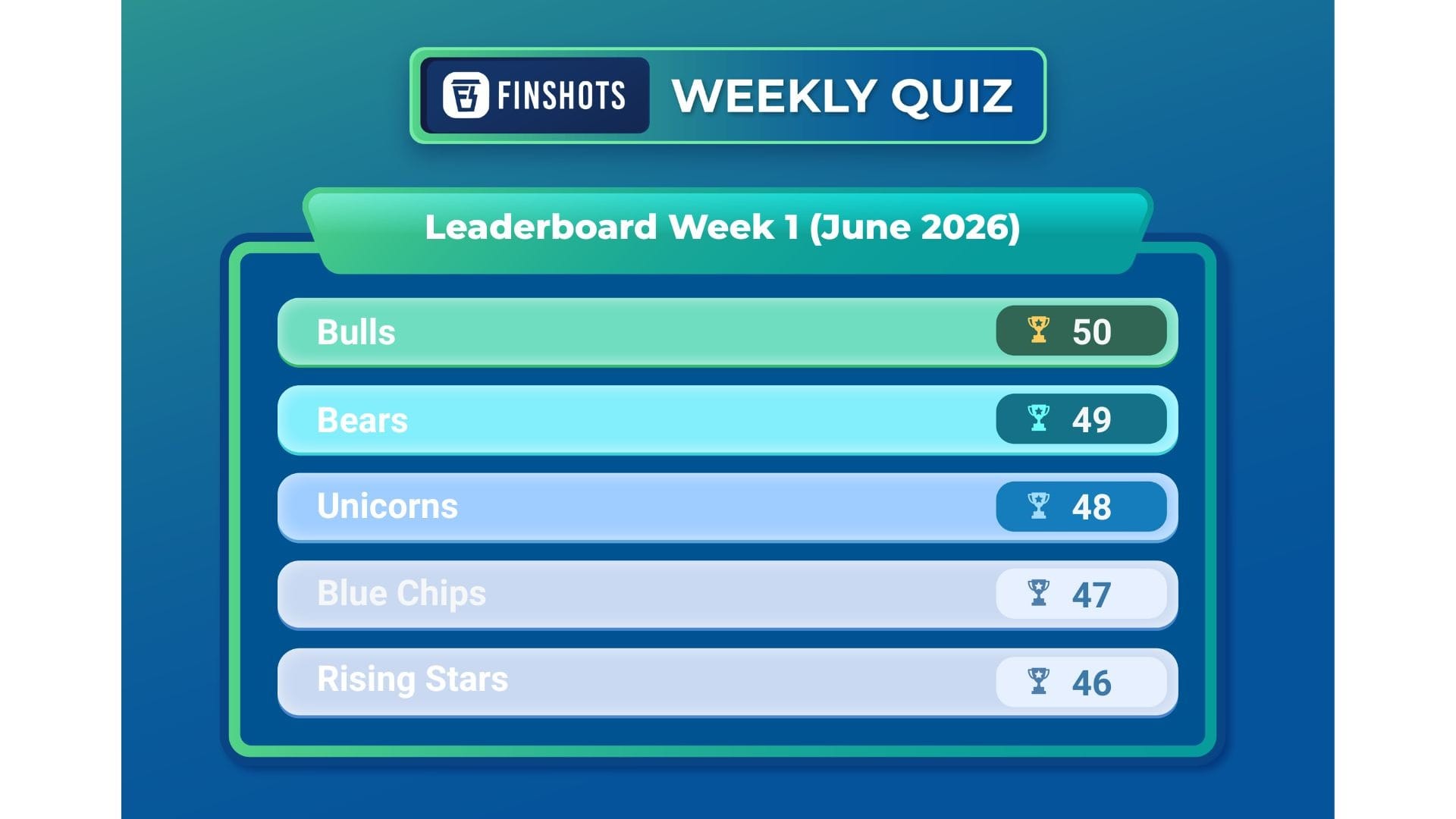
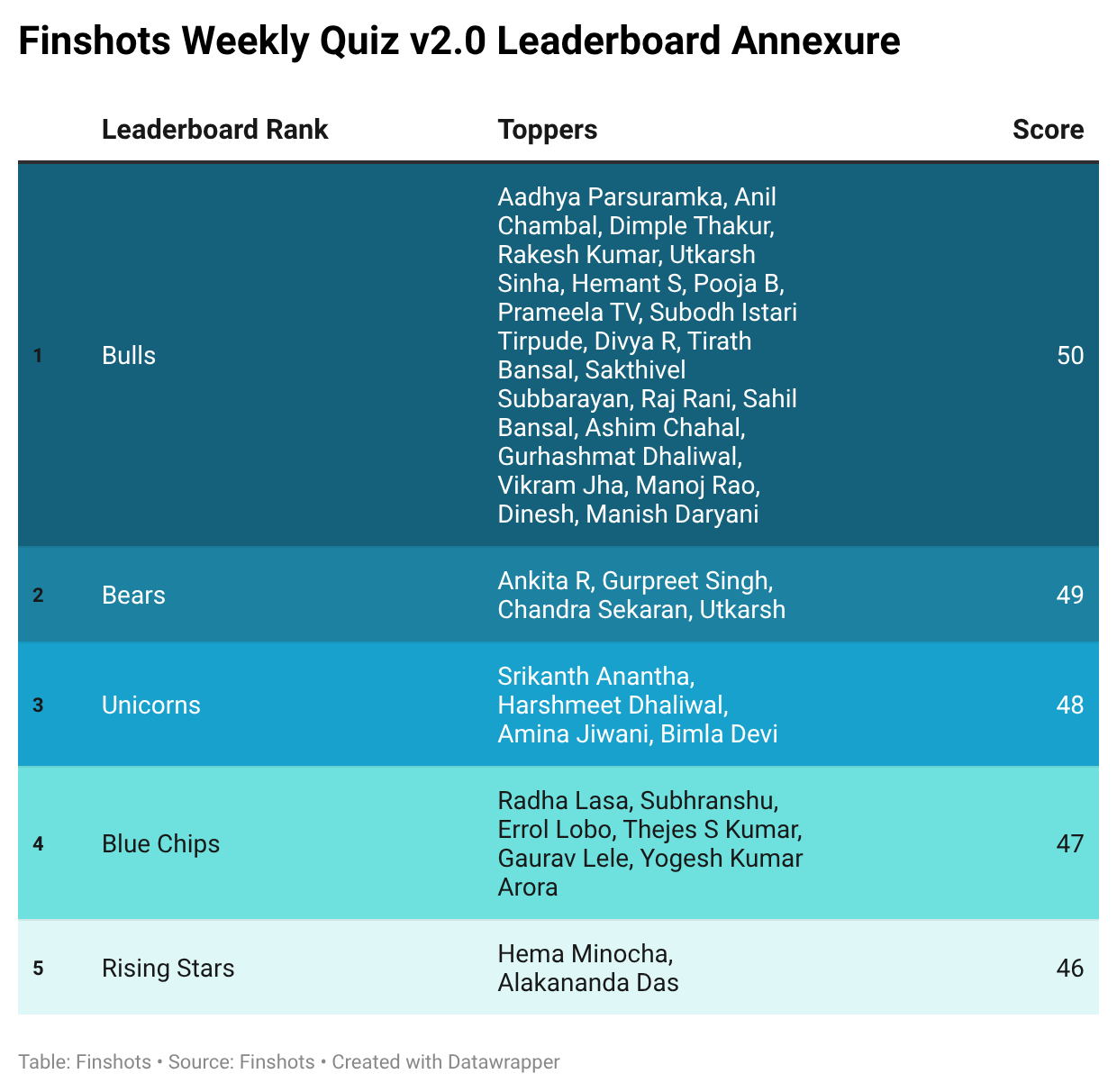
Next, let’s move on to the top scorers from our previous weekly quiz. There were a whole bunch of you who participated, and many of you ended up with the same scores. So we’re calling you Bulls, Bears, Unicorns, Blue Chips, and Rising Stars. Here’s how the leaderboard looks right now:
And from May’s leaderboard, we have nine top scorers fighting for the merch. But unfortunately, there’s just one merch box to be won every month.
So to break the tie, we’ll be sending a tie-breaker question to all the “Bulls” via email. Keep an eye on your inbox! The one who gets it right the fastest wins the exclusive Finshots merch for May 2026, and we’ll reveal the winner’s name next week.
And to the rest of you whose names made it to the leaderboard, congratulations! You may not have won the merch this time, but you showed up consistently and earned a spot on Finshots’ weekly leaderboard. That’s pretty cool.
So don’t lose hope. Hit the reset button this month and keep answering all the weekly quizzes. Who knows? You might just be the winner this time around.
Click on this link to take this week’s quiz, which is open till 12 noon, Friday, 12th of June, 2026. The more answers you get right, the better your chances of appearing on the Finshots Weekly Quiz leaderboard. We’ll publish it every Saturday in this edition. And the winner will be announced in the first week of July.