
Can Google still sell your brand name to competitors?
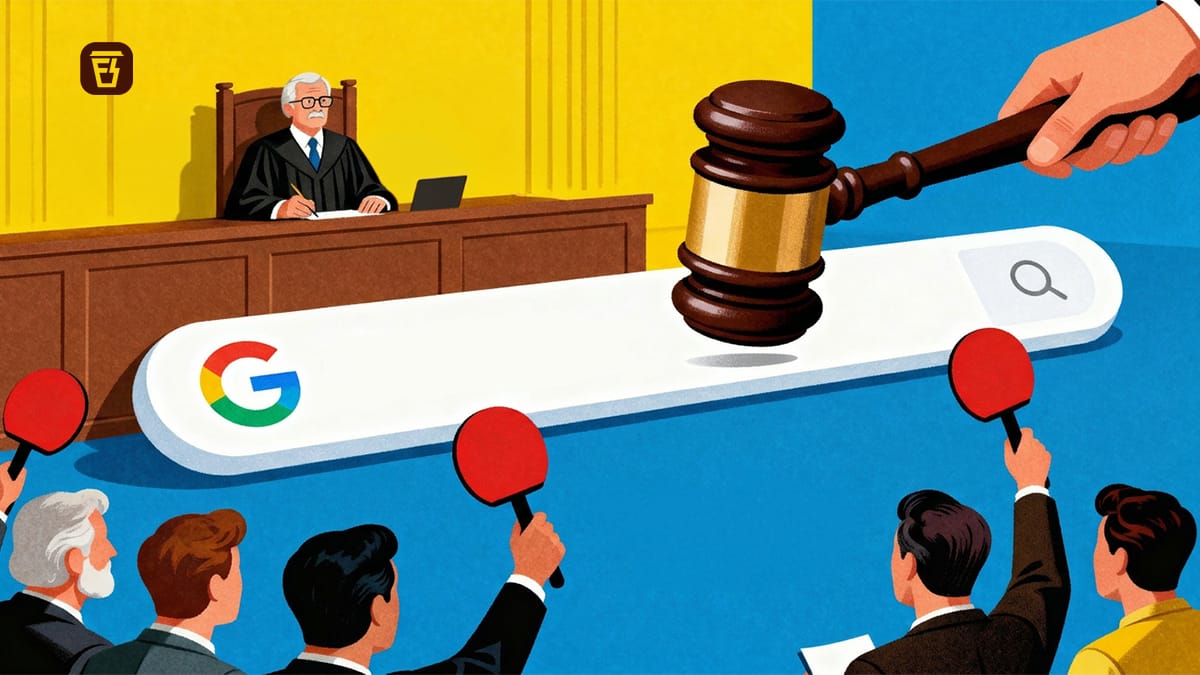
In today’s Finshots, we look at a court ruling that could reshape one of the internet’s most important business models.
But before we dive in, if you’re someone who loves keeping tabs on the world of business and finance, hit subscribe if you haven’t already. And if you’re already a subscriber, thank you! Maybe forward this to someone who’d enjoy our stories but hasn’t discovered us yet.
Now, onto today’s story.
The Story
Let’s say you own a coffee shop and have spent years building a loyal customer base. One not-so-fine day, you find a rival company right outside your entrance, redirecting customers walking toward your store. You wouldn’t be thrilled, right?
Well, for most of the internet's history, however, that's essentially how search advertising has worked.
Whenever someone searched for a particular brand, competitors could pay Google to place their own advertisements alongside those search results. If you searched for Nike, Adidas could bid on that search. Or if you searched for "Ditto Insurance", another insurance aggregator could position itself directly in front of a customer who had already expressed interest in “Ditto” Insurance.
This is called keyword bidding, where companies bid on competitors’ branded search terms to intercept high-intent customers. And it became one of the foundations of modern digital advertising because it allowed businesses to target users at the exact moment they were demonstrating purchase intent.
However, a recent Delhi High Court ruling may have just challenged that entire model.
You see, the story began more than a decade ago when sanitaryware manufacturer Hindware noticed something unusual. Whenever users searched for "HINDWARE" on Google, advertisements from competitors such as Grohe and Cera frequently appeared alongside the results. These competitors weren't necessarily using the word "Hindware" in their advertisements. But they were bidding on the trademark as a keyword inside Google's advertising system (AdSense).
Hindware went to court and argued that this amounted to trademark infringement. After all, the company had spent years and significant resources building brand recognition. So why should competitors be allowed to leverage that demand simply by participating in Google's advertising auctions?
The dispute eventually evolved into a legal battle that lasted more than twelve years. Along the way, the competing brands settled and agreed to stop using the trademark, leaving Google as the primary defendant.
Then, finally, in May 2026, the Delhi High Court delivered a judgment and ruled in Hindware's favour, permanently restraining Google from allowing "HINDWARE" and related variations to be auctioned as advertising keywords.
It also awarded damages and legal costs to Hindware. More importantly, however, the judgment concluded that using a trademark as a backend keyword constituted "use in advertising" under trademark law.
That finding may sound technical, but it goes directly to the heart of how search advertising functions, which makes up over 56% of Alphabet’s global revenue.
Google's defence rested on a relatively straightforward argument. The company claimed it was merely a neutral intermediary providing advertising infrastructure. After all, advertisers chose their own keywords, created their own campaigns, and competed against one another. Google merely hosted the marketplace.
But the court wasn't convinced.
In fact, Google tried to compare keyword bidding to a salesperson in a multi-brand electronics store recommending a Lenovo laptop when a customer asks for a Dell. The court rejected that analogy. Instead, it argued that searching for a trademarked brand is more like walking into that brand's exclusive showroom. In that setting, placing a competitor's advertisement in front of the customer isn't helping them compare products. It's effectively intercepting them inside someone else's store.
A major reason for that was Google's Keyword Planner, a tool that actively suggests keywords to advertisers based on search behaviour, traffic volumes, and commercial relevance. According to the court, Google wasn't merely hosting advertisements. It helped advertisers identify trademarked terms, encouraged bidding on those terms, conducted the auctions, and ultimately earned revenue from the resulting clicks.
In other words, the court concluded that Google was not simply providing the stadium. It was helping organise the game. And that's where the story becomes much bigger than one trademark dispute.
You see, for brand owners, the ruling feels like a long-overdue correction. And their argument is fairly intuitive. Building a brand requires years of investment in products, marketing, customer service, and reputation. So if a customer searches specifically for your company, that search reflects demand that you created. Allowing competitors to intercept that traffic effectively forces businesses to pay twice: first to build awareness and then again to defend their own brand name inside Google's auctions.
And in this regard, trademark bidding begins to look less like healthy competition and more like an invisible tax on successful brands.
But Google, along with many advertisers, argues that keyword bidding improves competition and benefits consumers. Their proposition is “If someone searches for Uber, why shouldn't Ola be allowed to present itself as an alternative? “
Consumers often compare products before making purchasing decisions, and search advertising has historically made those alternatives easier to discover. From this perspective, preventing competitors from bidding on brand names risks strengthening large businesses and making it harder for the underdogs to grow.
And this is where the discussion shifts from trademark law to asking a deceptively simple question: who owns consumer intent?
Because, for more than two decades, the internet has largely operated on the assumption that attention belongs to whoever wins the auction. Search engines created marketplaces where anyone could compete for visibility, regardless of who originally generated the demand. Google's business became one of the most successful advertising models in history precisely because it transformed user intent into an auction.
The Hindware judgment challenges that assumption.
It suggests that some forms of intent may not be entirely auctionable. If a consumer searches for a trademarked brand, the company that created that demand may have a legitimate claim over it. And the implications could be significant.
Large brands would likely benefit the most. They could spend less defending their own names and enjoy stronger competitive moats around the audiences they've spent years cultivating.
Smaller challengers and startups, however, may face a different reality. For many growing companies, bidding on competitors' brand names has historically been one of the most efficient customer-acquisition strategies available. Instead of spending enormous sums to build awareness from scratch, they could target consumers who had already shown interest in a particular product category.
If that avenue narrows, customer acquisition could become more expensive and more difficult.
The ruling also presents a challenge for Google itself.
Search advertising works because multiple advertisers compete for valuable keywords. And competition pushes auction prices higher and generates more revenue for the platform. If trademarked searches gradually become protected territory, the intensity of those auctions may decline. Over time, that could influence how Google's advertising ecosystem operates.
To be clear, the judgment does not automatically prohibit all competitor-keyword bidding nationwide. The ruling specifically addresses the “Hindware” trademark because it is a coined trademark with no independent dictionary meaning. Such distinctive marks generally enjoy broader protection under trademark law. Brands built around generic or descriptive words may find it harder to make the same argument because courts have historically been more willing to tolerate competitive advertising around those terms.
And that's where things get interesting.
For years, many businesses simply accepted trademark bidding as a cost of doing business online. But the Hindware case provides a roadmap for challenging it. If a company can demonstrate that competitors are using its trademark to divert customers and that a platform is actively facilitating that process, Indian courts may now be more willing to intervene.
That doesn't mean every business will automatically win. The court repeatedly noted that highly distinctive trademarks enjoy stronger protection than generic or descriptive names. But the judgment still shifts the balance of power toward brand owners.
It may also change how companies think about trademark protection itself. Registering a trademark is no longer enough. Businesses may increasingly monitor search advertisements, file complaints against infringing advertisers, register trademarks across international markets through systems such as WIPO (World Intellectual Property Organization), and secure translated or local-language versions of their brands before competitors do.
For Google, advertisers, and startups, the bigger challenge is adapting to a world where trademarked attention may no longer be freely auctioned.
For brand owners, however, the message is much simpler: if you've spent years building a reputation, Indian courts may be increasingly willing to treat that reputation as something worth protecting online too.
Until next time…
If you liked this story, feel free to share it with your friends, family or even strangers on WhatsApp, LinkedIn or X.
Message to all the Breadwinners
You work hard, you provide, and make sacrifices so your family can live comfortably. But imagine when you're not around. Would your family be okay financially? That’s the peace of mind term insurance brings. If you want to learn more, book a FREE consultation with a Ditto advisor today.