
Can AI really fix America's $39 trillion debt problem?
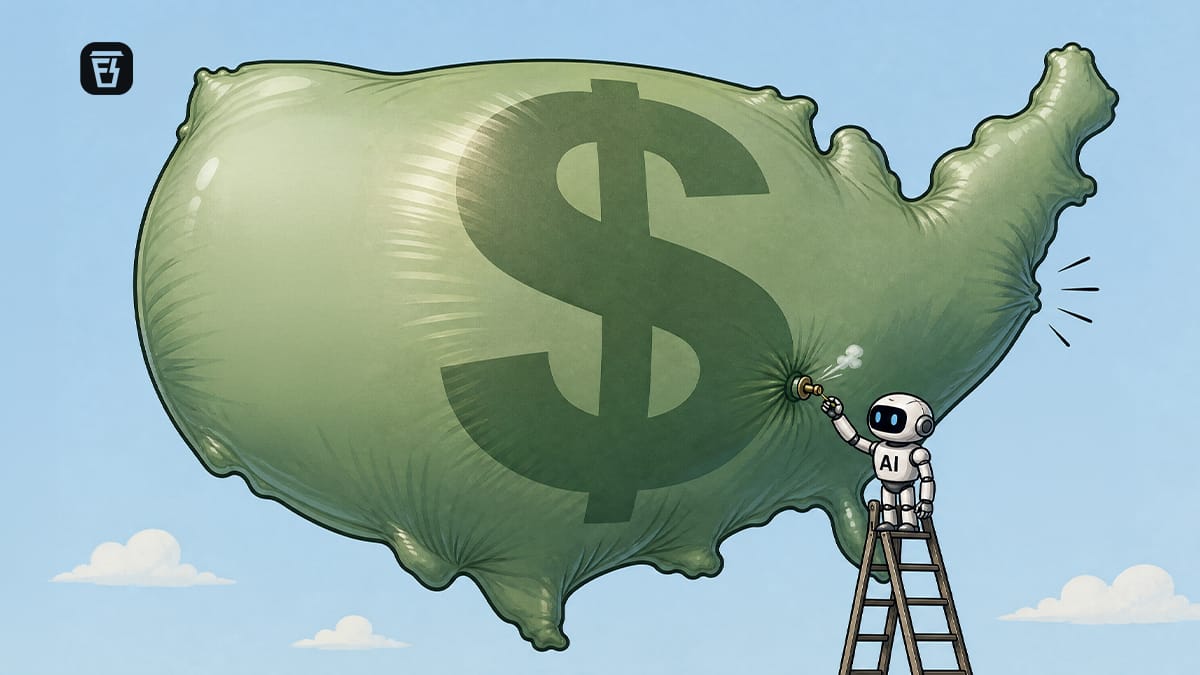
In today’s Finshots, we explore whether the AI boom can actually solve the US debt crisis.
But here’s a quick sidenote before we begin. If you’re someone who loves to keep tabs on what’s happening in the world of business and finance, then hit subscribe if you haven’t already. We strip stories off the jargon and deliver crisp financial insights straight to your inbox. Just one mail every morning. Promise!
If you’re already a subscriber or you’re reading this on the app, you can just go ahead and read the story.
The Story
When a government spends more than it earns in taxes and other revenue, it runs a deficit. To plug that gap, it borrows money by selling bonds to investors, banks, other countries, and even its own central bank. In return, it promises to pay them interest every year and repay the full amount when the bonds mature. Over time, all that borrowing, along with the unpaid debt that’s rolled over year after year, adds up to what we call the national debt.
And for the US, that debt crossed a staggering $39 trillion just a couple of months ago.
To put that in perspective, it took the US nearly 200 years to accumulate its first $1 trillion in debt, a milestone it reached only in 1981. Three years later, that figure had doubled. But jumping from $38 trillion to $39 trillion took just about six months.
A big reason is that America’s debt has kept snowballing over the years. The COVID-19 pandemic alone added more than $4 trillion in a single year as the government spent aggressively to keep the economy afloat.
Today, the consequences are becoming hard to ignore. The US now spends over $1 trillion every year just on interest payments. That’s more than what it spends on Medicare or national defence. And for the first time since the years following World War II (excluding the pandemic, when GDP temporarily collapsed), the country’s debt has grown larger than the entire economy that supports it.
And if current projections hold, US debt could climb to roughly 120% of GDP over the next decade.
Now, while all of this sounds alarming, America’s debt problem isn’t exactly new. The US has been living with a growing debt pile for decades. And year after year, it has managed by simply borrowing more. It has continued to issue fresh bonds to repay old ones, has raised the debt ceiling (the limit on how much debt it is allowed to take on) whenever necessary, and has kept the economy strong enough that investors around the world remain willing to keep lending it money.
That strategy has worked so far. But it comes with a cost. As interest payments keep rising, they eat into the government’s budget, leaving less money for things that can actually boost future growth, like education, research, and infrastructure.
Which is why the US needs more than just a way to keep borrowing.
The obvious way out would be to cut spending, raise taxes, or do a bit of both to shrink the annual deficit.
But what if there was another way? What if AI made workers and businesses so much more productive that the economy simply grew its way out of the problem?
Just think about it. If companies produce more, profits rise. Workers earn more. And without changing tax rates, the government automatically collects more tax revenue.
That’s why some people, including Elon Musk and economists like Joe Davis, believe that an AI-driven productivity boom could help the US outgrow its debt burden.
But can AI actually solve America’s debt crisis, you ask?
Well, let’s start with the optimistic side of the argument.
Economists generally agree that faster productivity growth can genuinely improve government finances. And history offers a good example.
During the internet boom of the late 1990s, the US economy became much more productive. As businesses expanded and incomes rose, the government collected more tax revenue without raising tax rates. The end result was that between 1992 and 2002, the US shrank its budget deficit by roughly 60%.
And many believe that AI could trigger a similar wave. In fact, a research paper published by Brookings just last week estimates that an AI-driven productivity boom of a similar scale could reduce annual deficits from about 6% of GDP to just 2%. That’s more than $2.2 trillion in deficit reduction over the next decade.
The OECD backs this up too. It says that if AI meaningfully boosts productivity and employment, public debt across wealthy economies could fall by around 10% by the mid-2030s.
So, at first glance, the idea sounds pretty convincing.
But there’s a catch because it’s not that simple.
Sure, AI can make workers more productive and help the economy grow faster. But it can also create new costs that chip away at those gains. And the Brookings paper points to a few important ones.
Take healthcare, for instance. If AI helps people live longer and healthier lives, that’s undoubtedly good news. But it also means that the government has to keep paying Social Security (pensions) and Medicare (healthcare benefits) for more years. And then there’s the labour market. If AI ends up replacing some workers, the government may also have to spend more on unemployment benefits and other forms of income support.
Then there’s another issue. AI could shift more income from workers to company owners because only a handful of companies are driving and profiting from the AI boom. But business income and corporate profits are generally taxed less heavily than wages.
To give you some context, payroll taxes which apply only to wages make up about 33% of US federal revenue. Income taxes account for another 52%, but only a small share of those taxes comes from capital income. And the tax rates themselves aren’t equal either. Top wage earners can face effective marginal tax rates exceeding 40%, while much business income is taxed below 30%. Dividends and realised capital gains are taxed at under 25%, and unrealised gains aren’t taxed at all until the assets are sold.
So if AI shifts more income away from paycheques and towards corporate profits and investment gains, the government could end up collecting less tax than expected, even if the economy grows faster.
You also have to remember that a faster-growing economy often means that consumers and businesses spend and borrow more. That can push inflation higher, prompting interest rates to rise. And when interest rates rise, borrowing becomes more expensive for everyone, including the US government, which already has a mountain of debt to finance.
Put all of this together, and the picture changes dramatically. The Brookings researchers found that once these knock-on effects are taken into account, more than half of the fiscal gains from AI-driven productivity simply disappear.
But there’s one way in which AI could come much closer to fixing the debt problem: if the government scaled back income support for workers who lose their jobs because of AI. And that’s not our wild idea but from a policy research centre at Yale.
And that could simply mean that AI’s ability to reduce the debt crisis doesn’t depend solely only on the technology itself. It also depends on how US policymakers respond to it. Will they raise taxes on corporations? Or will they cut back on income support for workers displaced by AI?
So yeah, AI isn’t some magical money tree. It will probably make the US economy stronger and give the government more breathing room. But it won’t magically wipe out a $39 trillion debt.
At the end of the day, tough decisions about taxes and government spending will still have to be made. AI may buy policymakers some time and make those choices a little easier, but it can’t make them disappear.
Until then...
Liked this story? Share it with your friends, family or even strangers via WhatsApp, LinkedIn and X.
A message to all the breadwinners
You work hard; you provide and make sacrifices so your family can live comfortably. But imagine when you're not around. Would your family be okay financially? That’s the peace of mind term insurance brings. If you want to learn more, book a FREE consultation with a Ditto advisor today.