
Finshots College Weekly - Women's Day Special
In this week's newsletter, we discuss women in the economy, Cred, space and more.
If you'd like to receive our 3-min daily newsletter that breaks down the world of business & finance in plain English - click here. Or, download the Finshots app here.
What if women were paid to do daily chores?!
That is the estimated value of unpaid labour attributable to women around the world. We’re talking about things like household chores, childcare and caring for the elderly.
But if you ask most people about unpaid labour, their responses would probably be “My wife doesn’t work.” Or “It’s just housework.” Or worse, “She’s just doing her duty.”
Unfortunately, housework has long been a task that’s relegated to women. So while women in India spend 297 minutes per day on household work, men spend a mere 31 minutes. The disparity is immense.
Now, the objective of the story is twofold. One, to quantify the compensation women ought to receive for the kind of work they do. Two, figure out how to compensate them.
So let’s address the first question — how do you calculate the value of this unpaid labour?
Well, most people recommend something called a ‘time-use survey’. Basically, you actually ask women about the kind of work they do around the house. And then, calculate how much labour value would have gone into those tasks if they had to hire someone else to do it.
Reasonable enough, right?
But some people argue that when you conduct surveys, you may not get the right answer from most women. They might believe that certain tasks are ones that they simply have to do. That they have no choice. And they may not consider it as work. So they might not report it. For instance, they may ignore the time spent caring for a child. Or tending to the cattle in the house. Even though both are productive work that contributes to the economy.
And if you ask India’s courts, they have their own methods. See, when cases around negligent driving and death go to court, judges have sort of determined what’s an appropriate compensation to be paid out. I’m talking about cases specific to when women homemakers are involved. They take into account the opportunity cost — or what a woman of her education qualifications might have earned in the job market. They consider the minimum wages for labour. And make some adjustments for age and children in the family.
And they’ve awarded compensation that ranges anywhere from ₹5,000 to ₹9,000 a month.
Now, one could argue that this doesn’t seem like much. Or that there are flaws in the calculations. But at least there’s some precedent for calculating such payments.
Then there’s the other question that everyone dreads — who pays for it?
Well, one suggestion is that the government bears this cost.
Hold on…you could say that it seems to be a lot of pressure on government coffers if they have to pay up for this. But what if you were to assume that the government is only sharing the benefits of what it has reaped? As Indira Hirway a professor of economics, wrote in The Hindu earlier:
“Unpaid work also subsidises the government by taking care of the old, sick and the disabled. The state would have spent huge amounts in the absence of unpaid work. Unpaid work is a privately produced public good which is critical for the sustenance of the mainstream economy.”
So you could argue that the state has an obligation to do something about this. In fact, political parties in the states of Tamil Nadu, Kerala and West Bengal have included “payment to homemakers” in their election manifesto too. We don’t know if it’ll ever come to fruition. But it’s a start.
But if we were being honest, this is still a stretch. These payments would inevitably cripple our finances and not everyone agrees these monetary payments will work.
Some economists think that it will keep women confined to the house even more. If people believe that women are getting paid by the government for housework, why should women bother to work outside? Why should they have a career of their own?
And while the labour force participation rate is only 25% for Indian women, this could fall further as a result.
Also, cash transfers might be a problem because men end up making money decisions at the end of the day. The women do not benefit.
So what’s the way out then, you ask?
Well, some suggestions involve in-kind transfers that will directly have an impact on their lives. And reduce the burden on their daily chores.
For instance, providing cooking gas cylinders to each household reduces the time that women spend collecting firewood and cooking. Or if free child-care centres are available, it reduces the burden of care on mothers. Take Uruguay for instance. When the country introduced the Care Act, it changed everything. It made it a right for children and elderly persons to get care. And the government took up the responsibility to provide these care services. And even ensure their quality.
Other countries have experimented with such unconventional policies too for unpaid labour. For instance, in Belgium, the government doled out vouchers to people who hired an agency to do their housework. It was a subsidy of sorts. Finland, Sweden, and Denmark have chosen to give tax breaks in similar cases. And it seems to have helped in Sweden because people who opted for these subsidies grew further in their careers. They even earned $2000 more annually.
Or maybe in societies like India where patriarchy is so deeply entrenched, we need ways to get men also involved in sharing housework. By giving them mandatory training and financial incentives for sharing housework. Or maybe even just formalising things like a mandatory paternal leave. So that men realize that they’re expected to help in child rearing too.
Anyway, we don’t know the right answer. But we’re glad that people are talking about unpaid labour and ways to deal with it. Because as Prabha Kotiswaran, a professor of law and justice at King’s College London, says, “At the current rate of change — the average gender gap between the time men and women spent on unpaid work in 72 countries reduced by seven minutes between 1997 and 2012 — it would take 210 years for housework to be shared equally.”
We don’t want to wait for over 2 centuries for the miracle to happen, no?
3 things from the Blume Ventures report
1) What does internet penetration mean for e-commerce?
3 things changed the face of digital India.
When Reliance Jio launched in 2016, the dirt-cheap tariffs meant that many Indians went online for the first time in their lives. Then, the launch of UPI made digital payments easier. And of course, demonetisation gave it a boost. Finally, when Covid struck, people took to online shopping and activities like fish to water.
All this meant that mobile internet subscribers in India soared. From 400 million users in 2016, it doubled to 800 million in 2020. Startups piggybacked on this. And the ones who pitched saying, “My industry is underpenetrated. Digital will solve everything,” raised lots of money.
But…there’s a problem now.
Especially for e-commerce. Because everyone’s an e-commerce user these days. Okay, not everyone. But the penetration levels are already quite high. 19% of India’s households shop online. If you dissect the numbers, you’ll see that in the high-income category (greater than ₹6 lakhs), the e-commerce penetration is already at 37%. Or as Blume put it, e-commerce has already captured the low-hanging fruit.
That means if they want to go after the rest of the market, especially the rural side where penetration is around 19%, it’ll be hard work. Because if e-commerce companies want to acquire and retain a new shopping household, they might have to shell out anywhere between ₹5,000 to ₹12,000. That’s what Credit Suisse pegs the costs to be. So if they want 30 million new households in their kitty, they’re going to have to spend between $1.8 billion to $4.5 billion to acquire them.
Will companies want to spend that kind of money?
Maybe not. Especially if you think about the return on investment. While people in metros spend $500 annually per shopper, the folks in Tier 2 and smaller cities spend just less than half of that sum — $220.
The economics may just not work for companies.
But there’s another roadblock too.
You see, there’s been a slowdown in mobile internet subscribers of late. Since hitting the 800 million mark in 2020, growth has been lacklustre. We are at about 837 million internet users today.
Even smartphone sales are going through a tough time — it fell by 9% in 2022. And that’s because entry-level smartphones aren’t as cheap as they used to be. Prices have gone up. Combine that with the fact that 750 million people already use smartphones in India and it’s hard to see where the growth will come from.
The pie isn’t expanding. And you need smartphone users to drive sales. It seems like we might have just reached a plateau for e-commerce. Makes you think, doesn’t it?
2) Is hyperlocal content the future of OTT?
Sometime last year, we wrote about how startup funding works. We said:
“Great entrepreneurs start as great storytellers. They can weave the most compelling narrative and get even the most reluctant Venture Capitalists on the cap table. But this assessment is only partially true. Sure, VCs love good storytellers. But they only like a very specific kind of story — the one where you tell them ‘the world is your oyster’.”
Essentially, VCs like to hear a fabulous story about how they can 1000x their money. And for that, they like hearing that the Total Addressable Market (TAM) in a country like India is massive. They want all 1.4 billion people on board.
But what if you’re launching a media startup that’s going to have a very niche audience? Maybe you’re creating video content (OTT) for a regional audience — in a specific dialect.
Most VCs won’t like this initially. You might find a select few who’ll help you get things up and moving, but the biggies might stay away. They’ll worry about how much revenue you can snag. They might say, “Sure, people pay for Netflix and it has 6 million subscribers in India. Sure, Disney Hotstar has 60 million subscribers too. But getting people to pay for content in local dialects…will that work?”
Well, maybe it will.
Blume points to an OTT platform called Stage which caters specifically to Haryana and Rajasthan for now. In July 2021, Stage had 10,000 paying subscribers. Less than 2 years later, it already has 235,000 viewers who pay.
These viewers might be people who already own other OTT subscriptions and decided to get a regional one too. Or it could be those who scoff at the content on Netflix and say that it doesn’t reflect the true India or Bharat as everyone likes to call it. That hyper-localised content is the way to go. That they’ll pay money for it.
Either way, Stage can show the VCs that they’ve achieved their Product Market Fit. That subscriptions work. That they can replicate this model across the length and breadth of India. That with nearly 20,000 dialects across India, the opportunity is immense. People will pay.
Then, the VC money will come in too.
And here’s the other thing. So far, OTT platforms haven’t really opened up for advertisements yet. They’ve stuck to subscriptions. That’s why you see data which says that only 1% of the $7 billion digital ad market goes towards OTT. Companies haven’t had the chance to advertise on OTT.
But platforms like Netflix are already experimenting with an ad-supported subscription model. Cheaper versions that’ll attract more people. And if regional OTT platforms can help companies target extremely specific audiences, then advertising could also blow up, no?
That means more VC money?
3) Can the e-commerce duopoly of Amazon and Flipkart be broken?
If you’re a startup selling products directly to customers (D2C), how do you attract them?
You could build your own website. And advertise heavily on social media to draw people’s attention. But it could cost a truckload of money.
You could choose to list your products on Amazon and Flipkart. Let them distribute it for you. You pay a listing fee and share some commission. But their massive user base could supercharge sales.
What if we tell you there’s a third option emerging stealthily?
We’re talking about Cred.
Yup, the ‘pay your credit card bills and earn coins’ company has something called the Cred store within its app. It curates a selection of brands and lists them. People can burn their stash of Cred coins and get sweet deals on the products. And going by what Cred said when it launched the store, it doesn’t charge any fees or commissions from the brands either.
Now there are a couple of interesting things about Cred’s e-commerce venture.
First, Cred is a play on discovery commerce.
Have you ever, when bored, simply popped up the Cred app and started browsing through the store? I have. And that’s thanks to its discovery commerce features — A personalized feed of products. Perfectly searchable categories. And even in-app games like addictive casino-like ‘spin the wheel’ deals and ‘bidding’ for products. It’s entertaining.
So while you’ll only fire up Amazon when you need to buy something specific, Cred’s store is scroll-worthy when bored. It’s an alternative social media feed. Just for shopping.
And this trend is catching on quickly. In fact, the most downloaded app recently in the US, across both Apple and Google, has been an obscure discovery commerce platform called Temu. Sales on the platform are through the roof.
Secondly, there’s Cred’s target market.
India has a creamy layer at the top. They’re the ones who contribute the bulk of e-commerce sales. As per Blume, this is approximately 120 million people who have a per capita income greater than $12,000.
And if you think about it, a subset of this is probably the same folks that are on Cred too. That’s because Cred gatekeeps its users by using the credit score as a filter.
The end result?
While Cred only has less than 5% of Amazon’s user base, it’s generating massive sales for some of the brands listed on its platform — anywhere between 30–50% of sales these days is thanks to Cred.
A discovery platform with gated access to the top earners seems to have done wonders so far for some D2C brands. And while this strategy may not break the Amazon-Flipkart duopoly, Cred’s emerging as an e-commerce force in its own right.
So yeah, there are lots of cool bits in the Blume Ventures report. But that’s all we could pack in for now. What did you think?
Today's Discussion: India's cost-effective space missions

India has cracked the code for cost-effective space missions. 👇
India’s Mangalyaan mission for instance — cost LESS than the budgets of space movies like Interstellar, The Martian and Gravity.
To put things into perspective: While the Mangalyaan mission cost $74M— Interstellar had a budget of $165M, The Martian had $108M and Gravity had $100M!
And that’s not all. Even the cost of India’s Mars mission is just a fraction of those by other countries — USA’s MAVEN for instance, cost a whopping $671M!
Similar trends are seen across all Indian space missions, including Chandrayaan.
So, how did India crack the code to space missions on a budget?
Well, since India’s space missions heavily rely on production in India itself, it benefits from low labour costs and low infrastructure costs. Also, the use of indigenous technology and outsourcing to local manufacturers for cheap can be reaped.
And by minimising the need for imports and assembling them domestically India is able to further cut down expenses.
This has been attracting foreign attention too — India’s PSLV rockets have placed around 345 foreign satellites in orbit, earning $279M in foreign exchange! With the recent opening up of the space industry to private players, these numbers are bound to increase — India’s space economy could be worth nearly $13B by 2025!
Now, all this cost-effectiveness does not mean quality is compromised either. In fact, with Mangalyaan, India became the first to successfully carry out a Mars mission on its maiden attempt!
All in all, with more ambitious projects in the pipeline such as Gaganyaan — India’s reputation for cost-effective space programs is only bound to grow.
Fascinating, isn’t it?
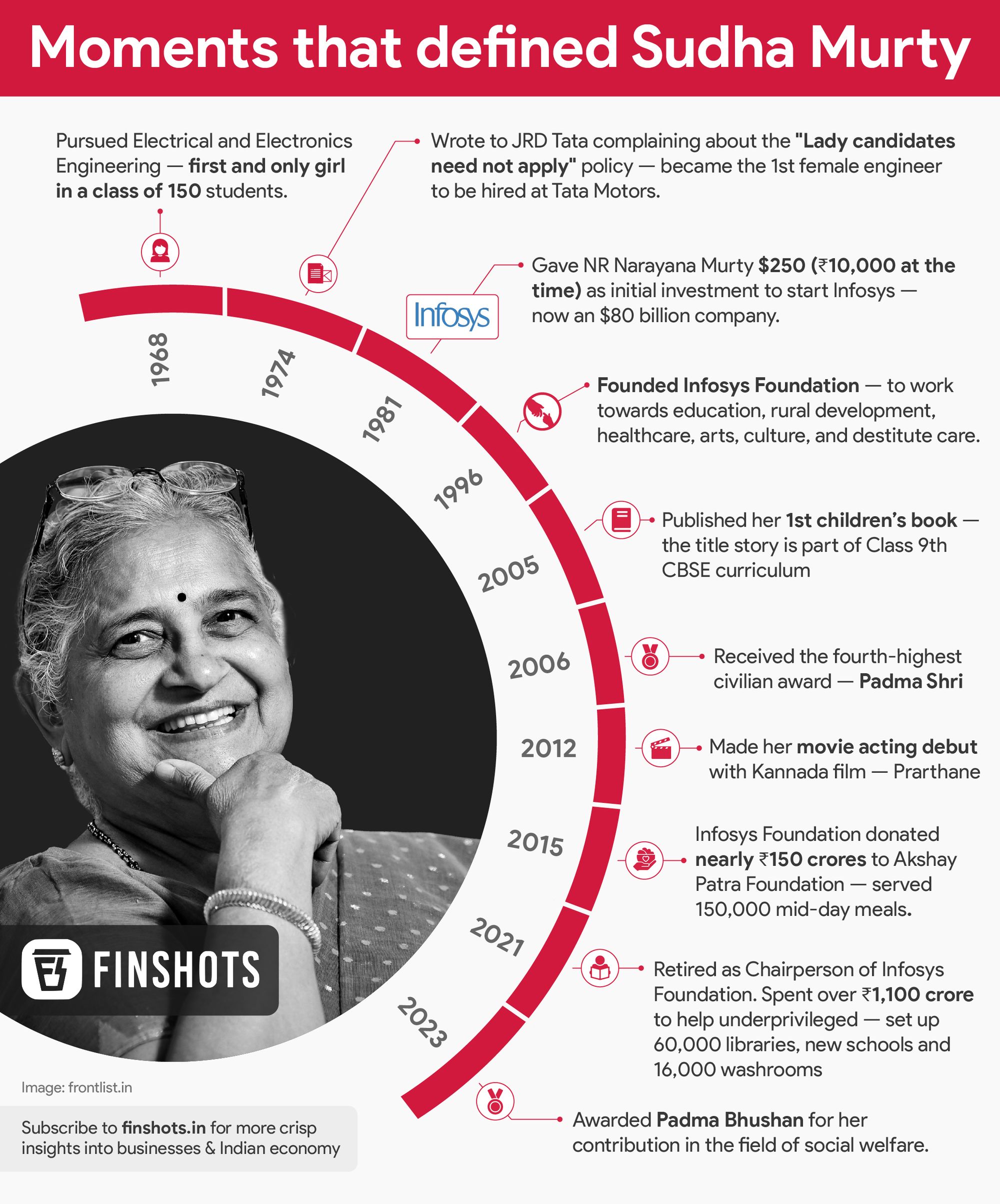
Infographic of the week!
And that's all for today folks! If you learned something new, make sure to subscribe to Finshots for more such insights :)