
The strange new economics of Hollywood, women's pockets, and more...
Hey folks!
We have a question for all the women reading this (men, you can stick around too).
Have you ever put on a pair of jeans and thought, “Oh wow, these pockets are too big!”?
We’re guessing not.
Because more often than not, men can fit a phone, wallet, keys, and probably even a small novel into their pockets, while women are stuck with pockets that feel less like pockets and more like decoration.
And if you’ve ever wondered why, well, this is less of a coincidence and more of a design choice. One that’s worth following the money on.
Back in 2018, data journalism outlet The Pudding measured the pockets of 80 pairs of 32-inch men’s and women’s blue jeans across 20 major brands.
And here’s what they found. Women’s front pockets were, on average, 48% shorter and 6.5% narrower than men’s. Only 40% of women’s front pockets could fit a smartphone. And just 10% could fit a woman’s own hand!
Now, this isn’t because tailors accidentally forgot to stitch larger pockets onto women’s jeans. This has been a deliberate design choice for well over a century.
To understand why, we need to rewind a little bit. See, women actually had fairly functional pockets until the 1800s. Then two things happened.
One, the rise of the handbag as a fashion accessory, and two, a shift in tailoring that prioritised women’s silhouettes over utility. Pockets create ‘bulk’. Bulk ruins a line. And so, in an illogically logical manner, pockets shrank, indirectly creating something that feels like a pink tax of sorts.
Now, when people talk about the “pink tax”, they usually mean women paying more than men for functionally similar products like razors, shampoos, personal care items and so on.
But the pocket gap feels like a different kind of pink tax because this isn’t about charging more. It’s about removing functionality in a way that quietly creates demand somewhere else.
Just think about it. If your jeans can’t hold your phone, wallet, or keys, you need somewhere else to put them. And that creates space for an entirely different market to thrive — handbags.
Just to give you a sense of scale, the global handbag market was valued at roughly $86 billion in 2025. And that market didn’t emerge from thin air. At least part of it grew around a design convention that quietly decided women’s hands should stay free, while their shoulders carried the burden.
Now, you could argue that women simply “prefer” handbags. And sure, many genuinely do. But preference and necessity have a funny way of blending into each other when necessity is engineered first.
Men, for the most part, have always had the luxury of choosing whether or not to carry a bag. But for women, functional pockets have often been the exception. You know… like when a dress comes with pockets and somehow gets announced like a premium feature, often greeted with genuine excitement.
Which leaves us with an interesting question: Is the handbag industry mostly a response to what women wanted, or is it partly a consequence of what women were quietly denied?
You tell us.
Also, speaking of pockets, have you checked out our new series, Finshots Pocket Economics yet? ;)
Here’s a soundtrack to put you in the mood…
You can thank our reader Mradul Garg for this soothing rec.
What caught our eye this week
How indie creators beat Hollywood at its own game
Imagine telling a young filmmaker 20 years ago that one day, a teenager making videos in his bedroom could create a movie that outsells Star Wars.
They’d probably laugh you out of the room.
But that has actually become reality.
For context, over the past few weeks, two unlikely films — Backrooms and Obsession, have become some of the biggest stories in cinema. The first was directed by Kane Parsons, a creator who first gained attention making short horror videos on YouTube as a teenager. The other was directed by Curry Barker, another young filmmaker who built an audience online long before Hollywood knew his name.
And together, they achieved something few expected. They outperformed Disney’s latest Star Wars film at the box office! Or, you could say, they caused a disturbance in the Force.
But how did they pull this off, you ask?
Well, for starters, it has a lot to do with how content ownership and intellectual property (IP) have evolved over the years.
You see, for most of movie history, there was only one path to success: convince a studio to take a chance on you. Before anyone bought a ticket or even before a single frame was shot, you first needed approval from a handful of executives sitting in a boardroom.
And if they said ‘no’, that was usually the end of the road. Success, in many ways, depended on convincing gatekeepers that an audience might exist somewhere out there.
But today’s creators can do something entirely different. They can build the audience first. A YouTuber no longer needs to say, “Hey, trust me, people will watch this.” They can simply say, “Ten million people already did.”
And this audience is precisely what helps creators compete with Hollywood’s giant distribution and advertising machine.
To put things in perspective, YouTube generated roughly $40 billion in advertising revenue in 2025. That’s more than the combined ad revenue of Disney, NBCUniversal, Paramount, and Warner Bros. Discovery, which together brought in about $37 billion. Besides, between 2021 and 2025, YouTube’s payouts to creators, artists, and media companies were also more than 1.25 times what Netflix paid over the same period.
And guess where some of that money went?
Well, back into Hollywood. Except this time, through independent creators making films instead of big studios.
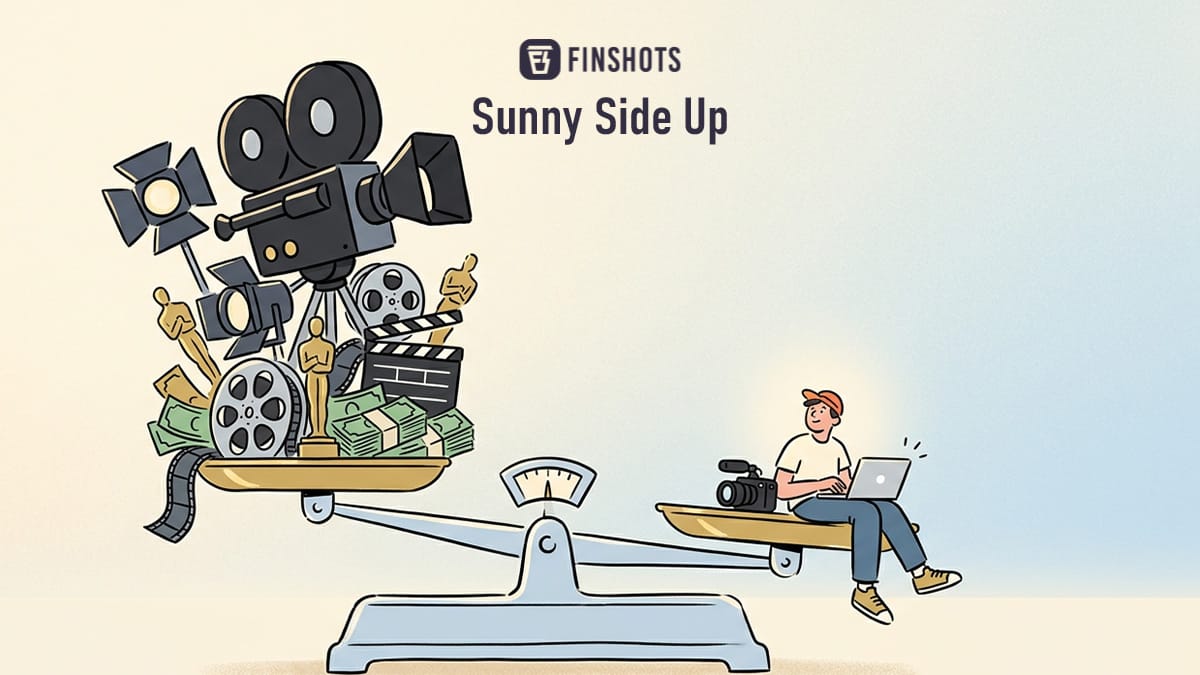
And these creators have been able to punch above their weight because of one very important thing ― the fact that the cost structure that hurts big studios often works in favour of independent creators. Let’s explain.
Hollywood's business model is structurally broken at scale. A wide-release feature film typically needs to make roughly 3 times its production budget at the global box office just to break even, without even factoring in marketing and distribution costs for big releases.
Independent creators, meanwhile, carry far less overhead. Smaller budgets and limited or direct-to-platform releases mean lower marketing and distribution expenses, which dramatically improves the return on investment.
The proof is in the pudding. Backrooms delivered a $118 million global opening against a production budget of just $10 million. That’s nearly 12 times its budget in a single weekend. Obsession, meanwhile, was reportedly made on a budget of less than $1 million and has earned roughly $148 million worldwide or close to a whopping 200 times its production cost.
Put all of this together, and you'll notice something fascinating.
The same system that once made young filmmakers beg for a meeting with Hollywood's biggies is now the one doing the chasing.
And this isn’t entirely new. Musicians once needed record labels. Writers needed publishers. Journalists needed mastheads. BUt in each case, the internet eventually created a way around the gatekeepers by letting creators show up with leverage.
And now, it seems, cinema’s turn has arrived.
While Hollywood built an empire on gatekeeping, the creator economy quietly dismantled that gate, showing us that we may be entering a world where talent can be discovered differently.
Readers Recommend
This week, our reader Rajesh BM recommends I Too Had a Dream by Verghese Kurien, the autobiography of the man behind Amul.
Thank you for the recommendation, Rajesh!
That’s it from us this week. We’ll see you next Sunday!
Until then, send us your book, music, business movies, documentaries, or podcast recommendations. We’ll feature them in the newsletter! Also, don’t forget to tell us what you thought of today's edition. Just hit reply to this email (or if you’re reading this on the web, drop us a message at morning@finshots.in).
Don’t forget to share this edition on WhatsApp, LinkedIn and X.