
The next gear in Uno Minda's growth story
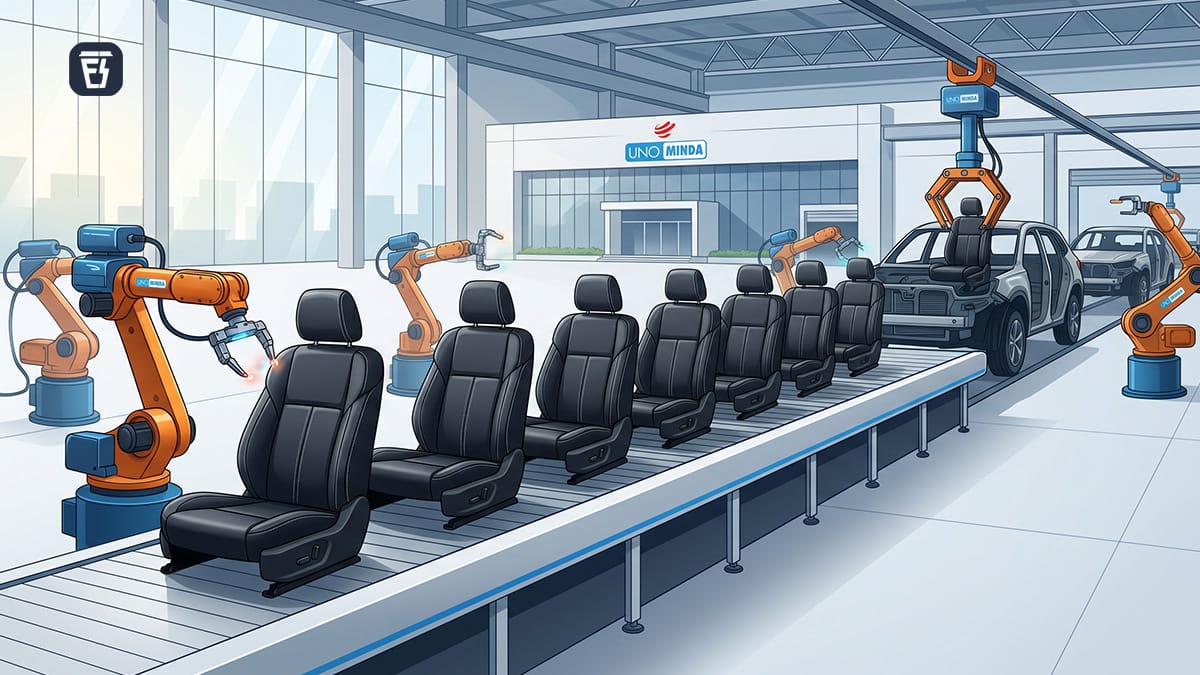
In today’s Finshots, we explore Uno Minda’s decision to set up a new plant that marks its entry into the four-wheeler passenger vehicle seating segment.
But here’s a quick disclaimer before we begin. Please don’t treat any part of this story as investment advice, and as always, make investment decisions only after conducting your own due diligence.
Also, if you’re someone who loves keeping tabs on the world of business and finance, hit subscribe if you haven’t already. If you’re already a subscriber, thank you! Maybe forward this to someone who’d enjoy our stories but hasn’t discovered us yet.
The Story
Today’s Markets edition has no fixed agenda. The markets are doing what they’ve been doing for quite some time now — being volatile. And honestly, there’s nothing particularly unusual about that anymore. Geopolitical tensions have almost become the new normal.
But amid all that chaos, one stock managed to grab analysts’ attention. We’re talking about Uno Minda.
Now, we last wrote about the company nearly five years ago, back when it was still called Minda Industries. So we figured it was a good time to revisit it and see why everyone suddenly seems so excited about it.
Well, for starters and some context, a couple of days ago, Uno Minda announced that it would invest ₹320 crore to set up a new manufacturing plant in Maharashtra, marking its entry into the four-wheeler passenger vehicle seating systems business. And according to Nomura, this move could add nearly ₹800 crore to the company’s revenue over the next couple of years.
But how did it arrive at this math, and more importantly, is this really a smart move for Uno Minda right now?
Well, to understand that, let’s first take a quick look at how Uno Minda makes money today.
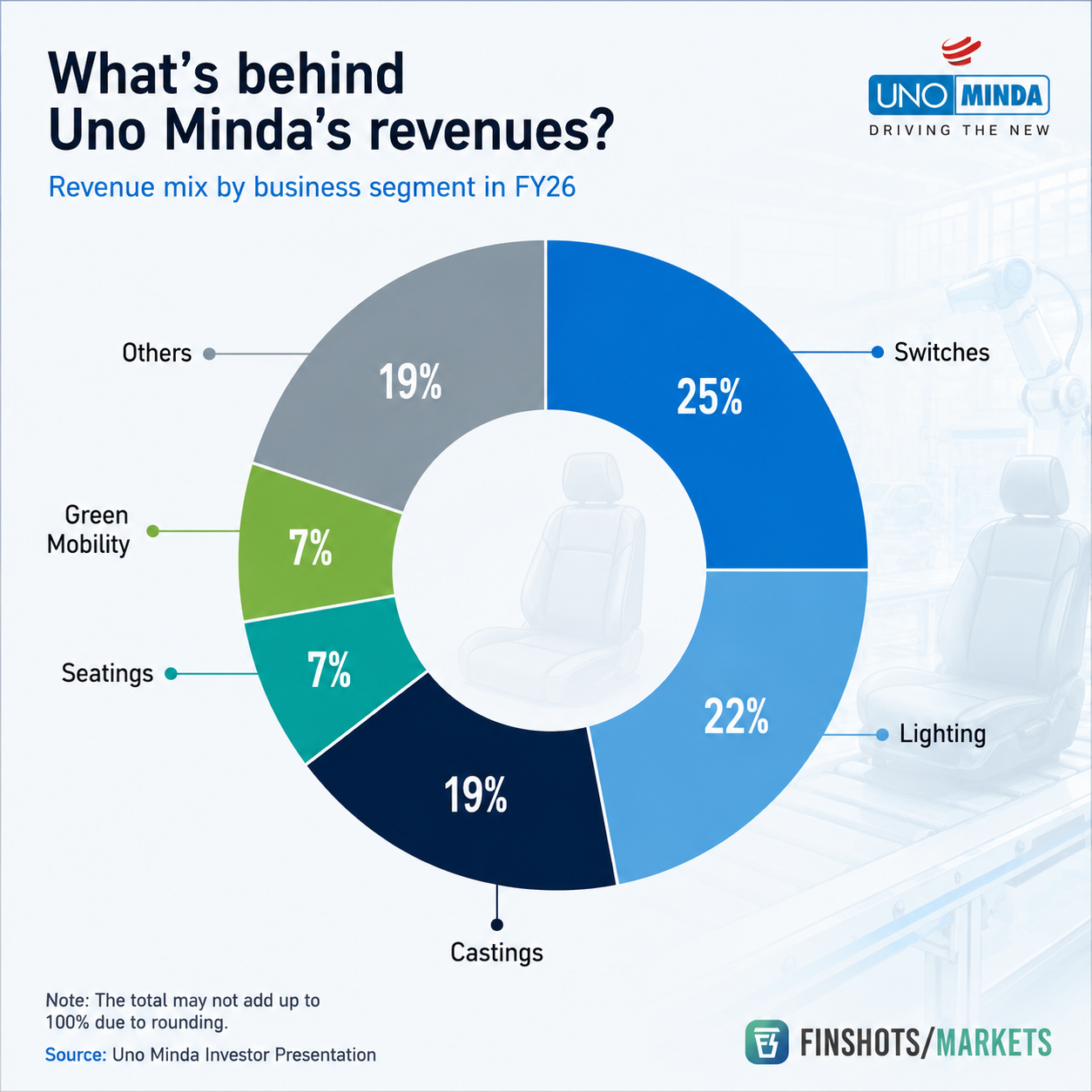
The company manufactures a wide range of automotive components, including switches, lighting systems, castings, seating systems, and green mobility components such as alternative fuel systems and EV-specific parts. And interestingly, no single business heavily dominates its revenue mix. The biggest contributors are switches and lighting, which account for 25% and 22%, respectively, of its FY26 revenue of ₹19,658 crore.
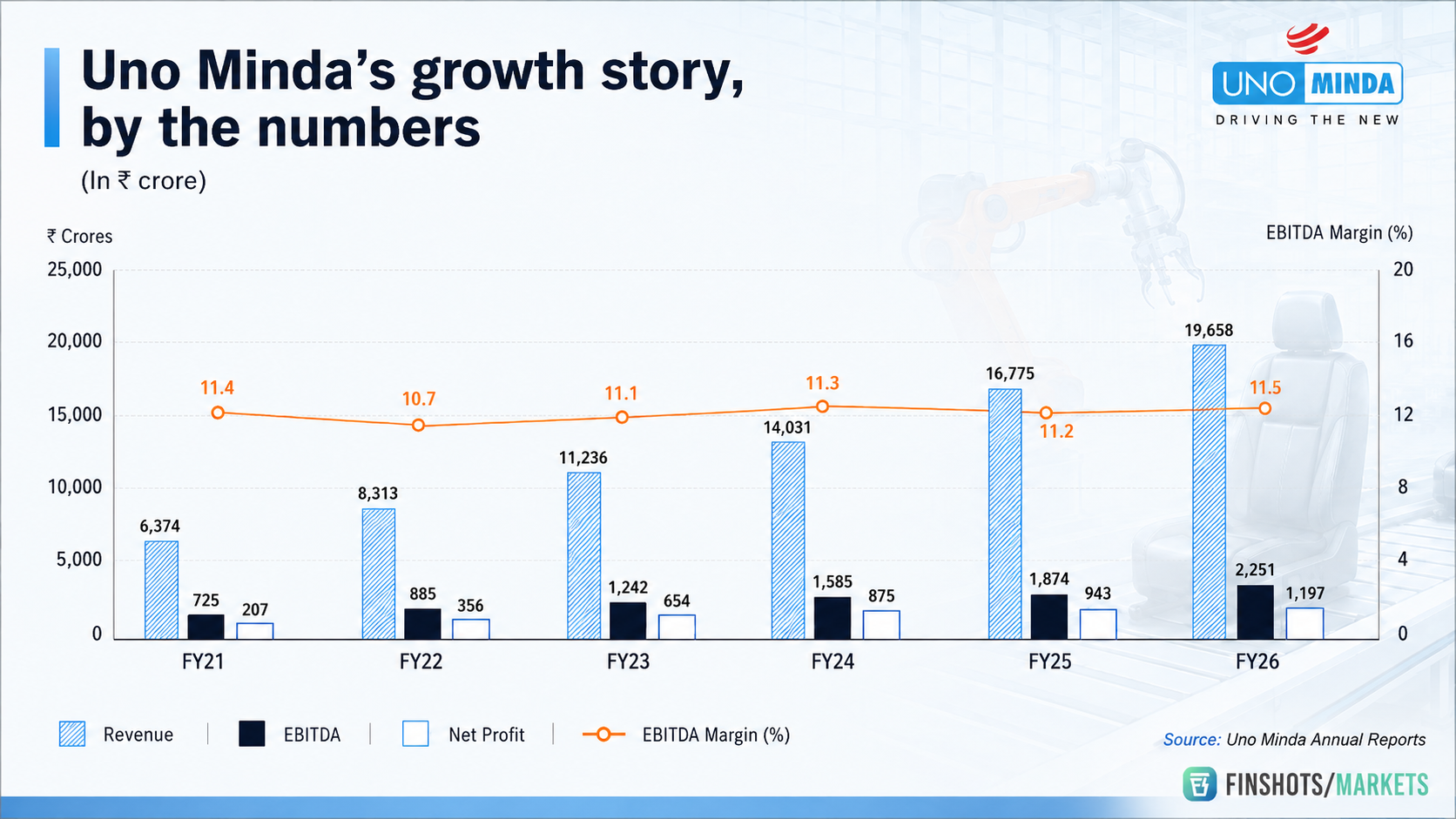
More importantly, the company’s revenues have grown steadily at a CAGR of 25% over the past five years.
So, what’s driving this consistent growth in sales and profits, you ask?
A lot of it comes down to something called content per vehicle (CPV). It’s simply the total value of all the parts a supplier sells for a single car or bike made by an automaker. Companies like Uno Minda use this metric to see how many of their components go into every vehicle built by the likes of Maruti Suzuki, Tata Motors, Hyundai, Honda, Bajaj, Hero MotoCorp, TVS, and others.
And for Uno Minda, that CPV has been steadily rising for a few reasons.
To begin with, the Indian automobile industry has been moving towards more premium vehicles. SUVs (Sports Utility Vehicles) now make up 67% of passenger vehicle sales in FY26, up from just 21% in FY16. Similarly, motorcycles with engines of 125cc or more now account for 55% of sales, compared with about 36% a decade ago.
At the same time, buyers want more features in their vehicles. So even an entry-level car today packs in more electronics, lighting, switches, and other components than it did a few years ago. And that’s good news for suppliers like Uno Minda because it means they get to supply more parts for every vehicle sold.
Then there’s the EV story. Electric vehicle adoption in India has been steadily picking up. In fact, EV sales have grown nearly 40-fold over the past decade, even though they still account for only about 7–8% of all vehicles sold in the country. And with the government targeting 30% EV penetration by 2030, there’s still plenty of room for growth.
So the objective now is to keep that momentum going. And how do you do that?
Well, you enter new segments that increase your CPV. And that’s exactly what Uno Minda is trying to do with its latest move.
As we mentioned earlier, the company is investing ₹320 crore in a new manufacturing plant to enter the four-wheeler passenger vehicle seating systems business. It will do this through its joint venture with Japan’s TACHI-S Company.
The joint venture, by the way, is called Uno Minda TACHI-S Seating. And it’s not exactly new. It was set up in 2022 to expand Uno Minda’s presence in the four-wheeler passenger vehicle segment. Back then, however, it was only making seat recliners, not complete seating systems. You could think of that as a pilot to build capabilities before taking on something much bigger.
Now, it’s hard to say whether the seat recliner business alone moved the needle for Uno Minda because the company’s seating business currently caters only to the two-wheeler and commercial vehicle segments, which contributed around 7% of FY26 revenue.
Even so, there are two reasons this latest foray looks like a sensible bet.
First, Uno Minda already has an anchor order from a leading OEM even though the manufacturing plant won’t be completed until FY28. And securing an order before a single brick is laid is probably the market’s way of telling Uno Minda, “Your recliners were good enough. We trust you with the entire seat now.”
Second, supplying the whole seat instead of just one part means earning more revenue from every car while becoming a more integral part of the manufacturing process. Besides, complete seating systems are among the highest-value product categories in the automotive supply chain. So this isn’t just a capacity expansion, but rather a deliberate move up the value chain.
And that’s probably why analysts believe that this new foray could add roughly 3% to Uno Minda’s projected FY28 revenue.
But before you get too excited and think about jumping in on Uno Minda, there’s a catch.
The payoff from this investment is still years away. Commercial production of these seating systems isn’t expected to begin until Q4 FY28. So, for now, the returns will be limited while the company keeps its capital tied up waiting for the business to scale.
Then there’s the execution challenge. Until now, Uno Minda made recliners, which are just one mechanism inside a car seat. Building an entire seat is a very different ball game. It involves frames, foam, upholstery, electronics for seat adjustments, and meeting stringent crash-safety standards. In other words, it’s a much more complex manufacturing and quality-control business.
And finally, here’s the biggest thing to remember. Uno Minda owns 51% of the joint venture, while TACHI-S owns the remaining 49%. That means a meaningful share of these future profits will go to its partner. So even if this business does very well, Uno Minda’s shareholders won’t get the entire upside.
So yeah, the recliner joint venture seems to have done exactly what it was supposed to do. It proved that Uno Minda could execute well enough in four-wheeler seating to earn a much bigger mandate.
Whether that works out the way the market expects will ultimately depend on Uno Minda’s execution over the years.
Until then…
Liked this story? Share it with a friend, family member or even strangers on WhatsApp, LinkedIn, and X.
Myth Alert: I'm Too Young to Buy Life Insurance!
The other day, one of our founders was chatting with a friend who thought life insurance was something you buy in your 40s. He was shocked that it was still a widely held belief.
Fact: Life Insurance acts as a safety net for your family. The younger you are, the cheaper it is. And the best part? Once you buy it, the premium remains unchanged no matter how old you get.
Unsure where to begin or need help picking the right plan? Book a FREE consultation with Ditto's IRDAI-Certified advisors today.