
RBI's problem with revolving credit
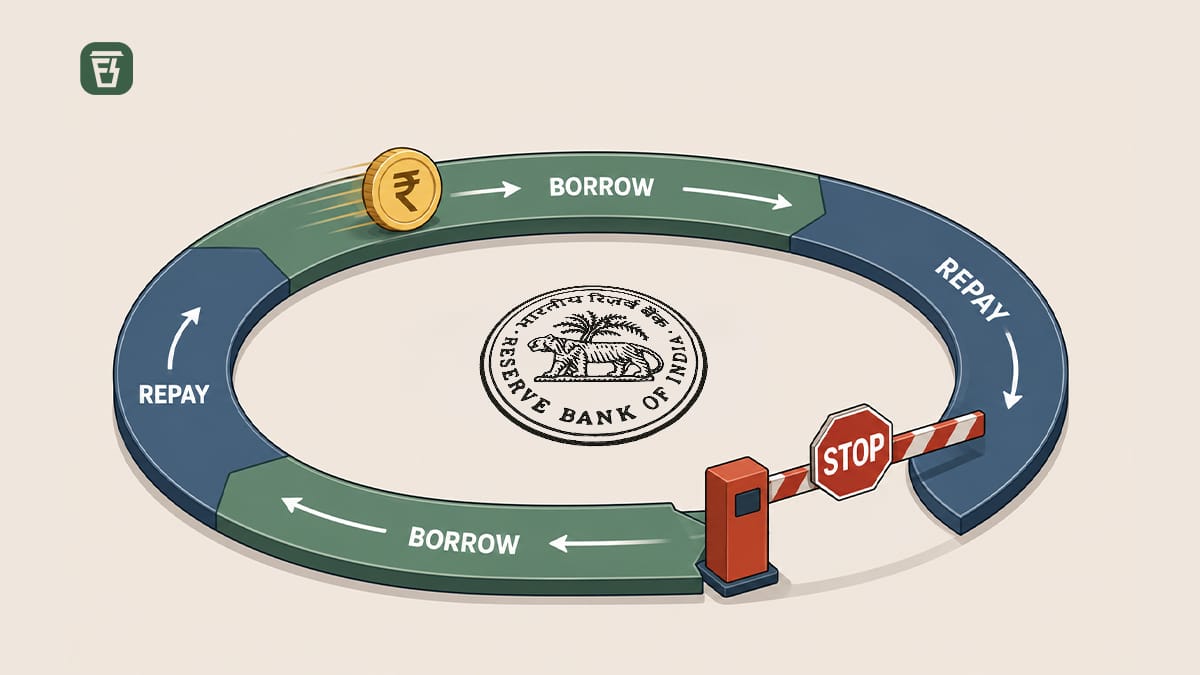
In today’s Finshots, we explain why the RBI wants to pull the plug on revolving credit offered by NBFCs (Non Banking Financial Companies).
 Love our insights? Add Finshots as a Preferred Source on Google ⭐
But here’s a quick sidenote before we begin. We’re looking for a Copywriter to join our marketing team. If you’re someone who can turn complex ideas into clear, engaging content, write copy that makes people care, and knows how to balance good writing with business impact, we’d love to hear from you. Apply through the link here, or share this with someone who might be a great fit for the role.
Now, on to today’s story.
The Story
A few days ago, the RBI issued a draft direction that defined “revolving credit” and “term loan” and, at the same time, proposed banning all NBFCs (except those authorised to issue credit cards) from offering revolving credit products.
And that’s caused quite a bit of chaos in the market. If you’ve seen stocks of large NBFCs like Bajaj Finance, Tata Capital, Jio Financial Services and others fall over the last few days, well, you can blame this. So let’s understand why this is such a big deal.
But before we get there, you need to know what revolving credit actually is and why the RBI wants to pull the plug on NBFCs offering it.
Think of revolving credit as a loan that is sanctioned once, but can be borrowed and repaid repeatedly, as long as you stay within your limit. Just like a credit card. Say you have a ₹1 lakh limit. You borrow ₹50,000. After a while, you repay that ₹50,000. You can then borrow any amount up to ₹1 lakh again without having to apply for a fresh loan.
That’s very different from a regular term loan. If you take a ₹1 lakh loan, borrow ₹50,000 and repay it, you can’t borrow again without submitting a fresh loan application and documents.
But what’s the problem with revolving credit, you ask?
To begin with, there’s something you may have heard in the world of credit: evergreening. For the uninitiated, evergreening is simply using a new loan to repay an old one. And revolving credit can potentially make this easier.
Say a business has taken a ₹1 lakh flexi loan, which is a type of revolving credit, for working capital (money required for day to day operations). It has drawn ₹50,000 so far. But the business is under stress and can no longer comfortably service the loan. If it doesn’t repay the interest or principal within 90 days, the loan could risk becoming a Non-Performing Asset (NPA), which could also hurt the business’s credit record.
But it could still do something smart here. Since it still has ₹50,000 left on its credit line, it could draw more money from that unused limit and use it to repay part of the earlier borrowing. And just like that, the repayment gets made, the account continues to look healthy, and the business avoids being flagged as a borrower that is struggling to repay.
So the loan keeps running, just on paper though. But in reality, the borrower may simply be borrowing more to keep an old loan alive. And that, you could agree, could be risky for the lender or the NBFC in this case.
But here’s something interesting. Even though revolving credit can potentially facilitate evergreening, the RBI has proposed to stop only NBFCs from offering it. Not banks. Which makes you ask, if this is risky, why let banks do it?
Because there’s a key difference. See, banks primarily lend money that comes from deposits they take from the public such as money sitting in savings accounts, current accounts and fixed deposits. NBFCs, on the other hand, generally can’t accept deposits from the public. So to lend to customers, they rely on borrowed money from banks or raise funds through debt instruments such as bonds.
That means revolving loans can create an additional problem for them. Their cash flows can become harder to predict because customers can draw money whenever they want, repay it and then borrow again. And a customer who looked financially healthy when the facility was sanctioned could continue drawing from it even after their financial situation has deteriorated.
There’s another issue too. An NBFC may only see what’s happening within the credit line itself. Like how much the customer has borrowed and how much they have repaid. It may not have a complete view of the borrower’s overall cash position or bank account activity.
To make this easier to understand, imagine a borrower is repaying one loan using another withdrawal from the same credit line. The NBFC’s records could still show a clean repayment history because the money is simply coming back. But it may not know whether that repayment came from the borrower’s actual income or whether the credit line is effectively being recycled.
Banks can sometimes have a clearer picture, especially when the borrower already has a savings or current account with the same bank. They can see salary credits, business receipts, other outflows and account balances alongside the loan. So if a business’s revenue has dried up, that may show up in its account activity even if its loan repayments still look perfectly fine on paper.
And it’s not as if the RBI has done this out of the blue. It has been tightening the screws for a while now. If you remember, back in 2023, when unsecured consumer lending was growing rapidly, the RBI asked NBFCs to maintain a higher capital cushion for riskier unsecured consumer loans. It was worried that some of this aggressive lending could eventually turn sour.
And if you look at it from the RBI’s perspective, this move does make sense.
Revolving credit can look a lot like a credit card, just without the card. And credit cards have a separate regulatory framework. For context, NBFCs need RBI approval and a minimum net owned fund (capital) of ₹100 crore to issue them. So allowing NBFCs to offer credit-card-like products without going through the same framework could encourage weaker underwriting and potentially create a regulatory loophole.
But there’s a downside too. This could meaningfully affect NBFC businesses, even if it isn’t an existential blow.
Take Bajaj Finance, India’s largest private-sector retail NBFC. It could be among the most affected because its flexi-credit products may account for nearly 20% of its standalone loan book, or roughly ₹70,000 crore.
And losing that business isn’t the only concern because there could be a domino effect. Reusable credit lines encourage repeat borrowing, make customer acquisition cheaper, improve retention and create opportunities to cross-sell other products. Replacing them with separate term loans could take away some of that convenience and weaken a valuable business model.
Besides, these products are also useful for MSMEs. A small business may need to repeatedly draw and repay short-term funds as inventory and receivables move. Requiring a fresh loan application, appraisal, and documents every time could make borrowing slower and more expensive.
But is there a way out here?
Well, maybe.
For starters, if existing revolving credit facilities are allowed to continue for a while instead of forcing NBFCs to shut them down immediately, the impact could be easier to absorb. NBFCs that offer a range of loan products could simply shift their focus towards other businesses, such as gold loans.
There’s another possibility too. NBFCs could redesign these products so that every time a customer wants to borrow more, the lender does a fresh check of their bank balance, spending and income patterns since the last loan. In other words, every new withdrawal could be treated like a fresh underwriting exercise. That could address some of the RBI’s concerns, although it would also mean more paperwork, checks and costs.
So yeah, that’s what the whole trouble in NBFC land is about.
But remember, this is still only a draft direction. The RBI is inviting comments until August 28th, and industry bodies such as the Finance Industry Development Council (FIDC), which represents NBFCs, are planning to make representations asking the central bank to reconsider the proposal.
Now we’ll just have to wait and see whether the RBI finds a middle ground or NBFCs have to start looking for Plan B.
Until then…
Liked this story? Share it with your friends, family or even strangers on WhatsApp, LinkedIn or X.
A note from our co-founder
When we started Finshots, our aim was to make finance simple and accessible for everyone. Soon, we realised that understanding finance is just one of the challenges. Making smart decisions, especially with insurance, is a whole different ball game. That’s why we built Ditto, a platform that makes insurance simple. No jargon, no spam, just honest advice from advisors who are only here to help you find the right plan.
— Shrehith Karkera, Co-founder, Finshots & Ditto Insurance