
How Rentomojo actually makes money
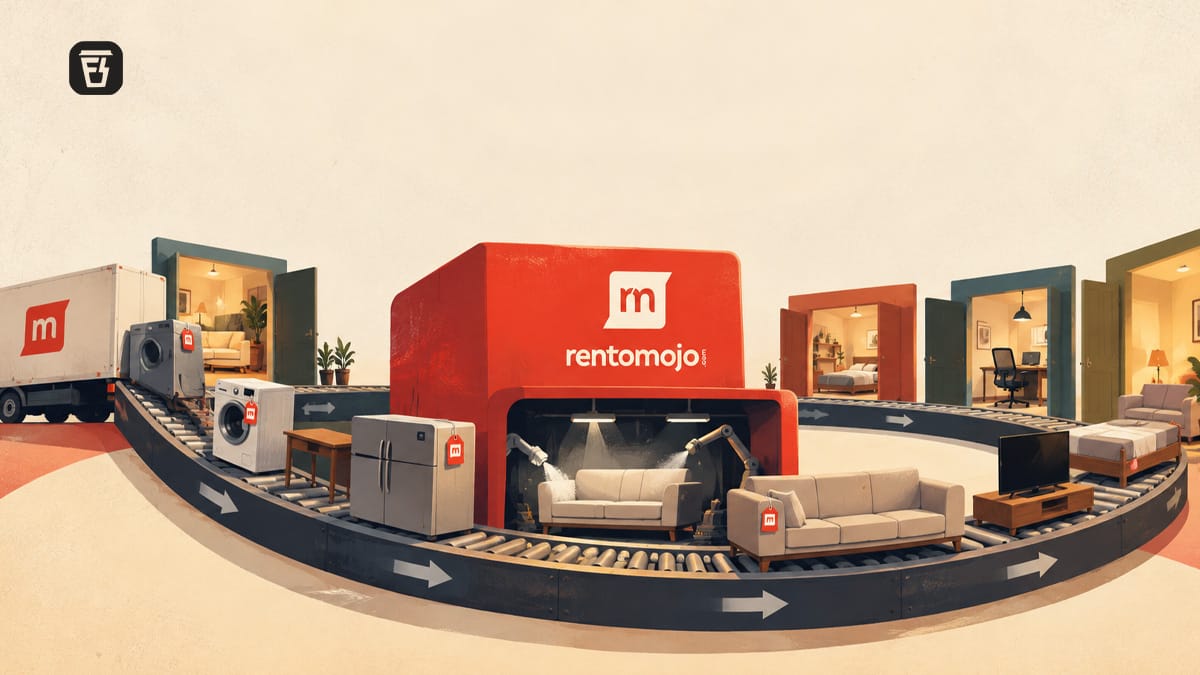
In today's finshots, we explain how Rentomojo succeeded in the furniture rental market and why, sometimes, asset utilisation matters more than customer acquisition.
 Love our insights? Add Finshots as a Preferred Source on Google ⭐
But here’s a quick sidenote before we begin. Most new parents are so caught up in the chaos of a newborn that insurance keeps getting pushed to “next month”.
But next month has a way of becoming next year.
That’s why we’re running a 2-day Insurance Masterclass, so you can finally stop postponing and understand what’s the best for you.
We’ll break down health and life insurance in simple, jargon free steps so that you can avoid costly mistakes.
📅 Saturday, 19th September at 11:00 AM: Life Insurance
📅 Sunday, 20th September at 11:00 AM: Health Insurance
Only few seats left. 👉🏽Click here to save your spot.
Now, on to today’s story.
The Story
Let’s imagine you just graduated from college and got a job in Bengaluru. You move there, maybe stay in a PG for a month or two, then move into an apartment. It’s completely empty. You need a bed, a sofa, a washing machine, maybe even a TV. But you’re not sure how long you’ll stay in the city, and spending ₹1 lakh furnishing a house you might leave in a year doesn’t make much sense.
So you do what thousands of young Indians do. You open Rentomojo, pick out the furniture and appliances you need, and pay a monthly subscription instead of buying them.
This solves two problems:
- You don’t have to ‘buy’ the asset upfront.
- When you move houses or no longer need it, you can just stop your subscription.
Pretty straightforward, right?
But here’s the interesting part. Rentomojo was not the first company to start renting furniture online. In fact, Furlenco was doing it before Rentomojo even existed. And of course, several smaller, unorganised players have also been doing the same thing offline.
Yet, today, Rentomojo commands more than 50% of the market by number of subscribers, and roughly 42-47% of India's organised furniture and appliance rental market by revenue.
So the real question isn't really “What does Rentomojo do?” Everyone knows that.
It's how Rentomojo managed to build the scale that others couldn't. And the answer seems to lie in something you and I don't see when we open the app.
You see, when Rentomojo buys a refrigerator, it has to spend the money upfront. The customer, however, pays for that refrigerator gradually through monthly rentals, potentially over several years and across multiple customers.
So the company is effectively making a bet on the future cash flow of every asset it purchases. The longer that asset remains usable and the more customers it serves, the more revenue RentoMojo can extract from the same initial investment. That means the first thing that matters is simple: the asset must be rented out.
And this is where the company's rather unglamorous operational infrastructure becomes important. Rentomojo describes what they do as a three-layered flywheel.
The first is its e-commerce layer, where deliveries, installations, doorstep repairs, relocations, and reverse pickups are coordinated through the same logistics network.
The second is the subscription layer. The objective here is to keep the customer around longer, with the average subscription lasting roughly 18 months.
And then comes the re-commerce layer. When an asset comes back, Rentomojo can refurbish it and put it back into circulation rather than treating it as dead inventory. In fact, the company refurbished over 6 lakh items in FY26 alone (compared to the 8.5 lakh items rented out in the year).
Put those three things together, and you get a rather clever flywheel. And at least at first glance it looks extraordinarily profitable.
In FY26, it reported EBITDA of roughly ₹163 crore on a revenue of about ₹387 crore. That's a cash operating profit margin of around 41%. And for a consumer subscription business, that sounds fantastic.
But there's a catch.
Remember what we just said about the business? Rentomojo has to buy refrigerators, beds, sofas, and washing machines before it can rent them out. And those assets don't last forever. They wear out, need repairs, and eventually have to be replaced.
And this is where EBITDA needs a little context. EBITDA is essentially operating profit before non-cash expenses like depreciation. But for an asset-heavy company like Rentomojo, depreciation is hardly something you can ignore.
In FY26, Rentomojo recorded around ₹70 crore of depreciation, which is over 40% of its EBITDA. And that's perfectly reasonable for a business like this. But if a company has to keep spending money to replace the assets that generate that operating revenue, you can't ignore those costs forever.
And Rentomojo's own numbers show why.
In FY26, it spent roughly ₹176 crore on capital expenditure, while generating about ₹173 crore of operating cash flow. So after buying the physical assets needed to run and expand the business, it had negative cash left over.
Now, that doesn't necessarily mean something is wrong. Rentomojo is expanding its fleet because it wants more customers and more revenue. If it buys 1 lakh new washing machines because demand is growing, that's not necessarily money being spent just to keep the existing business alive.
But some spending is effectively the cost of maintaining existing customers. That's why this business sits somewhere between two worlds.
If you think of Rentomojo as a subscription platform, the 41% EBITDA margin looks impressive. You have recurring customers, predictable monthly payments, and relatively high margins.
But if you think of it as an equipment rental company, the picture gets more complicated because depreciation, maintenance capex, financing costs, and each asset's life become important to the story.
And there is another accounting wrinkle we need to look into here. Rentomojo reported a FY26 PAT of roughly ₹104 crore. That sounds like a huge jump from the ₹43 crore it made in FY25. But around ₹37 crore of that FY26 profit came from a deferred-tax credit.
In simple terms, it was an accounting recognition of tax benefits the company got because of its past losses, which it expects to use against future profits. So if we're trying to understand how much the underlying business actually earned, it makes more sense to look beyond the headline PAT.
And this is where things get a little more nuanced.
The assets purchased in FY17 had already generated revenue equivalent to 5.1 times their original cost by FY26, and 56.1% of those assets were still generating revenue. The FY18 cohort had generated around 4.5 times its original cost, with 60.9% still earning revenue.This tells us depreciation doesn't necessarily mean Rentomojo's assets are becoming worthless quickly.
So yeah, so far, there are signs the model is working. Its older assets have generated several times their original cost, but after a point, Rentomojo needs to put more money into physical assets before those assets can generate rent.
And that’s the trade-off at the heart of Rentomojo’s model. The same assets that allow it to generate recurring revenue also mean that as the company gets bigger, it has to keep investing capital to keep that revenue engine running. So, if Rentomojo can keep those assets occupied, keep them productive for years, and refurbish them cheaply, the economics can still be quite compelling.
Whether this works out in the long run, especially for appliances, is a question that only time will tell.
Until then...
If you liked this story about how Rentomojo actually makes money, feel free to share this with your friends, family or even strangers on WhatsApp, LinkedIn or X.
Also, if you’re someone who loves keeping tabs on the world of business and finance, hit subscribe if you haven’t already. And if you’re already a subscriber, thank you! Maybe forward this to someone who’d enjoy our stories but hasn’t discovered us yet.