
Airtel is betting its future on a two-tier internet
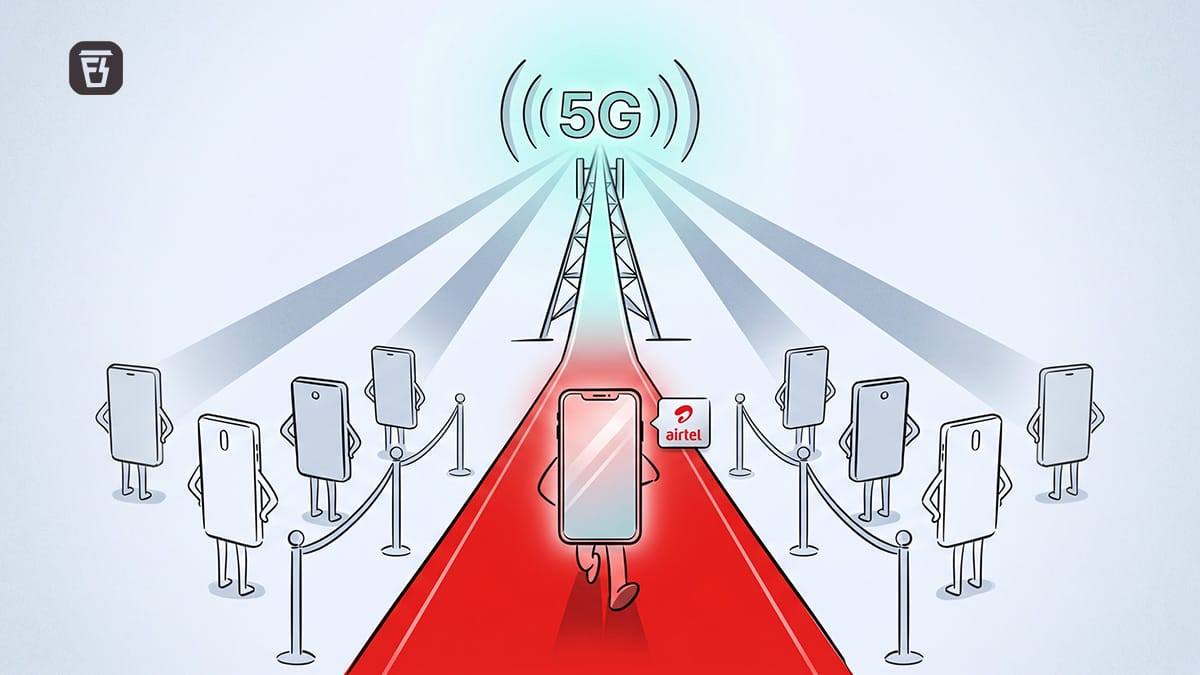
In today’s Finshots, we talk about Airtel’s new trick up its sleeve to get ahead in the revenue race and why the telecom industry thinks that’s unfair.
The Story
Whenever you fly, you’ve probably seen those priority check-in lines sitting right next to the regular bag drop counters. Or maybe you’ve even been in one of them.
If you’re flying IndiGo, it’s called Fast Forward. On Air India, it goes by ZipAhead. The idea is simple. Pay a little extra and you get to zip past the chaos and get access to dedicated check-in counters, shorter queues, quicker security, and even “anytime boarding” in some cases.
Until now, this sort of experience mostly existed in Indian airlines. But Airtel now wants to bring something similar to India’s telecom sector, specifically, mobile internet.
For context, last week, Airtel announced Priority Postpaid, a new service that uses something called 5G slicing technology to offer a more premium and consistent internet experience to postpaid users or the folks who pay a fixed monthly bill, unlike prepaid users who simply recharge as they go.
What’s 5G slicing, you ask?
Well, it’s a feature supported on standalone 5G architecture that allows telecom operators to carve out separate portions of network capacity for different categories of users or services. The idea is to deliver a more consistent experience in crowded, high-traffic places like concerts, railway stations, busy marketplaces, or packed urban areas where networks often struggle to keep up.
To understand it better, think of your mobile network as a single water pipe serving an entire apartment building. When everyone showers at 7 am, the water pressure drops for everyone.
Network slicing is like splitting that one pipe into separate channels. One gets reserved for postpaid residents, while another serves everyone else. So instead of treating every user exactly the same during congestion, telecom operators can reserve a slice of network resources for specific services or customer groups.
And this isn’t just Airtel experimenting. Reliance Jio, for instance, is reportedly quite deep into network slicing too, with around 10 live nationwide slices, including dedicated gaming experiences for consumers.
But here’s the thing. Network slicing has never really been done at the consumer level like this. Airtel’s Priority Postpaid experiment is a first of its kind. And not everyone in telecom town seems thrilled about it.
The reason?
Well, net neutrality.
If you’ve read our story on net neutrality before, you already know that it is the idea that the internet shouldn’t discriminate. It should treat everyone using it equally and handle all internet traffic in the same way.
So an internet service provider (ISP) shouldn’t care if you’re using data to binge on a Netflix video, send a text message over WhatsApp, or read an insightful Finshots story. You give them money. They give you data. And you do whatever you want with it.
On the flip side, the ISP can’t ask Netflix to pay a special fee just because a video consumes more internet bandwidth than a WhatsApp message or a Finshots story.
Everyone’s equal on the internet highway.
That’s why, if you remember, over a decade ago when telcos wanted to charge extra for internet-based phone calls on apps like Skype and WhatsApp, it triggered one of the biggest public mobilisations in India’s internet history.
At one point, lakhs of citizens joined the Save the Internet campaign, which eventually played a key role in shaping India’s net neutrality rules.
All of this culminated in 2018, when India ended up with what several global observers called some of the strongest net neutrality protections in the world. TRAI’s recommendations made it clear that internet access services should follow a simple “no discrimination” principle.
That meant telecom operators couldn’t block, slow down, degrade, or give preferential treatment or speeds to certain content. These principles weren’t just suggestions either. They were written directly into the licence agreements of every telecom operator.
So you can see why parts of the telecom industry are upset about Airtel trying to quietly reshape the rules of the game.
Their argument is simple. This strategy could end up putting lower-income, prepaid users at a disadvantage through differences in service quality based on how much you pay. And in a country where roughly 94–95% of India’s 126 crore mobile users are prepaid, and where most internet users are price-sensitive, giving wealthier postpaid users a smoother digital highway feels, to some extent, an internet version of a VIP queue that slows everyone else down.
And getting caught in a controversy like this is probably the last thing Airtel wants right now, especially when it’s trying new tricks to pull ahead in the revenue race.
To understand why, let’s zoom out for a second.
You see, a few years ago, Airtel wasn’t exactly in the best financial shape. Debt was piling up, profit margins were thin, and the company was stuck in a bruising price war with Reliance Jio, which had shaken up the market in 2016 by offering free data to hundreds of millions of Indians.
But Airtel played the long game.
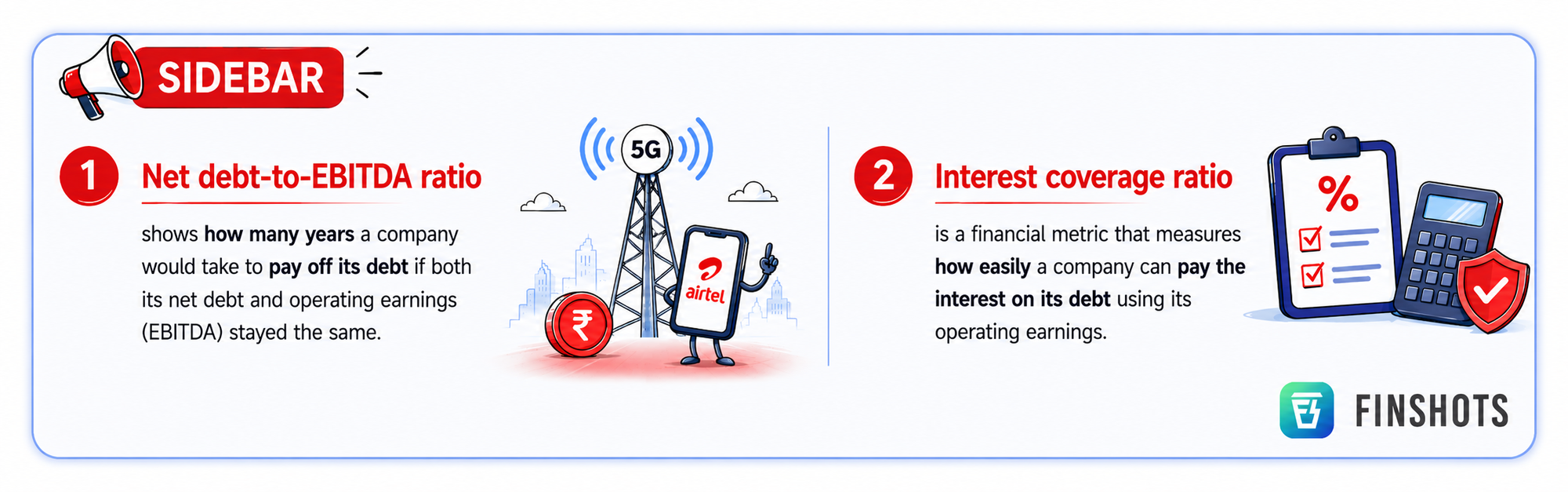
Just compare how the company has transformed over the past decade. In 2017, its net debt-to-EBITDA ratio stood at 2.66, its interest coverage ratio was 5.2, and EBITDA margin sat at 37.3%.
Fast forward to 2025 and those numbers look very different. Net debt-to-EBITDA has improved to 1.9, interest coverage has risen to 6.2, and EBITDA margins have expanded to 57.8%. Even net profit margins have jumped from just 3.9% a decade ago to 18.5% in FY25.
In telecom though, the single most-watched metric is ARPU or Average Revenue Per User. And this is where Airtel really stands out. Its ARPU stood at ₹257 in FY26, up from ₹245 a year ago and higher than Jio’s ₹211. In simple terms, Airtel makes significantly more money per customer, despite having fewer customers overall. For context, Airtel’s mobile subscriber base stands at 47.7 crore compared to Jio’s 49.6 crore.
But even that, according to Airtel, isn’t enough. The company has repeatedly said that mobile ARPU needs to cross ₹300 for the business model to remain financially healthy and generate reasonable returns on capital. And while telecom companies in India have been hiking tariffs, there’s only so much more you can charge price-conscious mass-market consumers.
Which brings us back to Priority Postpaid. Airtel’s logic seems straightforward. If people are willing to pay more for a smoother internet experience, why not monetise network quality itself and nudge users toward higher-value postpaid plans?
And the math does make some sense. Postpaid plans often start around ₹449, while many prepaid users recharge at ₹199 or ₹299. That naturally makes postpaid customers more valuable and, perhaps, more willing to pay for premium experiences.
Besides, Airtel doesn’t necessarily need to advertise harder or slash prices. It just needs a prepaid user stuck at a crowded concert where their WhatsApp call keeps breaking up, or in a traffic jam where their Uber map freezes, only to see their postpaid colleague’s connection running perfectly smoothly.
That experience alone could be enough to nudge some higher-value prepaid users toward premium postpaid plans. And in an industry where ARPU growth has largely plateaued, that could become a meaningful revenue lever.
The only problem?
We’re not entirely sure if this strategy will work.
Because according to an Economic Times report, back in 2020, postpaid users generated significantly more ARPU than prepaid users — the gap stood at around ₹129. But by 2025, that difference had shrunk dramatically, with postpaid ARPU reportedly just ₹5 higher than prepaid.
Which makes you wonder: if the value gap between prepaid and postpaid users is already narrowing, can a premium fast lane really move the needle?
That said, the more important question is what happens when 5G adoption scales up, priority plans become more common, and network headroom starts shrinking.
Right now, Airtel says its 5G network has plenty of spare capacity. So giving postpaid users a reserved slice of the network doesn’t really come at the cost of prepaid users.
But that’s today’s argument. What happens a few years from now, when tens of millions more people own 5G phones and far more users move to postpaid plans? The reserved slice gets bigger, while the pool left for everyone else naturally starts shrinking.
Now, that doesn’t automatically mean consumer-level 5G slicing can’t work in India.
In fact, in a recent submission to the Parliamentary Standing Committee, Jio itself argued that 5G slicing can coexist with net neutrality — but only if regular internet access for non-priority users isn’t degraded or restricted, and only if there’s no content-based differential pricing.
We’ll only have to wait and see how the Standing Committee and TRAI decide whether Airtel’s Priority Postpaid plan crosses that line, and whether Airtel’s push to pull ahead by squeezing more money out of its customers will actually prove successful and worth the while.
Until then…
Liked this story? Share it with a friend, family member or even strangers on WhatsApp, LinkedIn, or X.
Also, if you’re someone who loves keeping tabs on the world of business and finance, hit subscribe if you haven’t already. And if you’re already a subscriber, thank you! Maybe forward this to someone who’d enjoy our stories but hasn’t discovered us yet.
Our co-founder asked people why they avoid Term Insurance. The top reason? Right here. 👇🏽
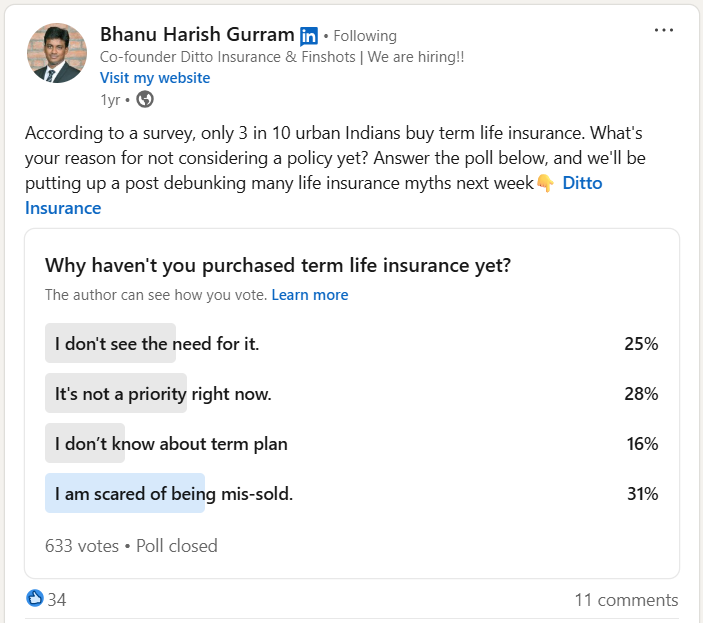
31% said their biggest fear is being mis-sold. Many worry that agents may push costly plans or add confusing extras without full transparency.
That's a valid concern. After all, how can you trust something you don’t completely understand?
That’s why Ditto, a product of Finshots, has pioneered India’s #1 Spam-Free insurance platform. Our IRDAI-Certified advisors offer honest advice and help you find the right plan. Book a FREE consultation today.