
The Augmont IPO Explained
In today's finshots, we take a look at the Augmont IPO and explain why evaluating a large bullion business requires looking far beyond its staggering revenue.
But here’s a quick sidenote before we begin. We're looking for a Copywriter to join our marketing team. If you’re someone who can turn complex ideas into clear, engaging content, write copy that makes people care, and knows how to balance good writing with business impact, we’d love to hear from you. Apply through the link here, or share this with someone who might be a great fit for the role.
The Story
India has an undeniable and historic obsession with gold. For generations, households have accumulated the precious metal not just for cultural celebrations and weddings, but as a foundational pillar of long-term financial security.
And when we think about this market, we typically picture brightly lit retail showrooms, famous jewellery brands, and eager consumers buying intricate necklaces or shiny coins. However, behind those familiar retail counters lies a complex, largely hidden supply chain.
You see, before a gold chain ever reaches a store display, the raw metal must be carefully procured, refined, and then sold to the jeweller in bulk. This unseen infrastructure is where Augmont operates, and it is the focus of the company's highly anticipated IPO.
At first glance, Augmont looks like an enormous enterprise. Its reported revenue jumped from just ₹34,921 crore in FY24 to ₹66,231 crore in FY25, then surged again to ₹94,186 crore in FY26.
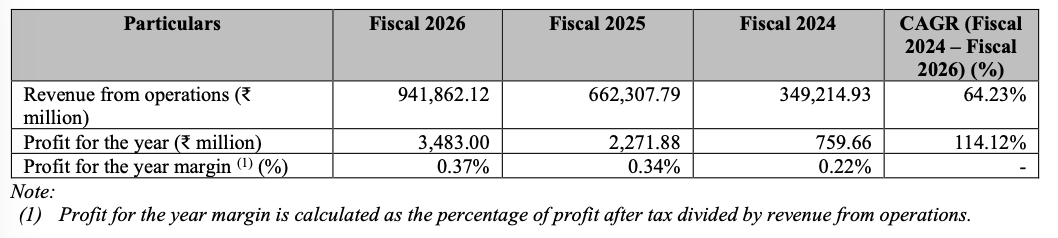
This is exactly the kind of explosive growth number that can make an IPO look exciting to retail investors. But something feels slightly unusual about those financial numbers when you dig a little deeper.
Augmont is neither a traditional jewellery retailer like Titan or Kalyan Jewellers nor primarily a gold company. It is a B2B precious-metals business that sits behind the scenes in India's gold market.
The company procures and refines raw bullion, sells gold and silver in bulk to retail jewellers, supplies bullion dealers, and provides materials to large manufacturers through its proprietary Augmont SPOT trading platform. It’s basically like a stock broker, but for gold.
It also exports jewellery and has only recently started expanding more aggressively into consumer-facing businesses such as digital gold, silver products, physical coins, and investment jewellery.
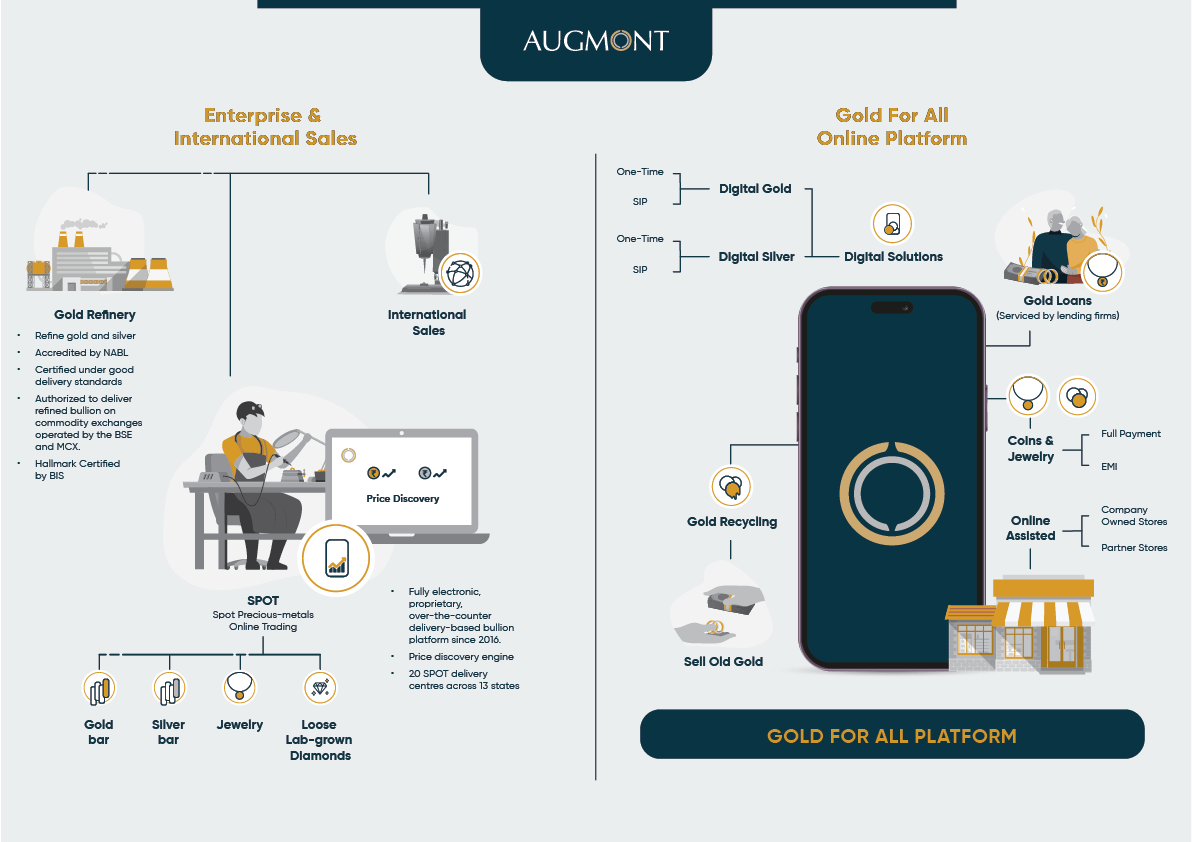
The segment revenue numbers make this operational distinction important.
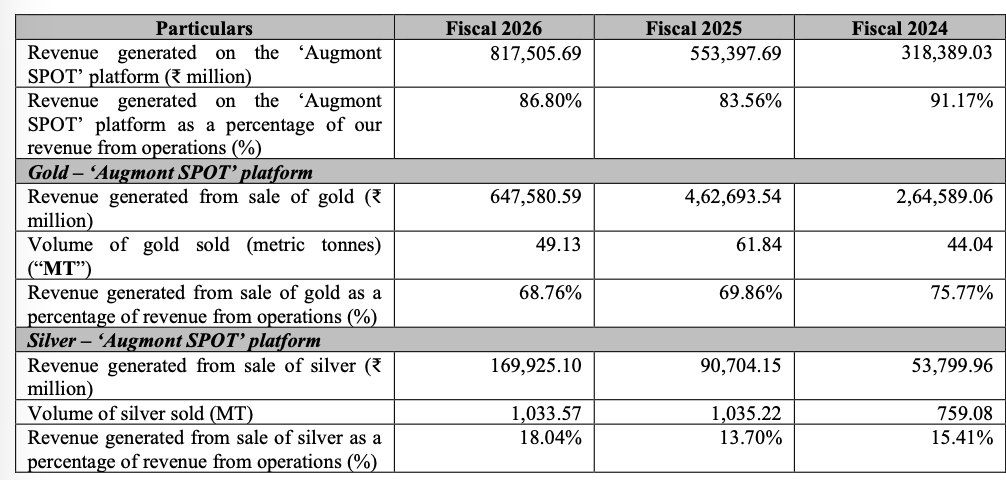
In FY26, the Augmont SPOT platform, its B2B electronic trading platform, alone accounted for 86.8% of total revenue. International sales contributed another 6.1%, while the heavily marketed consumer-focused business accounted for just 7.1% of the total pie.
That said, Augmont is one of India's larger organised gold refiners, with 284 tonnes of total refining capacity. As India's traditionally fragmented bullion market slowly becomes more organised, compliant, and technology-driven, Augmont is betting heavily that the physical infrastructure beneath that transition will become increasingly valuable.
But looking at Augmont’s growth just through its revenue can be misleading. That’s because the actual amount of gold traded through its SPOT platform fell in FY26.
The company sold 61.84 tonnes of physical gold through the wholesale network in 2025, but that number fell to 53.41 tonnes a year later. International gold export volumes also fell significantly from 11.52 tonnes to just 6.63 tonnes, while total silver SPOT volumes remained broadly flat.
Yet, despite moving less physical metal, total corporate revenue jumped by more than 42%. The simple explanation for this is that gold prices increased drastically in the last three years.
Now this can be a problem because Augmont is an extremely low-margin business. In FY26, its gross margin was 0.62% and its EBITDA margin (operating profit margin) just 0.4%.This is not necessarily a weakness as bullion trading is a high-volume, low-spread business. But it means small changes in procurement costs, hedging, pricing or operating efficiency can have a disproportionate impact on profits.
A direct comparison with industry competitors makes this margin profile even more interesting. Augmont had the highest revenue among its selected peers in FY25 and one of the sector's most integrated business models, spanning procurement, refining, wholesale bullion, digital gold, jewellery and recycling.
But its 0.4% EBITDA margin was lower than MMTC-PAMP's 0.78%, MD Overseas' 2.23% and Zaveri & Company's 1.62%.
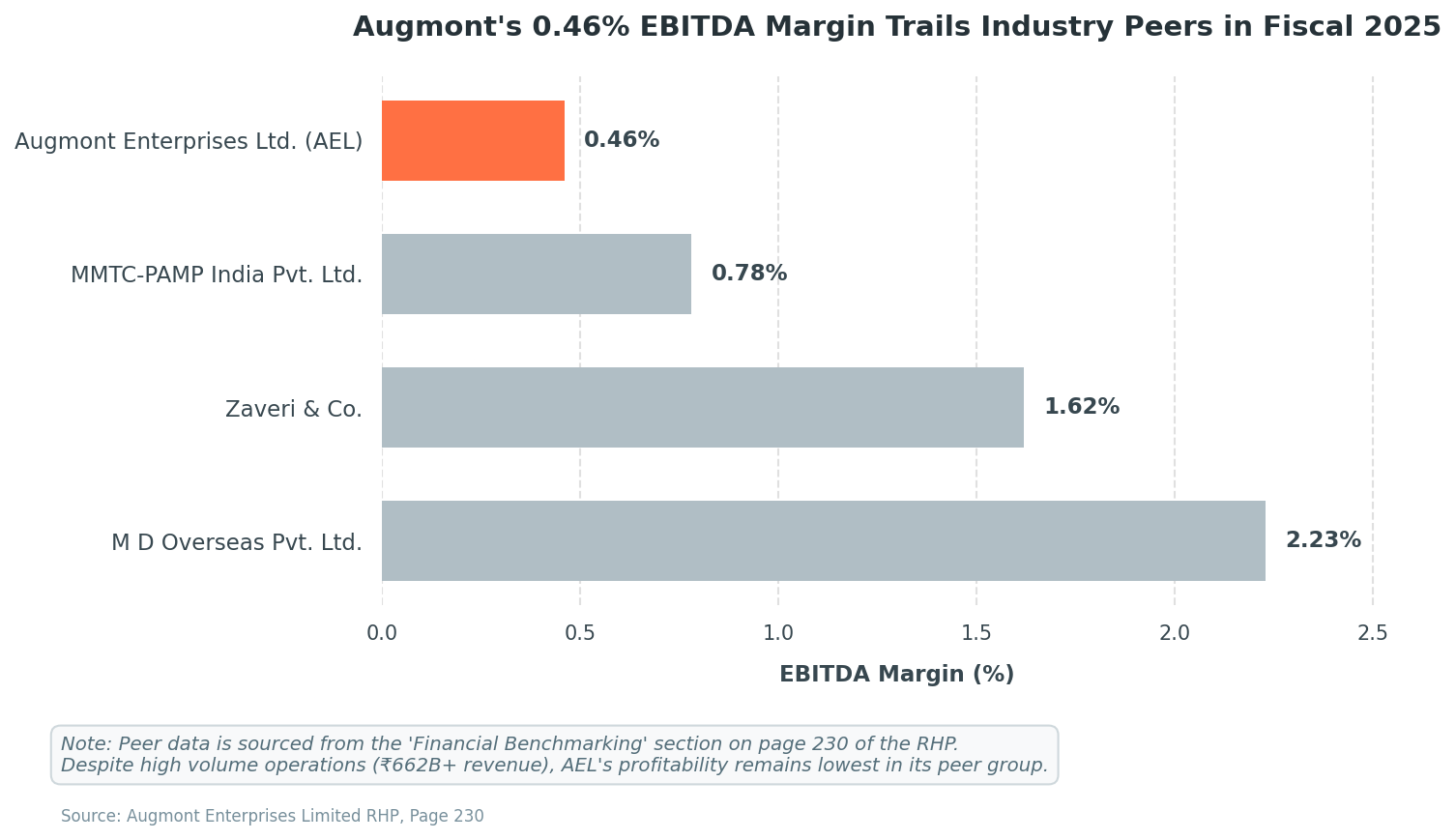
Its advantage, therefore, appears to be scale and integration rather than pricing power. The underlying product is globally priced, and wholesale customers can switch suppliers if economics change.
That also explains why the company is raising fresh capital via an IPO. Of the ₹620 crore it will raise via a fresh issue of shares, ₹465 crore will be used for working capital, including buying gold inventory and meeting advance-margin requirements. Augmont can’t simply borrow as much as it wants from banks to fund this inventory because regulations restrict such lending. So, to grow, the company needs a significant amount of equity or other sources of funding.
But the bigger question is whether more capital will actually translate into sustainably higher earnings.
There are certainly some very encouraging signs.
Consumer retail transactions are growing, and these segments could generate much better unit economics than traditional wholesale bullion trading. That is, if Augmont can build strong, direct relationships with everyday consumers.
But there are also reasons to be cautious.
The company's operating cash flow in FY26 was actually a negative ₹42 crore, despite reporting a net profit of ₹348 crore for the year.
At the same time, the company's top ten customers accounted for over half of total revenue, while its single largest customer contributed to close to a third of the total sales. And guess who that customer was?
Riddisiddhi Bullions, a closely connected promoter-group entity.
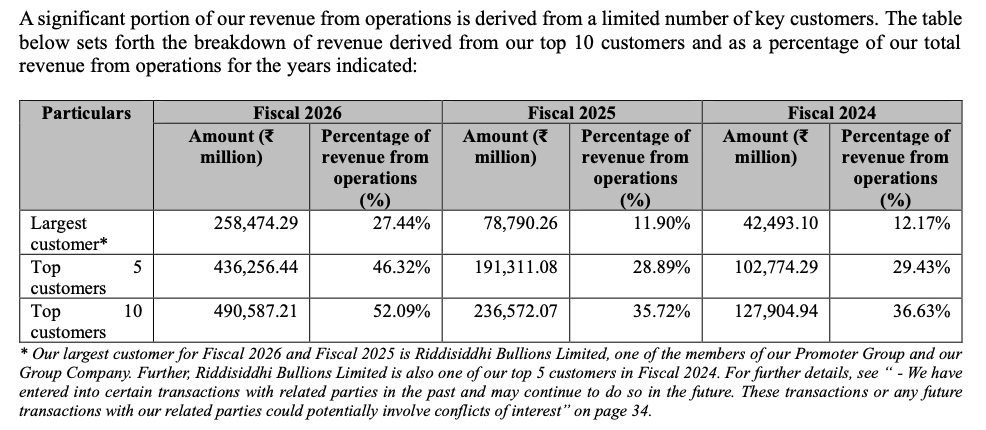
That’s also quite a bit of a worry because Augmont’s dealings with Riddisiddhi are quite large. For context, in FY26, Augmont reported ₹45,714 crore worth of transactions with related parties. This included ₹25,826 crore of direct sales and ₹5,954 crore of bulk purchases with Riddisiddhi. Augmont also gave it ₹6,742 crore in corporate loans and received ₹6,629 crore in repayments during the year.
These transactions are legally disclosed as being conducted in the ordinary course of business and executed at arm's length. However, the scale of these dealings means we must undoubtedly keep asking whether the company's publicised growth is truly coming from a broadening, diverse customer base or is simply driven by a very small number of closely connected relationships.
All of this leaves us with a few important questions:
- How much of the revenue jump between FY24 and FY26 came from genuine gains in customers, market share and physical volumes, and how much came from higher gold prices?
- What happens if gold prices stabilise or fall?
- And can Augmont sustain a 40-basis-point EBITDA margin through a full commodity cycle?
So yeah, the Augmont IPO isn’t really a bet on whether Indians will keep buying gold. But rather on whether the company can become an important part of the infrastructure supporting India’s increasingly organised gold market.
Can its scale and infrastructure turn those tiny margins into a sustainable business, is something we’ll have to wait and see.
Until then…
If you liked this story about the Augmont IPO, feel free to share this with your friends, family or even strangers on WhatsApp, LinkedIn or X.
Also, if you’re someone who loves keeping tabs on the world of business and finance, hit subscribe if you haven’t already. And if you’re already a subscriber, thank you! Maybe forward this to someone who’d enjoy our stories but hasn’t discovered us yet.