
Can Aditya Birla’s Ultravolt Challenge Polycab?
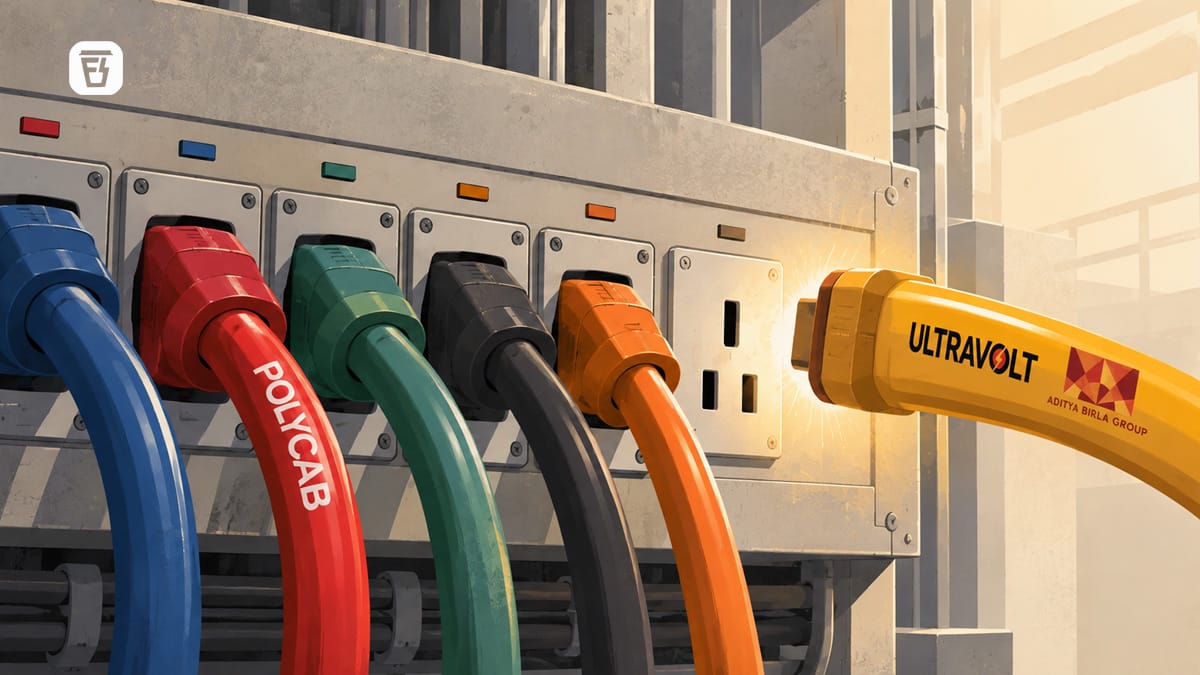
In today's Finshots, we explain why the Aditya Birla Group is entering the electrical wires and cables sector with Ultravolt and whether it can challenge Polycab's market leadership.
 Love our insights? Add Finshots as a Preferred Source on Google ⭐
But here’s a quick sidenote before we begin. Most new parents are so caught up in the chaos of a newborn that insurance keeps getting pushed to “next month”.
But next month has a way of becoming next year.
That’s why we’re running a 2-day Insurance Masterclass, so you can finally stop postponing and understand what’s the best for you.
We’ll break down health and life insurance in simple, jargon free steps so that you can avoid costly mistakes.
📅 Saturday, 12th September at 11:00 AM: Life Insurance
📅 Sunday, 13th September at 11:00 AM: Health Insurance
Only few seats left. 👉🏽Click here to save your spot.
Now, on to today’s story.
The Story
India is currently constructing more residential buildings, manufacturing plants, power lines, and data centres than in previous decades.

Since the industry’s low in 2020, the CAI (Construction Activity Index) and the Commercial Property Sentiment Index (CPSI) for India have risen steadily, with both sentiment and actual construction near their all-time highs.
But while these indices and the projects they track serve different purposes, they all depend on a common technical component: electrical cables and wires.
So let’s begin by understanding the cables and wires segment.
You see, while the terms are often used interchangeably, the industry actually brings together two very different products, with very different customers, applications and market dynamics.
Wires typically carry low-voltage electric currents within homes, offices, and small commercial structures. As a result, wire sales operate as a retail-driven business where brand recognition, consumer pricing, and recommendations from local electricians drive market share.
On the other hand, power and industrial cables are engineered for heavy-duty applications such as power transmission networks, utility grids, and industrial complexes. These products are usually high-voltage variants and are technically complex. And winning commercial contracts in the cable segment requires things like formal technical certifications and proven project execution experience.
And now the Aditya Birla Group wants a piece of the rising demand in the cables and wires space.
The group has launched Ultravolt under UltraTech Cement with an investment of ₹1,800 crore. It is entering with around 1.1 million km of initial wire capacity (the capacity of wires it is annually equipped to produce), making it the second-largest player in wire capacity from day one, and plans to expand that to 3.5-4 million km.
But this might make you wonder. Why would the Birlas enter a market where companies such as Polycab, Finolex, KEI Industries, RR Kabel, etc. have spent decades building scale and distribution?
To understand whether Ultravolt can really make a dent, let’s focus on Polycab, the industry’s largest player with around 30% share of the organised market, as a useful benchmark for how difficult it will be for a new entrant to challenge incumbents.
And the first place to look is building wires. These are the wires that run through homes and commercial buildings, and they are where Ultravolt has the biggest opportunity. Unlike industrial cables, building wires are largely a retail-driven product, and Ultravolt is coming in with roughly a 60:40 mix of wires and cables, which means it is allocating more of its initial capacity to wires.
It also has the Birla Group's financial muscle behind it and an interesting upstream advantage. Hindalco, another Aditya Birla company, can supply Ultravolt with copper. That gives the company some control over an important raw material and could help it compete on cost, especially now that copper prices are rising again.
But getting copper is one thing. Getting electricians and retailers to recommend your wires is another.
Sure, UltraTech's 5,000 retail outlets give Ultravolt a direct entry point into the construction market, but it cannot simply turn cement dealers into electrical dealers.
Wires have their own retail traders, electrician networks and channel relationships. So Ultravolt will still have to spend heavily on advertising, offer wider margins to distributors and retailers, and potentially provide longer credit terms to establish itself.
At the same time, Polycab, too, has plenty of firepower to defend itself.
The company ended FY26 with around ₹4,194 crore in net cash and spent ₹1,480 crore on capex during the year, and aims to grow its wires and cables business faster than the overall market while maintaining 14% EBITDA margins, the highest among its peers.

Polycab therefore has the financial flexibility to increase advertising, expand distribution and add capacity of its own if competition intensifies.
More importantly, Polycab's position becomes much harder to challenge when you move from building wires to industrial and power cables.
These cables, as we've told you earlier, often need technical approvals, lengthy qualification timelines, institutional relationships and a proven project track record. And Ultravolt itself is not initially entering the high-tension, medium-voltage or extra-high-voltage cable segments at the moment. That leaves a significant part of the market where Polycab, KEI and Havells have years of experience and established relationships with EPC (Engineering, Procurement and Construction) companies and large customers.
The bigger threat, then, may come from what happens to margins in the wires business.
In fact, according to estimates by Kotak Institutional Equities, incoming wire capacity from new entrants, spearheaded by UltraTech's Ultravolt, could match more than half of the industry's incremental demand over the next few years. So, if several companies are trying to fill their order book, they may have to compete harder through advertising, retailer incentives, channel margins and pricing. All of this, at the end of the day, would bring margins down.
That said, the incumbents also have their own strengths. KEI has its EHV (extra-high voltage) technology, while Havells has built strong brand pull and industrial cable momentum, and RR Kabel has a network of more than 4.5 lakh registered electricians.
Ultravolt is therefore entering a market where established players have built different forms of defence over the years, even though building wires remains the segment most exposed to a new competitor.
That makes the outcome more nuanced than simply asking whether Ultravolt can disrupt Polycab.
In building wires, Ultravolt could put meaningful pressure on market shares and margins because the barriers to entry are lower, and a well-funded player can spend aggressively to build its retail and electrician network, unlike in industrial and power cables.
That said, this may not be a zero-sum game in the long run. The overall wires and cables market is estimated to grow at 14.5% a year from 2025 to 2034. If that growth continues, Ultravolt can build a sizeable business without taking it all from Polycab. And the more likely outcome here is that the industry sells far more wires and cables, while the added competition makes it harder for everyone to earn fat margins on those wires.
So the real question is whether Polycab's decades-old distribution and brand moat can protect its margins when one of India's biggest business groups enters the same market.
Sure, the Birlas have the capital, manufacturing capabilities and access to a large construction ecosystem. But what they still need to build is the one thing they can't buy overnight: the trust of the electricians, retailers, and customers who decide which wire gets installed in their homes.
Until then…
If you liked this story about the rivalry in the wires and cables industry, feel free to share this with your friends, family or even strangers on WhatsApp, LinkedIn or X.
Also, if you’re someone who loves keeping tabs on the world of business and finance, hit subscribe if you haven’t already. And if you’re already a subscriber, thank you! Maybe forward this to someone who’d enjoy our stories but hasn’t discovered us yet.