
Copper prices are rising again
In today’s Finshots, we give you a simple explainer on why copper prices are rising.
But before we begin, if you love keeping up with the buzz in business and finance, make sure to subscribe and join the Finshots club, loved by over 5 lakh readers.
Already a subscriber or reading this on the app? You’re all set. Go ahead and enjoy the story!
The Story
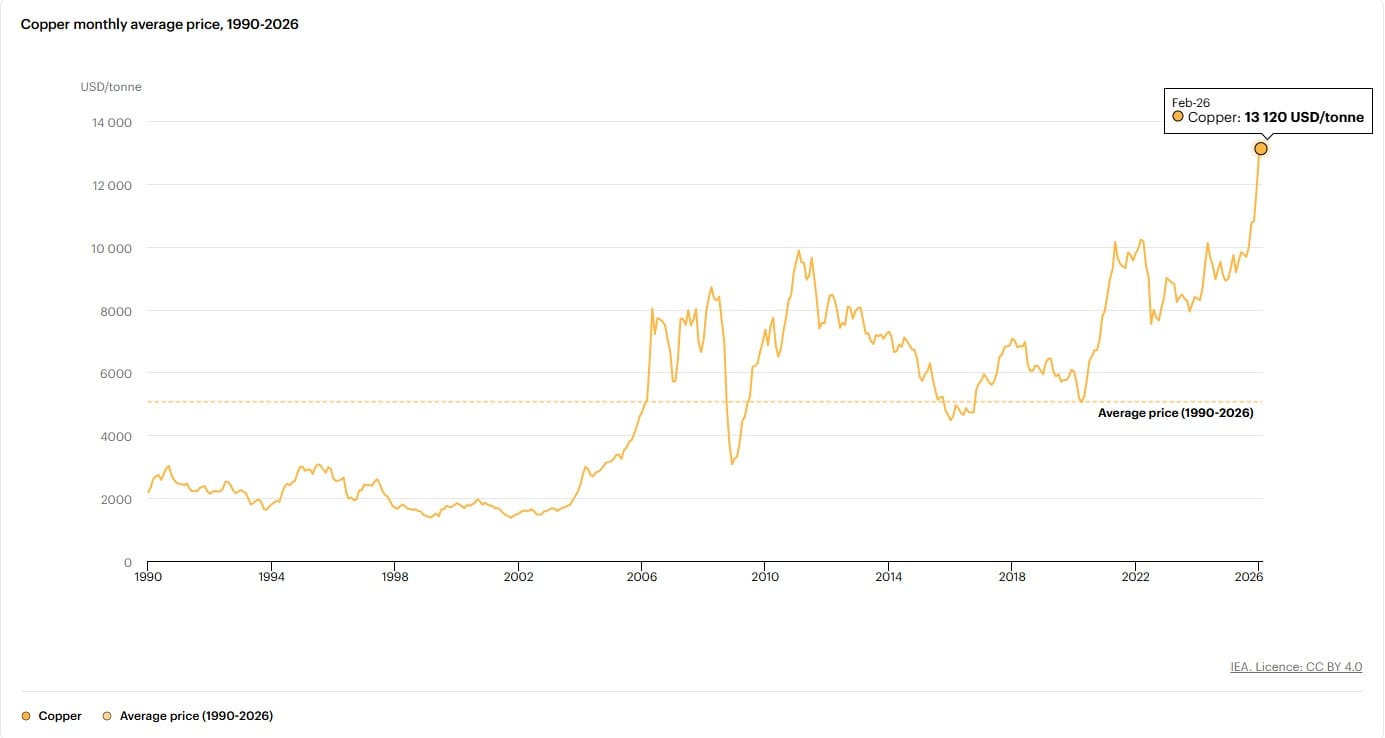
Copper prices have crossed $14,500 per tonne on the London Metal Exchange (LME). And prices seem to be moving in only one direction right now — up. So far, copper prices have risen 16-17% in 2026 and nearly 48% over the last one year.
And to understand this rally, we’ll have to start from the very beginning, i.e., where does copper come from?
See, Chile is the world’s largest producer of copper, accounting for nearly a quarter of global output. It also sits on the largest reserves, at around 180 million tonnes, which represents roughly 18% of the global total. To put that in perspective, that’s nearly double Australia’s, the next largest holder. After that, you also have Peru, the Democratic Republic of Congo, China, and the US, which are also major copper producers. Together, they produce about 20-25 million tonnes of copper a year.
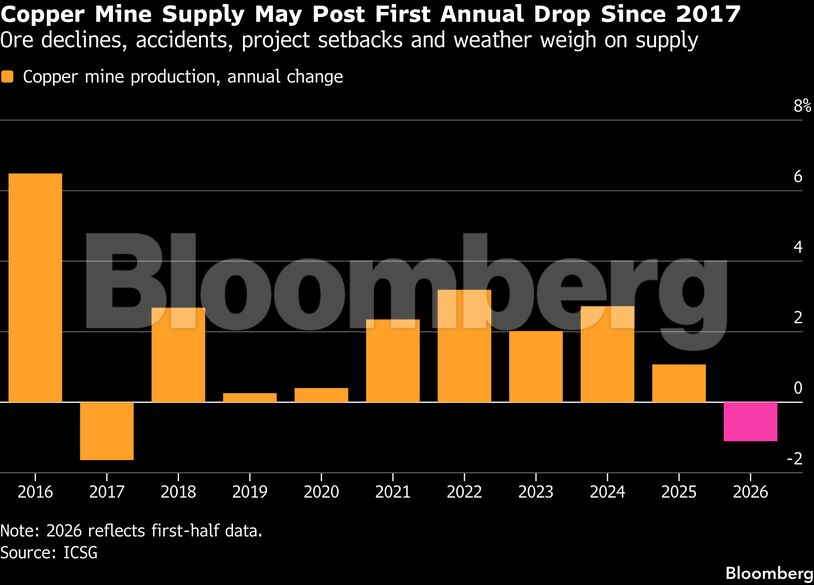
But copper production is now beginning to decline. For instance, Chile’s copper production is expected to fall 2.6% this year to 5.3 million tonnes.
The reason?
Well, a few troubles are brewing in Chile’s copper mines.
To begin with, last year, a fatal rockburst and tunnel collapse at El Teniente, Codelco’s flagship mine and the country’s largest copper mining company, killed six workers and halted mining operations for a while. Soon after, its output dropped to a 25-year low.
And as if that wasn’t enough, even after partially reopening, it recently had to stop expansion work in a section of the mine after discovering very dangerous seismic risks. This means that for the next five years, the mine will produce 3 lakh tonnes or less of copper, compared with the 3.56 lakh tonnes it produced before the incident. Besides, Codelco is itself in the middle of changing how it mines some of its mines. And this transition will temporarily reduce how much copper it can produce over the next few years.
And the problem isn’t limited to Codelco. Several mining companies and mines across Chile, including BHP’s (the world’s largest copper mining company) Escondida and Spence mines, are facing similar issues. In general, several mines are dealing with declining ore grades, ageing infrastructure and delays in expansion projects.
There’s also the shortage of sulphuric acid, which, if you’ve read our earlier story on copper ETFs, you know is necessary for extracting copper from low-grade ores. A lot of this acid previously came from China. But recently, China halted sulphuric acid exports because it wanted to prioritise using the acid to make fertilisers needed to grow crops at home.
On top of that, even the sulphuric acid being transported through the Strait of Hormuz isn’t moving quickly enough because of disruptions. But the thing is, about 15% of global copper production depends directly on sulphuric acid availability. So, not having enough of it naturally means less copper production in the years to come.
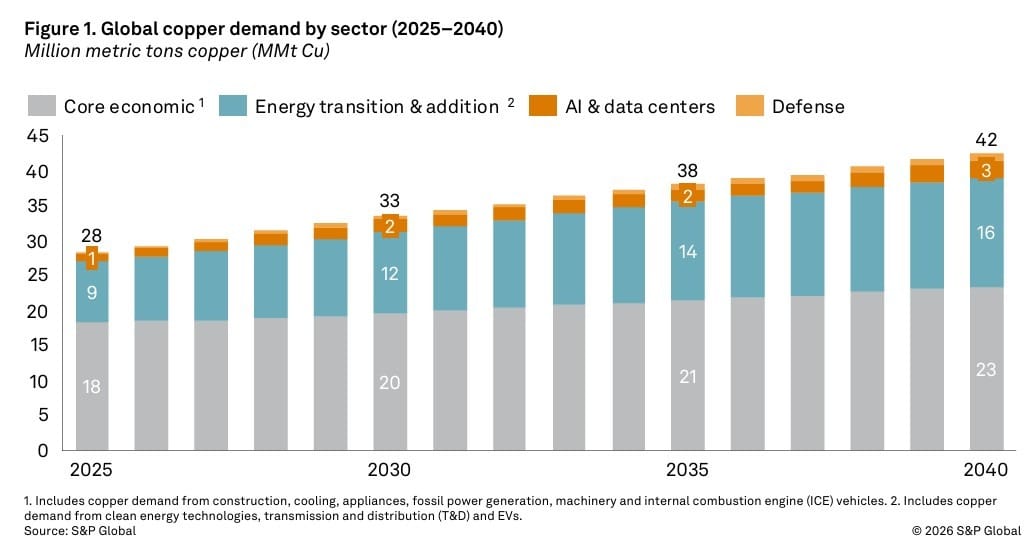
But even as supply dips, demand for copper is rising faster. Until now, the not so humble metal was mainly needed for things like electrical wiring, plumbing and electronics. But since 2022, its use in EVs (an EV needs roughly three times as much copper as a regular combustion-engine car), grid modernisation, renewables and, lately, AI data centres, which need heavy copper busbars and cooling infrastructure, has been increasing.
As S&P Global puts it, global copper demand is rising from about 28 million tonnes now to more than 42 million tonnes by 2040. Data-centre demand alone is expected to grow from roughly 1.1 million to 2.5 million tonnes over that span.
This combination of rising demand and falling supply is creating a copper deficit. In fact, this year alone, the world is expected to face a deficit of 1.5 lakh tonnes, instead of the 2.09 lakh tonne surplus we had expected earlier, according to the International Copper Study Group (ICSG).
And all of this gets reflected in the copper market. Copper is mainly traded on three major global commodity exchanges. There’s the London Metal Exchange (LME), the ultimate global benchmark for physical copper prices, with a vast network of approved warehouses around the world. Then there’s New York’s Commodity Exchange (COMEX), the dominant exchange for the Americas. And finally, there’s the Shanghai Futures Exchange (SHFE), the most significant trading hub for the Asia-Pacific region. Together, these exchanges influence not just how copper prices move, but also how the metal physically moves around the world.
To give you some more context, after copper ore is mined, processed and turned into refined copper, much of it is stored in warehouses approved by these exchanges, where it can be traded or delivered against futures contracts (legal agreements to buy or sell an asset such as a stock, index or commodity at a predetermined price on a set date in the future).
Normally, traders keep copper prices across these exchanges roughly in sync. If copper becomes more expensive in one market, they simply move metal there to take advantage of the price difference.
For example, let’s suppose copper is selling for $9,500 per tonne in London but $10,000 in New York. A trader could buy it in London, ship it to New York and pocket the $500 difference after accounting for shipping and other costs. But as traders take copper out of London, stocks there fall, pushing its price up. Meanwhile, the extra supply arriving in New York could push its price down.
Eventually, the price gap narrows enough that moving copper between the two markets is no longer worthwhile. That’s how arbitrage normally keeps copper prices across major exchanges broadly in line.
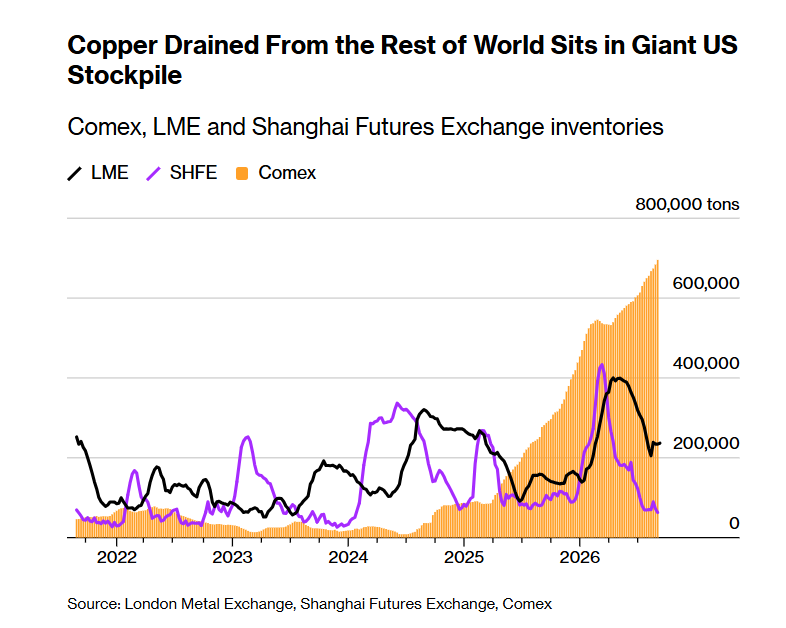
But right now, something very different is happening. Traders are moving large stockpiles of copper to the US, not because prices are higher there, but because of a new fear unlocked by US President Donald Trump — the fear of copper getting hit by tariffs.
Because you see, according to the US, it has plenty of copper underground that can be mined, but not enough facilities to turn it into usable metal. China, on the other hand, controls about 40-60% of the world’s copper-smelting capacity and owns four of the five largest refining facilities.
So it feels that it has become too dependent on foreign countries to process copper, even though the metal is critical for defence equipment, power generation, telecom networks, EVs and the electricity grid. That’s why the US wants to slap import taxes on copper, encouraging more production within the country instead of relying on imports.
As a result, last year, Trump signed an order imposing a 50% tariff on copper, except raw materials such as copper ore, concentrate, refined copper cathode and scrap. But according to Societe Generale analysts, the probability of tariffs eventually hitting these materials by next year or 2028 is rising.
And that’s why copper is flowing one way, into the US, leaving less metal available elsewhere and pushing prices higher.
But does this logic actually hold up, you ask?
Well, partly, maybe. But critics aren’t convinced.
For starters, the US currently imports around 57% of the refined copper it uses. And building new copper smelters and refineries takes years. So simply slapping tariffs on imported copper products doesn’t magically create new American capacity.
There’s also an unintended consequence. If tariffs make copper more expensive, construction companies, manufacturers and other copper-heavy businesses could end up paying more.
And because the tariffs largely target finished and semi-finished products rather than raw refined copper, companies might find it cheaper to send cheap foreign copper abroad, manufacture the finished product there and sell it globally, rather than make it in the US.
So, we’ll have to wait and see whether these tariffs actually materialise, and what happens to copper if they do.
Until then…
If you liked this story, consider sharing it with your friends, family, colleagues, or even strangers on WhatsApp, LinkedIn, or X.
🚨 ATTENTION: FINSHOTS FAMILY
This weekend, we’re hosting a free 2-day Insurance Masterclass that helps you build real financial security by understanding health and life insurance the right way.

📅 Saturday, 12th September at 11:00 AM: Life Insurance: How to protect your family, choose the right cover amount, and understand what truly matters during a claim.
📅 Sunday, 13th September at 11:00 AM: Health Insurance: How hospitals process claims, common deductions, the mistakes buyers usually make, and how to choose a policy that won’t disappoint you when you need it most.