
What if the Maldives disappeared?
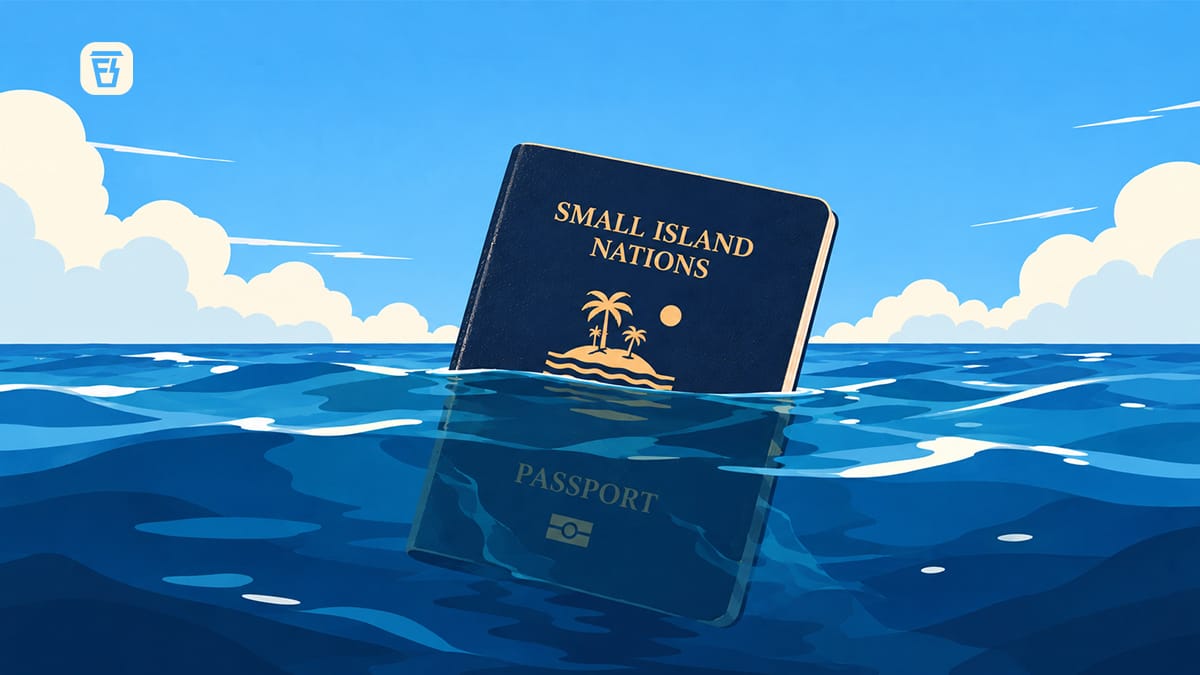
In today’s Finshots, we look at the UN’s draft Declaration on Sea Level Rise, which explains how a country may have to function if rising seas swallow its physical land.
 Love our insights? Add Finshots as a Preferred Source on Google ⭐
But here’s a quick sidenote before we begin. Your CTC includes health insurance, but not peace of mind.
Most employees assume their company has them covered, until they realise corporate plans have low limits, no life cover, and vanish the day they resign. There’s a whole side of insurance your employer is never going to take care of.
Our 2-day Insurance Masterclass will show you exactly what that looks like and how to fix it.
📅 Thursday, 1st October at 6:30 PM: Life Insurance
📅 Friday, 2nd October at 11:00 AM: Health Insurance
Only few seats left 👉🏽 Click here to save your spot.
Now, on to today’s story.
The Story
The Maldives is one of the world’s most popular and preferred luxury tourist destinations. It’s Asia’s smallest country, with 99% water and just 1% land.
But soon, the over 2 million people visiting it on vacation every year may not be able to go there anymore. Because the Maldives may not exist at all in a few years.
Yup, we’re not making this up. Rising sea levels, thanks to warmer ocean surfaces and melting glaciers, could actually swallow whole island nations or coastal regions of larger countries. And the Maldives could be at the highest risk because it’s the lowest-lying country in the world, with an elevation of just 1.5 metres above sea level.
This could mean that an entire nation could disappear from the world map. And along with that could disappear its contribution to the global economy, its culture and, of course, its people.
This could happen as early as 2050. Tuvalu, an archipelago of 9 small islands, for instance, could lose half of its capital city, Fongafale, to tidal flooding by 2050.
Now, we know we said that the Maldives is the lowest-lying country. But Tuvalu’s surrounding water levels are rising faster than in the Maldives. It’s also a tiny island country spanning just 25-26 sq. km., and a majority of its population lives in the capital. So flooding there threatens most of Tuvalu at once.
And this crisis was seriously recognised by the United Nations (UN) General Assembly last week when it adopted a draft of the world’s first UN Declaration on Sea Level Rise. This declaration recognises rising sea levels as an existential threat.
Because you see, when a country or region disappears because of climate change, you have to be prepared for what happens after. What should countries actually do about this?
But to understand that, we’ll first have to understand what’s actually at risk.
To begin with, around 50 cm of sea-level rise by 2100 is already unavoidable because the oceans have absorbed much of the excess heat caused by global warming. And this will continue driving sea-level rise even if emissions fall.
This means that extreme floods that occur once in 100 years could become routine. So folks living on coastlines are at acute risk much earlier than 2100. For context, nearly 770 million people, or approximately 10% of the world’s population, live in coastal areas less than 5 metres above the high-tide line. And if that isn’t enough to scare you, cities such as Kolkata and Mumbai are also included, with more than 14 million people at immediate risk of losing their homes.
This undoubtedly means massive economic challenges and costs. If there’s land loss and infrastructure damage, living will naturally become more expensive because displaced people will have to move elsewhere. And that will create a sort of domino effect.
For instance, imagine what could happen to the world’s ports. More than 80% of global trade in goods is carried by sea. But if ports shut down because of flooding or permanent land loss, countries like India can’t import or export goods normally. Factories may not get the inputs they need on time, production could slow down and businesses could lose money.
Tourism, coastal transport and fishing could face similar disruptions. The Caribbean is a good example. Even under a low-emissions scenario, it could lose 39% of its sandy beaches, which could translate into losing 17% of its tourism revenue by 2050.
And then there’s another strange business problem which we don’t think of much: insurance. As the risk of floods and storms rises, insurers have to pay out more. So they may respond by increasing premiums, reducing coverage or refusing to insure properties altogether.
The US is already seeing this. Average homeowners’ insurance premiums rose from $1,902 in 2020 to $2,530 in 2023. In areas facing greater disaster risks, insurance costs were much higher. And homes in these areas gained about $40,000 less in value than homes in less exposed areas.
Now, once insurance becomes too expensive or unavailable, the problem spreads. Banks may become more cautious about lending against risky properties, property values can fall and governments may eventually have to step in and pay for recovery.
And when you talk about losing a land mass or an entire country, you can’t just talk about the money, right? It’s also a loss of culture, heritage and identity. That’s particularly unfair to small island nations that contribute less than 1% of global greenhouse gas emissions.
But the problem doesn’t end with the loss of land. There’s also the question of what happens to a country’s government or statehood, and to its people’s rights, identity documents, resources, maritime and fishing rights, and nationality.
Let’s say Tuvalu’s physical islands disappear. It could potentially face questions about its maritime zones. Under the law of the sea, countries have maritime zones such as territorial seas and Exclusive Economic Zones (EEZs), giving them rights over fishing and natural resources.
Current international law doesn’t provide a comprehensive rulebook for all of these situations. So that’s one of the things the UN’s draft declaration tries to address.
For instance, a country shouldn’t automatically stop being a country simply because climate change physically damages or even removes some of its territory. Once a state has been established, it should continue to exist.
But the next question is how would such a country actually function without its physical territory?
One idea is to digitise a country by preserving land records so that its government can continue functioning even without its land. Tuvalu has already begun doing this by building a digital replica of itself in the metaverse.
But beyond that, countries need to tackle the problem by reducing emissions and preparing for the sea-level rise that is already locked in.
The UN’s main suggestion is obvious: cut emissions by at least 60% by 2035 compared with 2019 and keep any overshoot of 1.5°C (the global warming limit countries agreed to try to stay within under the Paris Agreement) as small and short as possible.
Governments may also have to plan for sea-levels rising everywhere. Some countries are already doing this by building warning systems or even raising land.
Tuvalu, for instance, has sensors along its coast to map sea-level rise and understand how much it could rise in the future. It plans to use this information to build new man-made land around three of its islands, which could temporarily protect them from storm surges and extreme floods until the end of this century.
But to do all this the world will have to spend far more on adaptation funding. And there’s a huge gap between what developing countries need and what they actually receive. Developing countries will need $310 billion to $365 billion every year for adaptation. But in 2023, they received only around $26 billion. So this gap will also have to be closed.
Whether and how that will eventually happen is something we’ll have to wait and see. For now the UN just has a draft on paper. But it would be quite delusional for us to assume that a draft could save us all from the inevitable.
Until next time…
If you liked this story, don’t forget to share it on WhatsApp, LinkedIn, and X.
And if you’re someone who loves keeping tabs on the world of business and finance, hit subscribe if you haven’t already. And if you’re already a subscriber, thank you! Maybe forward this to someone who’d enjoy our stories but hasn’t discovered us yet.