
Why did 7-Eleven fail in a country obsessed with convenience?
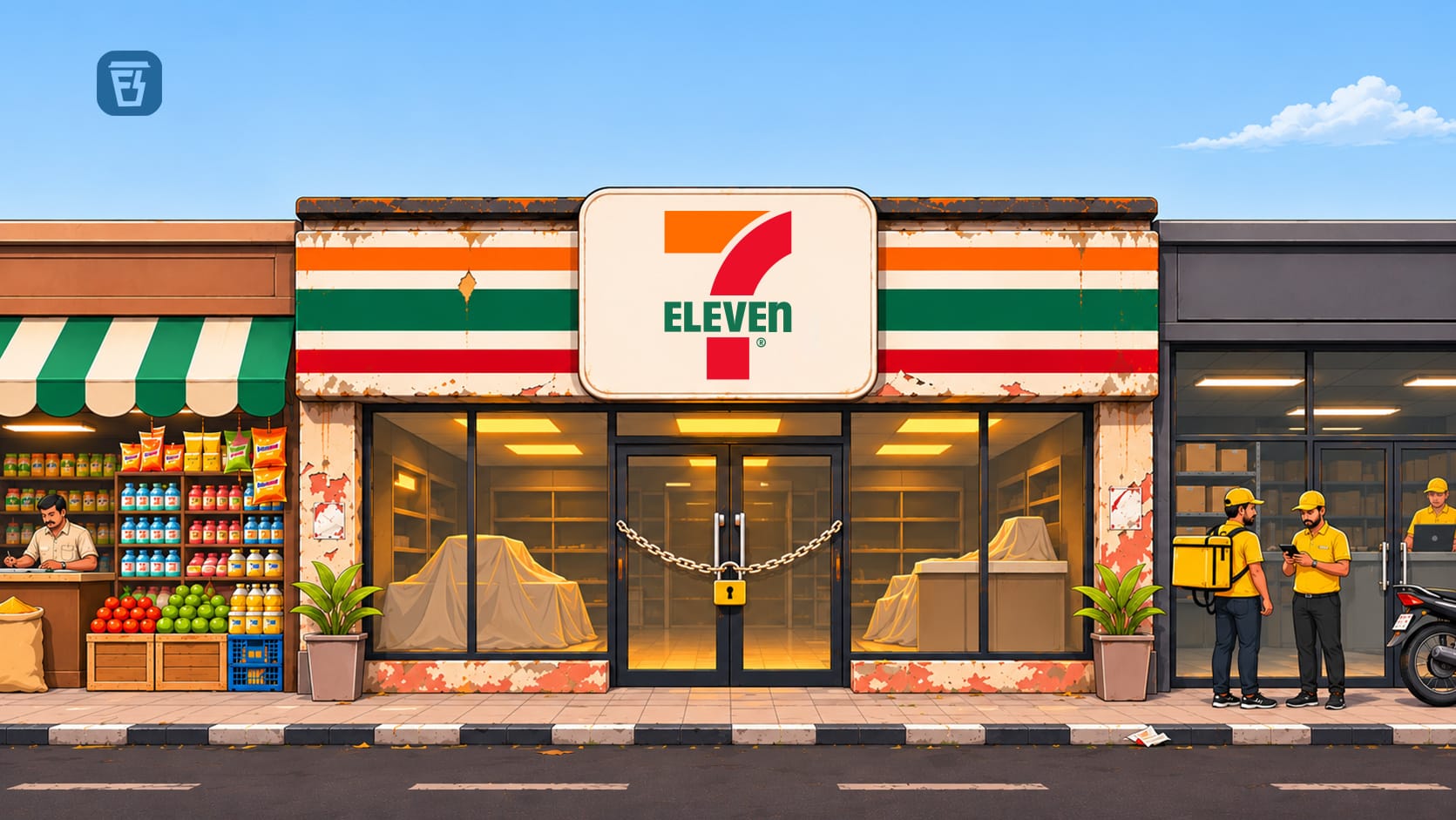
In today’s Finshots, we look at why 7-Eleven struggled to make it in India, and what it would take to make a comeback.
But here’s a quick sidenote before we begin. If people depend on your income, you need to read this.
Most first-time earners skip insurance entirely or buy the wrong thing because someone sold it to them. Both are expensive mistakes.
That’s why we're running a 2-day Insurance Masterclass to help you get it right from the start.
📅 Tuesday, 24th November 6:30 PM: Life Insurance
📅 Wednesday, 25th November 6:30 PM : Health Insurance
👉🏽 Click here to reserve your spot today.
Now on to today’s story.
The Story
In September 2026, Reliance Retail ended its five-year partnership with Seven & i Holdings and shut down the last of the 31 7-Eleven outlets in India. And with that, a business that simply wasn’t making money came to an end. To put things in perspective, in FY26, 7-Eleven earned around ₹91 crore in revenue but lost nearly ₹90 crore. In other words, almost every rupee it earned was eaten up by expenses.
So how did Reliance, with its deep pockets, fail to make the world’s largest convenience store chain work in India, despite its popularity in East Asia and North America?
Well, to understand that, let’s go back to why 7-Eleven entered India in the first place, despite the presence of supermarkets and familiar retail names like Reliance Retail, More, Spencer’s and Spar.
It all started in 2019, when Kishore Biyani’s Future Group signed a master franchise agreement with 7-Eleven. This gave Future Group’s new subsidiary, Future 7-India, the rights to run the brand across the country. Essentially, 7-Eleven could enter India without having to invest its own capital or figure out the country’s real estate and supply chains.
But 7-Eleven wasn’t trying to be just another supermarket. It wanted to offer people who relied on neighbourhood kiranas for small purchases a more modern convenience store experience.
The idea was to stock everyday essentials, snacks, confectionery, tobacco, alcohol and products from Future Consumer’s portfolio. In addition, it offered freshly prepared food and quick meals, with cafes in larger outlets. But the biggest selling point yet was that they would be open 24/7.
Basically, Future Group wanted to replicate the scale that made 7-Eleven successful globally. In Japan, for instance, it has the largest network of nearly 22,000 stores, often just 500 metres apart in densely populated urban areas. So in India, the plan was to start with Mumbai, open around 1,000 stores, build scale and get people accustomed to the brand. Once that worked, it could expand to other cities and even convert some existing Future Group stores into 7-Eleven outlets.
But things fell apart almost as soon as the plan took off. Future Group ran into financial trouble and had to cut the deal short as it couldn’t meet its store expansion targets or pay the franchise fees. In fact, Future 7-India had already reported a net loss of ₹17.3 crore in FY21, even before its first store opened.
That’s when Reliance took over and started opening stores across Mumbai and Pune. But by then, the market had changed quite a bit. The pandemic made people comfortable with quick commerce, where they could get almost anything, including cigarettes, delivered to their doorstep in under 30 minutes.
And when it came to buying just one or two things, like milk or a toothbrush, people still preferred their neighbourhood kirana stores. That’s exactly why kirana stores continue to account for roughly 91% of India’s grocery market. In other words, the very convenience that 7-Eleven was banking on was already being offered by someone else.
Which is why even at its peak by the end of 2025, 7-Eleven had just 60 stores, all in Mumbai and Pune, two fairly expensive cities to operate in. With fewer customers walking in, footfall remained low. But the stores still had to bear fixed costs like rent, electricity and staff salaries.
For context, a breakdown of its FY26 financials showed that for every ₹100 it earned, ₹129 went towards merchandise, employee expenses, warehousing and distribution. Add rent and electricity to that, and the losses only pile up. So simply opening more stores wouldn’t solve the problem without enough customers walking in.
Even the other big selling point, freshly prepared food, didn’t quite fit the way Indians eat. For one, we don’t eat out as often as people in countries like Japan. While people in Japanese cities often grab breakfast or lunch on the go, Indians still prefer home-cooked meals. We eat out only about 5 times a month and spend an average of ₹220-240 per order. In Japan, at least 40% of people buy food from convenience stores like 7-Eleven at least thrice a week, or 12 times a month. It saves them time and makes for a quick meal. In the US and China, the average is even higher at 25-30 times a month.
But even if we assume that more people in Mumbai and Pune are warming up to quick meals, 7-Eleven still had to compete with the likes of vada pav stalls, chai shops and local bakeries, which offer quick and pocket-friendly options. Besides, some customer discussions around 7-Eleven’s Indian outlets also pointed to dissatisfaction with the offerings, suggesting that the food wasn’t always compelling enough to encourage repeat visits.
And finally, there’s one more thing that makes 7-Eleven stores especially convenient in Japan but didn’t quite translate in India, i.e., people can pay bills and withdraw cash from ATMs at these stores, making them an all-in-one stop. But in India, UPI and digital payments already make these services easily accessible.
That explains why Reliance couldn’t make 7-Eleven work in India, despite its vast retail network and deep pockets.
But it doesn’t necessarily mean that the story is over, as 7-Eleven hasn’t completely ruled out a return to India. But as they say, once bitten, twice shy. If it wants to give India another shot, it will have to avoid repeating the same mistakes. So what will it need to do differently this time, you ask?
For starters, it must remember that what works in Japan, the rest of Asia or the US may not necessarily work in India. Our consumption habits are quite different. So one option could be to adopt a hybrid retail model, where a compact 7-Eleven outlet could double up as a fulfilment centre for quick-commerce orders. That way, the same premises and inventory could serve both walk-in customers and those ordering online. Reliance and Vishal Mega Mart are already doing this to make better use of their physical networks instead of building separate dark stores everywhere.
Another thing worth considering is whether 7-Eleven should ditch the franchise model if it decides to give India another shot. Because if you think about it, Reliance was paying royalties to run a convenience store format that its own retail network was already offering at a much larger scale. Perhaps it would make more sense for 7-Eleven to run its stores itself instead. This is something its rival, Japanese convenience store chain Lawson, might do. There’s chatter that Lawson is also exploring India, with plans to enter the market through its own local subsidiary.
So yeah, to make the economics work, convenience alone isn’t enough of a selling point anymore, as urban Indians already have plenty of it. Whether avoiding its earlier mistakes will give 7-Eleven another fair chance at redemption is something we’ll have to wait and see.
Until then…
If you liked this story, feel free to share it with your friends, family or even strangers on WhatsApp, LinkedIn or X.
And if you’re someone who loves keeping tabs on the world of business and finance, hit subscribe if you haven’t already. And if you’re already a subscriber, thank you! Maybe forward this to someone who’d enjoy our stories but hasn’t discovered us yet.