
3 retail lessons from the father of Japan’s convenience store industry
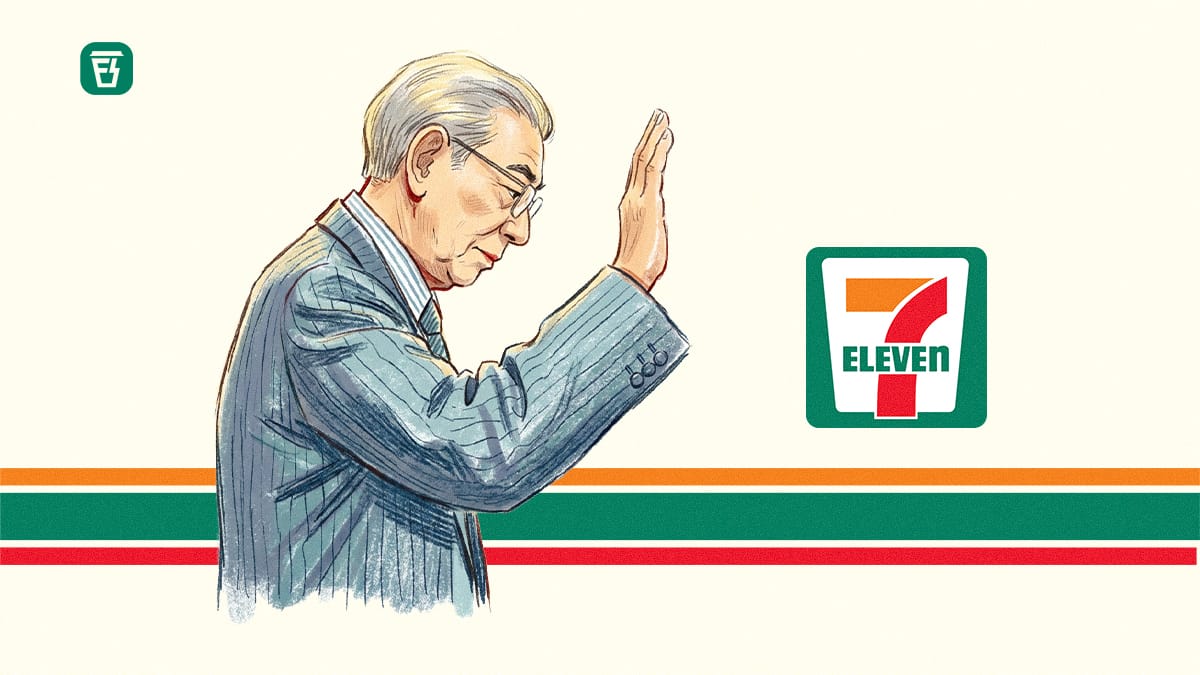
Toshifumi Suzuki, the man who revolutionised Japan’s convenience stores via 7-Eleven, passed away last week.
So in today’s Finshots, we tell you why Japan’s 7-Eleven work so differently and three lessons Toshifumi Suzuki left behind for retail.
But before we dive in, if you’re someone who loves keeping tabs on the world of business and finance, hit subscribe if you haven’t already. And if you’re already a subscriber, thank you! Maybe forward this to someone who’d enjoy our stories but hasn’t discovered us yet.
Now, onto today’s story.
The Story
Toshifumi Suzuki was known as the father of Japan’s convenience store industry. So when he passed away last week, we knew we had to write a story in his honour to tell you why Japan’s convenience stores or konbini, especially 7-Eleven, are so special.
But before we get to that, you’ll need a little context.
See, 7-Eleven didn’t begin life as a convenience store. It started with an ice dock.
Yup. Back in 1927, a man named John Jefferson Green worked at Southland Ice Co., an ice company in Dallas, Texas. This was before refrigerators became common in homes, so people regularly stopped by to buy blocks of ice.
That footfall gave Green a simple idea. While customers were already there, why not also sell basics like milk, eggs, and bread?
His boss agreed. That tiny experiment quietly laid the foundation for what would become the world’s first known convenience store. Over time, the stores grew. And by 1946, they had started staying open from 7 in the morning to 11 at night. That’s where the name 7-Eleven came from.
Decades later, the business expanded overseas. In 1974, Japanese retailer Ito-Yokado opened the country’s first 7-Eleven franchise.
And this is where Toshifumi Suzuki enters the picture. At the time, Suzuki worked at Ito-Yokado. He later negotiated a bigger licensing deal with Southland Corporation, the American parent, helping 7-Eleven expand rapidly across Japan.
But back in the US, the company that invented the convenience store was beginning to lose its way.
By the 1980s, Southland Corporation had drifted far beyond convenience stores, expanding into all sorts of businesses including dairy farms, video rentals and oil. The core business suffered, debt piled up, and by 1990, Southland filed for bankruptcy.
Meanwhile, Japan’s 7-Eleven was heading in the opposite direction. Instead of spreading itself too thin like its American counterpart, 7-Eleven Japan went deep. It became obsessive about understanding what customers wanted, built systems around fresh food, and trained store managers to think more like analysts than shopkeepers.
So while Southland struggled, 7-Eleven quietly became Japan’s highest-grossing retailer.
Then for the twist, in 1991, Ito-Yokado bought 70% of Southland for $430 million. So yeah, strangely, the company that invented the convenience store was now being owned, managed, and rebuilt by the Japanese retailer that had taken the idea and perfected it.
But how exactly did this happen, you ask?
Well, much of it traces back to Toshifumi Suzuki himself. And here are three ways he did it, which in effect became the lessons he left behind for retail.
Lesson #1: Treat your staff not as stockers but as analysts
For most of retail history, stores worked on a model where they restocked what sold. So a store shelf was, in a way, a record of the past.
But Suzuki didn’t believe this was the right approach because he noticed that Japan had changed.
Through the 1950s and 60s, the country ran on a seller’s market. When people needed things, they would simply walk into a store and buy any beer, any rice, or any jacket. That’s how shelves emptied themselves.
But by the 1970s, people had moved beyond just fulfilling basic needs. Buying any functional product was no longer enough. Customers didn’t just want beer anymore. They wanted a particular brand of beer. And if you didn’t have it, they would simply move on and look for it at a competitor’s store.
This meant dead products started piling up on shelves. Suzuki called them “shelf warmers”. And he realised that a computer tracking past sales could never solve this problem.
So he built a system called tanpinkanri, where store staff didn’t just restock shelves based on past data, but on what customers would want next. They made predictions based on hypotheses: What will this specific customer, in this specific neighbourhood, want today?
But how would they know that?
Well, let’s explain with a simple example.
Let’s say there’s a local sports event tomorrow at a stadium three streets away. That would mean the store needs to stock energy drinks, glucose, quick bites, soft drinks, and maybe even pom poms for the audience to cheer. That’s how staff would decide what orders to place with suppliers today.
Or take payday. Since Japanese workers are paid once a month, some stores would strategically lower the price of boxed lunches in the days before payday and raise them again afterwards.
Another store may have noticed that a sunny morning during monsoon season often meant unprepared customers by afternoon. So they stocked umbrellas.
Basically, the local knowledge of store staff fed directly into what appeared on shelves. They worked more like analysts than simple store staff, observing and asking fresh questions every single day, staying true to tanpinkanri, which literally translates to “control of every single item” — tanpin meaning “every single thing” and kanri meaning “control”.
Lesson #2: Killing a product is not a failure
Tanpinkanri was not just a system for choosing what to stock but also for deciding what to stop stocking, and doing it quickly.
Because in retail, the standard instinct is to keep a product on the shelves as long as it’s moving. But Suzuki believed otherwise.
He felt that stores shouldn’t just focus on adding what sells. They should also be unapologetic about ruthlessly removing what sells slowly to make room for what customers want right now.
To make this work, store staff had access to a central system that helped them continuously examine, hypothesise, and re-examine product performance against demand patterns. This helped them figure out exactly when a product’s moment had passed.
7-Eleven was also able to create a system where a single truck could carry products from multiple suppliers. That meant stores could frequently order small quantities of a wide variety of items without driving up costs. It also reduced the chaos of having too many delivery trucks showing up every day.
The end result was that by 2003, this constant rotation meant 7-Eleven Japan was replacing nearly 70% of its products every year. And while most other retailers found that alarming, to Suzuki, that was exactly the point.
He believed that one of retail’s biggest problems was letting shelves go stale. Over time, these products which were merely “good enough” crowded out the things customers actually wanted and quietly signalled that the store wasn’t really paying attention anymore.
Lesson #3: Consensus is not always your friend
In Japanese corporate culture there’s a long followed practice called nemawashi. Basically, before making a big decision, top executives meet different teams one-on-one, gather feedback, understand if there are any objections, refine ideas, and only then move forward with a formal proposal to introduce something new. The idea is to simply avoid conflict and build consensus before taking any action.
But Suzuki wasn’t always a fan of this approach. He believed that too much consensus could slow down decisions that were good for the business. And he proved it when 7-Eleven Japan took control of Southland.
He decided to shut around 1,200 underperforming stores and replaced its old distribution network, improved product selection, rationalised pricing, and most importantly, rolled out an integrated information system inspired by Japan’s model.
As you can imagine, not everyone liked it. Many franchise owners pushed back because they were losing the freedom to choose their own manufacturers, products, and distributors. But Suzuki pressed ahead anyway.
And the results spoke for themselves. By 1994, the US business was profitable again.
Now, just to be clear, this isn’t an argument for arrogance or ignoring expertise. Suzuki still listened. He just didn’t believe that every good idea needed universal approval. Because sometimes, chasing consensus only gives you the average of existing opinions. And Suzuki understood that customers can’t always tell you what they want if what you’re building doesn’t exist yet. They have to experience something new to like or hate it.
And that, folks, is how 7-Eleven Japan became so different from the many other 7-Elevens around the world — turning into a place where busy people don’t just grab sandwiches, chips, and drinks, but also pay bills, withdraw cash, photocopy documents, book tickets, and more.
Until next time…
If this story helped you understand 7-Eleven Japan’s business model in three simple lessons, share it with your 7-Eleven-crazy friends, family, or even random strangers on WhatsApp, LinkedIn, or X.
How Strong Is Your Financial Plan?
You've likely ticked off mutual funds, savings, and maybe even a side hustle. But if Life Insurance isn't a part of it, your financial pyramid isn't as secure as you think.
Life insurance is the crucial base that holds all your wealth together. It ensures that your family stays financially protected when something unpredictable happens.
If you’re unsure where to begin, Ditto's IRDAI-Certified insurance advisors can help. Book a FREE 30-minute consultation and get honest, unbiased advice. No spam, no pressure.