
A bitter aftertaste for liquor companies
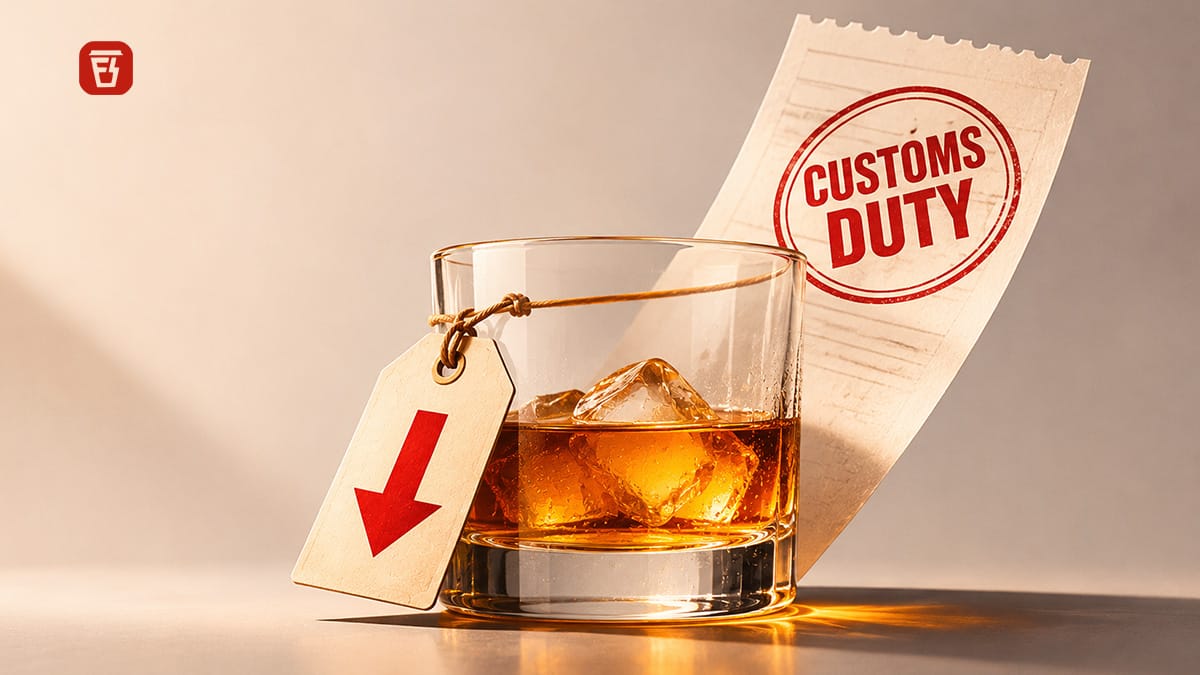
In today’s Finshots, we tell you why liquor stocks are falling.
But here’s a quick sidenote before we begin. The moment you became a parent, insurance stopped being optional.
It’s the one thing you keep meaning to sort out but never quite get to. And the longer you wait, the more expensive and complicated it gets.
Our free 2-day Insurance Masterclass will help you figure out what to buy, how much cover you need, and how to avoid common mistakes.
📅 Saturday, 21st November at 10:00 AM : Life Insurance
📅 Sunday, 22nd November at 11:00 AM: Health Insurance
👉🏽 Click here to reserve your spot today.
Now on to today’s story.
The Story
When I was nine years old, my dad told me that he’d take me and a few of my friends for a movie. Nine-year-old me was on cloud nine. I went and told nearly half my class, and the guest list must have gone up to ten to twelve people. But when I came home and told dad, he obviously wasn’t so excited. He made it very clear that he couldn’t take so many people to a movie and that I could take a maximum of three or four friends.
Yeah, going back to class and uninviting people was pretty embarrassing. But it was all my fault. I had excitedly assumed things.
And the liquor industry, specifically companies making Scotch whisky, has now done something quite similar.
For context, last year, the India-UK FTA (Free Trade Agreement) came into effect. An FTA is simply an agreement between two countries to reduce barriers to trade in goods and services. This could include reducing tariffs and import duties. And one of the things this FTA promised was to bring down import duties on Scotch whisky imported from Britain from 150% to 75% initially, and then eventually to 40% over the next ten years.
Naturally, liquor companies were elated because 80% of Scotch imports from Britain arrive in bulk. Foreign liquor makers, such as Pernod Ricard (which isn’t listed yet but is planning an IPO soon) and Diageo (listed in India through its subsidiary United Spirits), import this whisky and blend it into Indian-Made Foreign Liquor (or IMFL), which is the cheaper, mass-market whisky sold in India.
So, as soon as the FTA came into effect, they happily began reducing their prices.
Now, before we go ahead, here’s something you should know about pricing in the liquor market. In India, liquor prices are largely governed by state excise rules. This means a company usually can’t just change its prices whenever it wants. It needs approvals, and it takes time for the benefits of lower prices to reach retailers, restaurants, pubs and other customers.
But even though this is such a slow process, liquor makers were willing to take that chance. Because why not, right? Lower prices could mean higher sales volumes. After all, India is the world’s biggest whisky market by volume, and Scotch is still a small, expensive slice of it. So lowering prices is how these companies hope to win over drinkers who would otherwise stick to purely Indian-made whisky.
But then, a few weeks ago, something happened that these very happy whisky makers weren’t prepared for. A good number of their containers carrying bulk whisky imports were stopped by Indian customs authorities at the ports. The reason? Customs officials said the whisky they were importing wasn’t eligible for the lower import duty. This meant the companies would have to pay the original 150% duty, or even higher, at 162.5% after adding an additional consumption tax, if they wanted the authorities to release their shipments.
But hey, didn’t the India-UK FTA clearly say that it would reduce duties on imported British Scotch whisky? So why are customs authorities asking them to pay more?
Well, it comes down to how these shipments are classified.
India’s customs tariff system has different categories for different products. And in the whisky world, there’s a category for whisky and other spirits, and another for concentrates or compound alcoholic preparations.
The distinction here is that the first category covers whisky that is imported in bulk and then simply bottled and sold in India. The second covers products that are essentially base ingredients or concentrates that undergo further processing or are mixed with other ingredients to create another spirit or blend before being bottled and sold.
The authorities argue that if these imports fall under the second category, they’ll attract a higher duty, plus a consumption tax and won’t qualify for the concessions under the FTA.
And, as we told you earlier, liquor companies import Scotch whisky in bulk and then blend it with other spirits or dilute it to make IMFL. One of the authorities’ main arguments is that the imported product has an alcohol content of 62-66%, while finished Scotch whisky typically has 42-46%. This, they say, shows that what’s being imported is a concentrate rather than finished whisky. Which gives them sufficient ground to say that these imports aren’t eligible for lower duties.
But the industry disagrees. It argues that bulk Scotch remains whisky whether it’s imported in retail bottles or in large containers for subsequent bottling and blending. Besides, whisky doesn’t magically become something else just because it hasn’t been bottled yet. And adding water to bring it down to the required bottling strength is different from manufacturing an entirely new product. So it should qualify for the lower import duty under the FTA.
So that’s where things stand right now. The issue is still unresolved. But the government says the FTA covers whisky imported in bulk as well as in bottles. So hopefully, this confusion should be sorted out soon.
But here’s the thing. Until that happens, the liquor industry is stuck in the crossfire.
For one, as we told you earlier, many brands have already cut prices by up to 7%. And companies can’t keep changing prices every few weeks. Take Allied Blenders and Distillers, which makes Officer’s Choice, for instance. It’s among the most directly exposed companies because it claims to be one of the largest importers of bulk Scotch whisky. The UK trade deal was supposed to make its luxury portfolio more accessible. In fact, if the duty concessions came through, the company expected to gain around 70 basis points (0.7 percentage points) in profit margins.
But without those concessions, its margins could come under even more pressure. For context, in the first half of FY27, its EBITDA margin fell from 12.9% a year earlier to 12.3%, while its net profit margin dropped from 6.1% to 5.3%. This was mainly because it spent heavily on its newly established luxury portfolio. So losing out on the expected duty concessions would mean even more pressure on its margins.
The other problem is that liquor companies can’t keep waiting indefinitely for the issue to be resolved. If they do, they risk not being able to bottle their products on schedule. This could be particularly difficult for companies with limited Scotch stocks, as they’d have to shift production timelines, which can be expensive.
So to get these shipments provisionally released, companies would have to pay 75% of the goods’ value upfront, with the remaining amount covered by bank guarantees. Smaller companies may have to provide collateral to secure these guarantees. This ties up their working capital. And since the additional customs duty is still under dispute, they may also have to account for the potential liability in their financial statements, depending on how likely they think they’ll have to pay it. If the 162.5% duty is eventually confirmed, the guarantees could translate into actual payments too.
Finally, it’s not just foreign liquor companies making whisky in India that stand to lose. Major Indian distillers could also be affected.
Just think about it. If bulk Scotch doesn’t get the lower import duty, companies could have an incentive to import finished whisky instead. The logic is simple. If importing bulk Scotch as an input attracts 150% duty while importing Scotch in finished bottles attracts just 75%, it could become cheaper to import the finished product rather than blend and bottle it locally.
That would hurt India’s domestic blending and bottling industry, which is exactly the opposite of what the government’s ‘Make in India’ push is trying to achieve.
So yeah, there’s a lot at stake in this tariff dispute between the liquor industry and customs authorities. Whether the government manages to resolve it amicably and keep liquor companies happy is something we’ll have to wait and see.
For now, investors aren’t waiting. They’re already factoring in the possibility that liquor makers could lose out on profit margins. And that’s why listed liquor stocks are under pressure right now.
Until then…
If you liked this story, feel free to share it with your friends, family or even strangers on WhatsApp, LinkedIn or X.
And if you’re someone who loves keeping tabs on the world of business and finance, hit subscribe if you haven’t already. And if you’re already a subscriber, thank you! Maybe forward this to someone who’d enjoy our stories but hasn’t discovered us yet.