
India's black powder problem with battery recycling
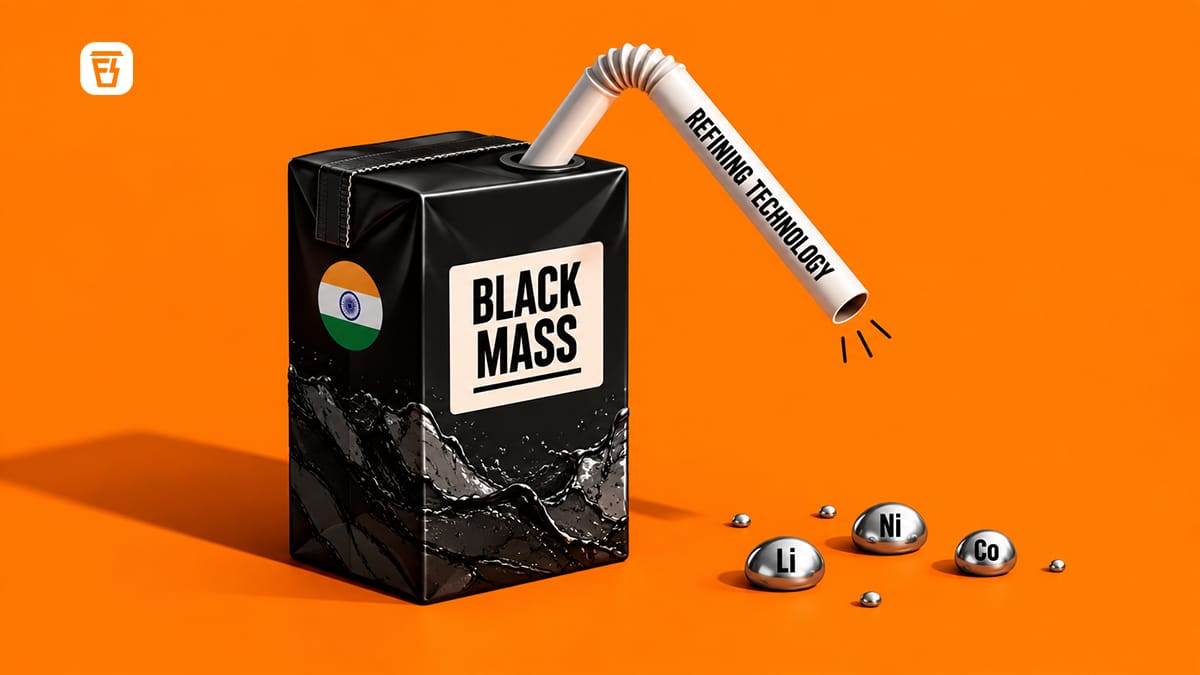
In today’s Finshots, we talk about black mass, the problem standing in the way of India’s efforts to recover critical minerals from recycled batteries.
 Love our insights? Add Finshots as a Preferred Source on Google ⭐
But before we begin, if you’re someone who loves to keep tabs on what’s happening in the world of business and finance, then hit subscribe if you haven’t already. We strip stories off the jargon and deliver crisp financial insights straight to your inbox. Just one mail every morning. Promise!
If you’re already a subscriber or you’re reading this on the app, you can just go ahead and read the story.
The Story
Last year, China tightened exports of rare-earth elements and many technologies and equipment used in lithium ion batteries (LIBs). That became a problem for India because we still depend heavily on imports of critical minerals for clean energy and electronics. In fact, it was China that supplied more than 85% of India’s permanent magnet imports (by quantity) between FY23 and FY25.
But as you know, minerals like lithium, cobalt, nickel, copper and graphite are essential for electric vehicles, batteries, renewable energy and power grids. That makes them important for India’s energy security, especially as the country wants to achieve 500 GW of non-fossil fuel capacity and 50% of its energy capacity from renewables by 2030.
So since one door sort of closed, India had to find another way. The government basically thought, “We depend on other countries for the critical minerals we need for our renewable energy expansion plans. But if imports become uncertain, we need another source. Building new mines or acquiring mineral assets will take years. So, for the short term, why not recover the minerals we already have in old batteries, e-waste and other scrap?”
That’s why it rolled out a ₹1,500 crore incentive scheme. The idea was to recover critical minerals from secondary sources such as LIB scrap.
The scheme would run from now until FY31. It offers a 20% capital expenditure (capex), subsidy for the plant and machinery needed for recycling. And also an operating expenditure (opex) incentive based on additional sales over the base year. That means a company could receive financial support of about ₹25 crore if it is a smaller entity and up to ₹50 crore if it is a larger one.
But there’s a catch. This incentive will only go to plants that actually extract critical minerals, not those that only produce black mass.
What’s that, you ask?
Well, you see, LIBs contain valuable materials such as lithium, copper, manganese, cobalt and nickel. Once a battery reaches the end of its life, it can be collected, fully discharged and then shredded. The useful materials are separated from the rest, and what remains is a black powder called black mass. It contains valuable materials such as lithium, nickel, cobalt, manganese, copper and graphite. But they still need to be separated and refined before they can be used again.
Black mass makes up roughly 40-50% of the total weight of an EV battery and is called by this name because it contains a lot of graphite, which is naturally very dark.
And last week, this black mass became part of a discussion during a national seminar on critical minerals recycling in India organised by the Ministry of Mines.
That’s because last year the government temporarily banned black mass exports because it wanted to retain as much of it at home as possible and build a stronger domestic ecosystem for battery recycling and refining.
And yet, it found that black mass was still being exported by some shredding companies by using incorrect labels, so that it could get through export checks.
That’s despite countries across the world, including several African ones, moving towards restricting the export of minerals without beneficiation. Beneficiation simply means processing something to increase its usefulness and value.
Suppose you dig up a rock containing a small amount of nickel. You don’t want to export the entire rock and let someone else extract the useful material from it. You want to process it first and recover the nickel.
The same applies to battery recycling. You don’t just want to shred a used battery, produce black mass and send it abroad. You ideally want to extract the useful minerals in India itself.
That’s what the government is concerned about.
But here’s the thing. Despite its concerns, maybe the government should also see why shredding companies are doing this in the first place.
You see, India can currently recycle more than 60,000 tonnes of LIBs every year. This can produce around 30,000 tonnes of black mass. The minerals you get from black mass also depend on the type of battery it comes from. Two common types are LFP (Lithium Iron Phosphate) and NMC (Nickel Manganese Cobalt) batteries.
India mainly uses LFP batteries because they are cheaper than NMC batteries. So, depending on the battery, Indian black mass can contain different amounts of lithium, iron, copper and graphite.
The problem is that India does not yet have enough facilities to process all this black mass and extract the minerals from it. So instead of recovering the valuable minerals in India, recyclers often export the black mass to foreign refineries, where those minerals are extracted.
Then there’s also another problem. Refiners in China and South Korea operate at a huge scale and can often pay more for black mass. They may also settle payments faster as opposed to Indian refiners who may offer a lower price, and take longer to pay up.
So Indian shredding or recycling companies are sometimes willing to take the regulatory risk of exporting black mass under a different export code because they can make a little more money by selling it abroad.
What this does is provide less raw material, or feedstock, to refiners in India. Companies like Rubamin (Gujarat) and Attero (Uttar Pradesh) need black mass to extract the critical minerals that can eventually be used to make new batteries. But when they don’t get enough of it from India, they may have to import the raw material they need for refining, often at a much higher price. So it’s like we’re exporting something and then importing it back at a higher price.
So is there a way to solve this?
Well, maybe two things.
One, make the rules clearer. Different departments such as customs, DGFT (Directorate General of Foreign Trade), CPCB (Central Pollution Control Board), etc. need to have one clear definition and classification for LIB black mass. That way, companies can’t simply give it a different name and get around the export rules.
Customs officials could also be given clear examples of the different names companies might use to describe black mass, making it easier to spot when someone is trying to export it under the wrong classification.
The second thing is the ₹1,500 crore incentive itself. If the government helps Indian refiners reduce the cost of setting up and running their plants, they could afford to pay more for black mass and compete with foreign buyers. This would ensure that companies selling black mass get a fair price in India, without having to export it.
So yeah, that could probably help in a way.
But there’s one more problem. Even if we manage to keep the black mass in India and successfully extract the valuable minerals from it, someone still needs to buy them.
From FY28, battery makers will have to use a certain amount of recycled material in their batteries, starting at 5% of the EV batteries and eventually rising to 20% from FY31.
But India’s battery manufacturing capacity is still tiny. Cell manufacturing capacity was only about 1 gigawatt-hour by the end of 2025, while around 75% of the LIBs used in EVs come from China. Besides, as of 2025, India had no battery-grade cathode producers.
So there’s a possibility that even after we recover these valuable minerals in India, we may not have enough companies here to use them. And we could end up exporting those refined minerals all over again. And that sort of brings us back to square one.
How the government will sort this out is something we’ll have to wait and see, because the government apparently has a plan up its sleeve to soon launch a “very substantial” scheme to promote domestic processing of lithium and nickel. What that plan is is still under works.
And maybe what comes out of it will be a story for another day.
Until then…
If you liked this story, don’t forget to share it on WhatsApp, LinkedIn, and X.