
What is the appeal of orbital data centres?
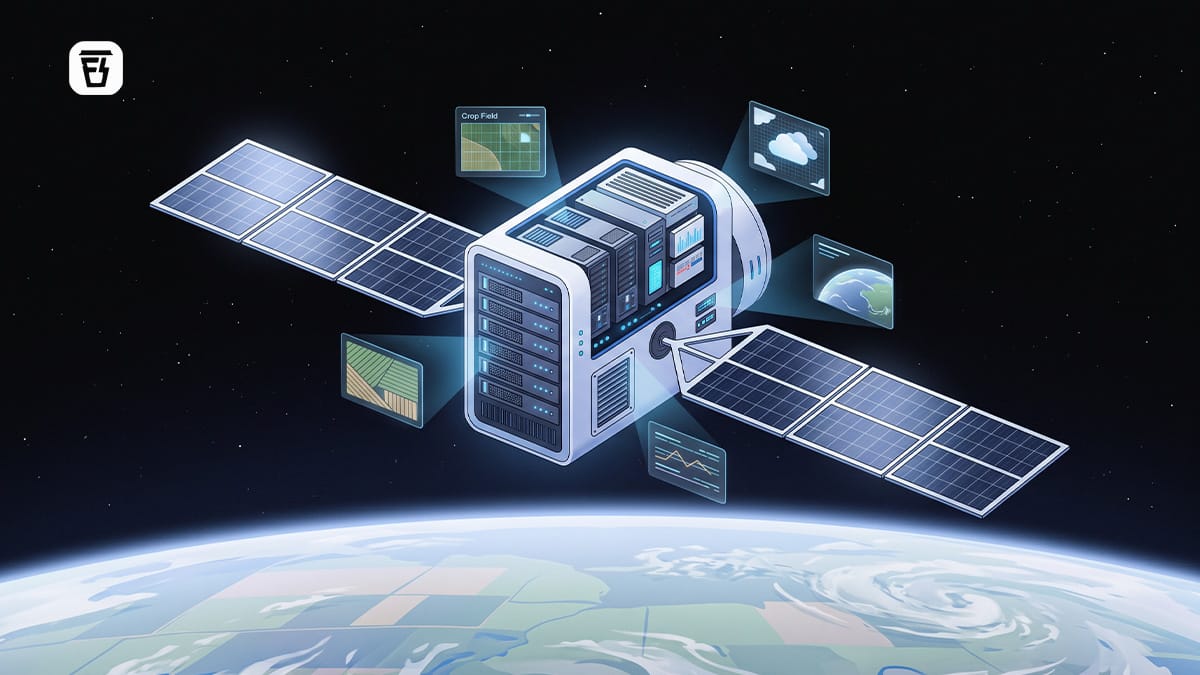
In today’s Finshots, we argue whether putting data centres into space makes sense economically.
But here's a quick sidenote before we begin. This weekend, we’re hosting a free 2-day Insurance Masterclass that helps you build real financial security by understanding health and life insurance the right way.
📅 Saturday (tomorrow), 9th May at 11:30 AM: Life Insurance
How to protect your family, choose the right cover amount, and understand what truly matters during a claim.
📅 Sunday, 10th May at 11:30 AM: Health Insurance
How hospitals process claims, common deductions, the mistakes buyers usually make, and how to choose a policy that won’t disappoint you when you need it most.
👉🏽 Click here to register while seats last.
Now on to today’s story.
The Story
On May 3, 2026, Bengaluru-based space-tech startup GalaxEye launched Mission Drishti. Now, this may sound like just another satellite launch. But the underlying technology is actually quite interesting.
Traditionally, satellites have relied on either optical sensors or Synthetic Aperture Radar (SAR) sensors. Optical sensors work much like a regular camera, capturing visual imagery, while SAR uses radar waves to see through clouds, darkness, and poor weather conditions.
Both are useful individually. But combining the two creates a much richer picture of Earth. The problem though, is that the data usually comes from different satellites, captured at different times and angles, creating inconsistencies.
And that’s what Mission Drishti attempts to solve. Instead of merging data later, GalaxEye built both sensors into a single satellite so they can observe the same target simultaneously.
The real magic, however, happens in the software layer. AI models fuse the data from both sensors into a single, unified image with far higher accuracy than conventional approaches.
Even after all this, there is still one bottleneck. Most of the heavy computation still happens on Earth, where GPUs process the raw satellite data after it is transmitted back from orbit to terrestrial data centres.
But imagine, what if satellites themselves could run datacentre-grade AI models directly in space?
That is exactly what companies are now chasing. And it is where the idea of orbital data centres starts becoming far more than science fiction.
Earlier this week, Bengaluru-based space startup Pixxel announced plans to launch India’s first orbital data centre satellite. The satellite, called Pathfinder, is expected to go into orbit as early as this year and will host datacentre-grade GPUs directly in space. Its first major workload is expected to involve Sarvam’s AI models, which would analyse crops, infrastructure, and weather patterns directly in orbit.
That last part is what we’re going to focus on for now.
Because Pathfinder wants to eliminate that entire loop of satellites capturing raw imagery and beaming it back to Earth, where data centres process the information. The idea is to do this processing in orbit itself using AI and transmit only the insights.
In theory, that could improve efficiency for applications like defence, weather forecasting, precision agriculture, and disaster monitoring. But once you move past the novelty factor, a much larger question emerges.
Why would anyone want a data centre floating in space in the first place?
Well, the answer begins with three problems the technology industry is slowly running into on Earth.
You see, AI infrastructure is becoming extraordinarily resource-intensive. Training and running large AI models now requires vast amounts of electricity, cooling infrastructure, land, and water. For context, a single hyperscale AI data centre can consume as much electricity as a small city. And as AI adoption accelerates, governments and companies are beginning to realise that raw computing power itself is becoming a strategic edge. This is where orbital computing starts to sound like an attempt to solve a very real bottleneck.
The first advantage is power.
Unlike terrestrial solar farms, satellites in orbit can theoretically access near-continuous solar energy without interruptions from weather or night cycles. That makes the long-term economics of power-intensive computing potentially attractive, especially if launch costs continue to fall.
The second appeal is cooling because cooling a data centre has become one of the biggest costs in modern computing. AI chips generate enormous amounts of heat, and terrestrial data centres spend heavily on cooling systems, often consuming huge quantities of freshwater in the process.
Space changes that equation because the vacuum of space can act as a heat sink. However, it is not as straightforward as it sounds. We’ll explain why a little later.
The third appeal is land.
As countries compete to build AI infrastructure, they are also realising that data centres occupy enormous amounts of physical space and consume substantial electricity and freshwater. And in densely populated countries like India, that raises an important question: Should scarce land and electricity be allocated to server farms that employ relatively few people compared to manufacturing industries or services?
So yeah, orbital data centres attempt to sidestep some of those constraints by shifting part of the infrastructure burden into space.
However, the moment the concept starts sounding compelling, physics steps back into the conversation.
Because putting GPUs in space is far more difficult than putting GPUs on land.
To understand why, let’s go back to the thermal problem. Modern AI hardware generates intense thermal loads. And while the vacuum of space offers theoretical advantages in cooling, heat dissipation in orbit is actually extremely complex. On Earth, server racks can help remove heat through airflow, liquid cooling systems, or water-based heat exchange. In space, there is no atmosphere to transfer heat via convection, so thermal management relies heavily on radiation systems, which are slower and technically challenging.
Then comes the issue of maintenance.
When a terrestrial server fails, technicians replace or repair it relatively quickly. However, in orbit, repairs become vastly more expensive and complicated. A hardware malfunction could potentially render an entire compute node unusable. And that creates very different economics compared to traditional cloud infrastructure.
Then there’s the radiation problem. On Earth, our atmosphere and magnetic field naturally shield electronics from most cosmic radiation. But in orbit, GPUs are constantly exposed to them. Over time, this radiation can corrupt memory, damage components, and cause “bit flips”, in which tiny changes in data lead to computational errors.
However, recent NASA tests on commercial GPUs and TPUs showed that modern AI hardware may survive radiation exposure far better than previously expected. But that does not eliminate the problem entirely because it is still too early to know how reliable this hardware would remain over long periods in space.
Launch costs are another constraint. Even though companies like SpaceX have dramatically reduced the cost of reaching orbit, sending satellites into space remains more expensive than deploying servers on Earth.
In fact, the entire economic viability of orbital computing depends on one thing above everything else: launch costs collapsing dramatically over the next decade. Right now, running AI workloads in orbit is staggeringly expensive.
To understand just how extreme the economics currently is, running a single H100-equivalent GPU in orbit today is estimated to cost roughly $142 per GPU-hour, with most of that cost coming from launch. Running that same GPU inside a modern terrestrial data centre costs approximately $1 per hour.
And if companies manage to survive the enormous upfront launch costs, the operating economics in orbit begin to look surprisingly attractive. Energy generated from uninterrupted solar exposure could potentially become dramatically cheaper over long durations compared to terrestrial electricity markets.
At the same time, orbital systems avoid some of the massive freshwater requirements that modern terrestrial data centres struggle with today. Which means the future of orbital computing will depend more on whether reusable rockets can make it cheap enough for the economics to finally make sense.
And there is a broader concern, too.
Low-Earth orbit is already becoming crowded. Thousands of satellites now operate there, and orbital debris is becoming a growing concern. Adding more satellites to an increasingly congested environment introduces long-term operational complexity.
This is why we can view orbital computing not as a replacement (at least not yet) for terrestrial cloud infrastructure, but as a specialised extension of it.
For workloads tied closely to space-generated data, such as military intelligence, Earth observation, or climate monitoring, processing data directly in orbit could make sense. In these cases, speed and resilience matter more than pure cost efficiency.
But for mainstream cloud computing, orbital infrastructure still struggles to compete with terrestrial alternatives. Many of the constraints driving this conversation could eventually be solved more economically on Earth itself through better energy systems and more efficient chips.
Which means orbital data centres may ultimately occupy a niche.
Still, for India, the opportunity is strategically interesting. We already have strengths in space engineering, software talent, and a rapidly growing AI ecosystem. If companies like Pixxel and Sarvam AI can demonstrate that orbital computing works reliably, India could establish an early position in this emerging infrastructure category.
Also, the fact that companies are seriously considering moving computing infrastructure into orbit says something profound about where technology is headed. Our computing demands are becoming so enormous that companies are beginning to look beyond Earth itself for the next frontier of infrastructure.
Until next time…
If you liked this explainer on the next frontier of computing, feel free to share this with your friends, family or even strangers on WhatsApp, LinkedIn, or X.
Something new is brewing at Finshots…

Stay tuned, and keep an eye on your inbox tomorrow for a special announcement!