
Is PLI alone enough to induce manufacturing?
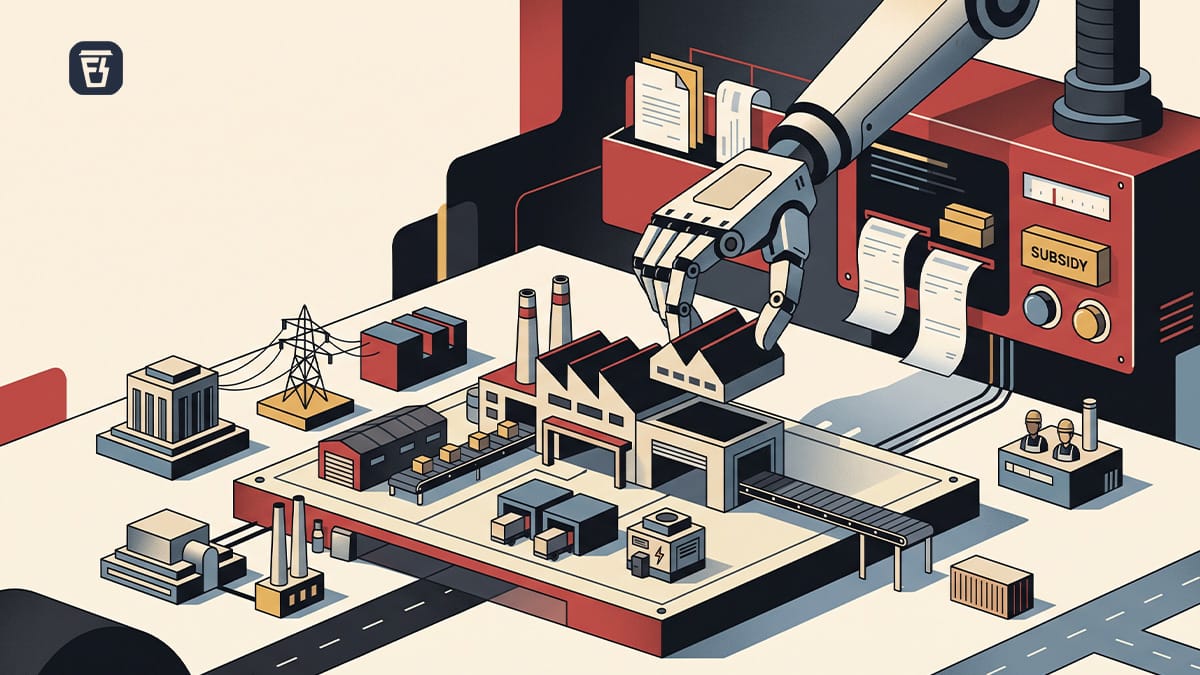
In today’s Finshots, we explain why subsidies alone cannot build a manufacturing powerhouse, and what it really takes to create an industrial ecosystem.
But here’s a quick sidenote before we begin. If you’re someone who loves to keep tabs on what’s happening in the world of business and finance, then hit subscribe if you haven’t already. We strip stories off the jargon and deliver crisp financial insights straight to your inbox. Just one mail every morning. Promise!
If you’re already a subscriber or you’re reading this on the app, you can just go ahead and read the story.
The Story
If you look at India's industrial policy over the last decade, a clear pattern begins to emerge. Whether it is semiconductors, battery storage systems, electronics, defence equipment, or solar panels, the government's ambition extends far beyond simply consuming these products. The real goal is to manufacture them at home.
To make that happen, thousands of crores of rupees have been earmarked under Production Linked Incentive (PLI) schemes.
Under the PLI scheme, the government offers companies financial rewards for manufacturing products in India and selling more of them over time. The idea is simple. The more you produce and sell, the more support you receive.
Apart from this, certain customs duties have been tweaked, import restrictions have been introduced, and local content requirements have become increasingly common. This domestic push also happens to coincide with a major geopolitical realignment. As global corporations look to diversify away from China under the China+1 strategy, countries like India have a rare window to capture investments that might have gone elsewhere a decade ago.
The latest illustration of this shift comes from the solar energy space.
At last week's AGM, Reliance Industries announced plans to scale its renewable energy and battery manufacturing capacity from around 40 GWh in the first phase to over 120 GWh annually. Once this capacity is commissioned, it will make Reliance one of the world's largest manufacturers of lithium iron phosphate (LFP) batteries.
This massive expansion builds on capabilities developed over the past year, including solar wafer production, which is one of the most technologically complex and strategically critical layers of the solar value chain.
Around the same time, the government extended the deadline for enforcing rules that require solar projects to procure domestically manufactured solar cells, conceding that local production capacity still needs time to catch up with demand.
At first glance, these seem like two completely unrelated developments: one is a corporate expansion announcement, and the other is an administrative deadline extension. But together, they point to a much larger question: can governments actually engineer a manufacturing industry into existence?
After all, factories do not spring up overnight simply because a government wishes for them. And private companies invest capital only when they believe they can earn a reliable return over the next decade or two. And that is precisely where industrial policy becomes far more complicated than simply handing out subsidies.
Most people assume that governments build national industries primarily by writing big cheques. In reality, subsidies are often the least interesting part of the story.
Imagine you are in the shoes of Reliance management. Building a high-tech solar wafer facility is not like opening a few retail outlets. It requires thousands of crores in upfront capital, sophisticated manufacturing technology, specialised technical talent, years of construction, and complete confidence that customers will keep buying your output long after the ribbon-cutting ceremony is over.
Now ask yourself a simple question: would you make that multi-thousand-crore commitment if solar developers could indefinitely import cheaper Chinese wafers and cells whenever global prices dropped?
Probably not.
This is because, beyond direct financial incentives, manufacturers need absolute certainty that a reliable domestic market will exist for what they produce. And this is where governments have fundamentally changed their playbook. Instead of merely subsidising factories, policymakers are actively trying to engineer demand.
PLIs lower manufacturing costs, but unlike traditional industrial policies, they do not pay companies just to set up plants. Firms earn incentives only if they actually manufacture and sell more goods than they did in a base year. In short, the government pays for tangible outcomes rather than idle capacity.
At the same time, import duties narrow the price gap between domestic and foreign goods. Government procurement guarantees large initial orders, while local content rules mandate that specific projects source components locally. Even extending implementation deadlines, as happened with India's solar cell mandate, is part of this balancing act. It is not a concession per se, but it is something that gives domestic manufacturers the breathing room they need to build capacity before local sourcing becomes mandatory.
Of course, this transition is rarely smooth sailing. India's push for domestic solar sourcing has already exposed the growing pains of aggressive industrial policy. Because the country still relies heavily on imported solar cells, enforcing strict local-content rules (prioritising domestic procurement) has created severe supply shortages in the domestic market. In fact, nearly a third of smaller solar panel manufacturers had to temporarily halt production because they could not secure enough locally made cells.
At the same time, the higher cost of domestic components pushed up the overall cost of solar power generation. Building domestic manufacturing often requires accepting short-term economic pain in exchange for long-term strategic independence.
And this strategy is not unique to India.
China spent decades nurturing its domestic industries through local procurement mandates, export incentives, and patient state backing before becoming the world's manufacturing engine.
The US is also attempting something similar through the Inflation Reduction Act, combining direct subsidies with generous tax credits tied to domestic production. Europe has launched its own industrial initiatives out of fear of losing strategic capabilities to both China and America.
In many ways, India's timing has been fortunate. Because global firms seeking to diversify their supply chains away from China are actively searching for alternative bases, making government incentives far more effective than they would have been in a quieter geopolitical era.
That said, engineering demand does come with difficult trade-offs. Creating protected domestic markets can reduce healthy competition, inflate prices for consumers, and encourage companies to rely on state support rather than real innovation.
If the protection lasts too long, businesses become complacent and fail to become globally competitive. And if domestic demand is not large enough to sustain true economies of scale, manufacturers will struggle even with generous incentives in place.
So, the real challenge for policymakers is ensuring that trade protection remains strictly temporary. Otherwise, firms risk becoming experts at winning subsidies instead of winning customers.
That brings us back to Reliance's decision to manufacture solar wafers. It is evidence that India's industrial policy is beginning to direct private capital in exactly the direction policymakers intended.
However, the ultimate success of this strategy will not be measured by the number of factory inaugurations or the size of incentive packages announced today. It will be measured years from now, when those very factories are forced to compete on a global stage without policy protection.
History shows that governments can play a decisive role in midwife-ing entire industries. South Korea nurtured its shipbuilders and electronics giants through heavily subsidised loans, but those loans came with strict export targets and performance benchmarks.
Another example is Taiwan. They did not simply write cheques for semiconductor firms. It also invested heavily in research institutions such as the Industrial Technology Research Institute, built the Hsinchu Science Park, which focuses on the development of semiconductors, and created an ecosystem that enabled companies like TSMC to flourish.
In each case, governments did far more than just fund factories. They built the infrastructure, talent pipelines, and policy incentives needed for an entire industrial ecosystem to emerge.
At the same time, economic history demonstrates that temporary shelter works only under specific conditions. Infant industries sometimes need protection from global competition while they build scale, but that protection works best when ambitious entrepreneurs are already eager to invest and innovate. Government policy can accelerate that journey, but it can rarely ignite entrepreneurial ambition out of thin air.
That is perhaps the broader narrative unfolding across India's manufacturing sector.
Which is why the next phase will prove even more critical than the first. Tariffs and subsidies can persuade conglomerates to build factories, but sustaining those operations requires continuous investment in research, skilled engineering talent, industrial infrastructure, and globally competitive supply chains.
Eventually, Indian manufacturers will need to win customers not because the policy favours them, but because their products offer the best value on the market.
Until then…
If you liked today’s story on how to enable local manufacturing better, feel free to share it with your friends, family, or even strangers on WhatsApp, LinkedIn, and X.
How strong is your financial plan?
You've likely ticked off mutual funds, savings, and maybe even a side hustle. But if Life Insurance isn't a part of it, your financial pyramid isn't as secure as you think.
Life insurance is the crucial base that holds all your wealth together. It ensures that your family stays financially protected when something unpredictable happens.
If you’re unsure where to begin, Ditto's IRDAI-Certified insurance advisors can help. Book a FREE 30-minute consultation and get honest, unbiased advice. No spam, no pressure.