
Is NSE’s IPO really fairly valued?
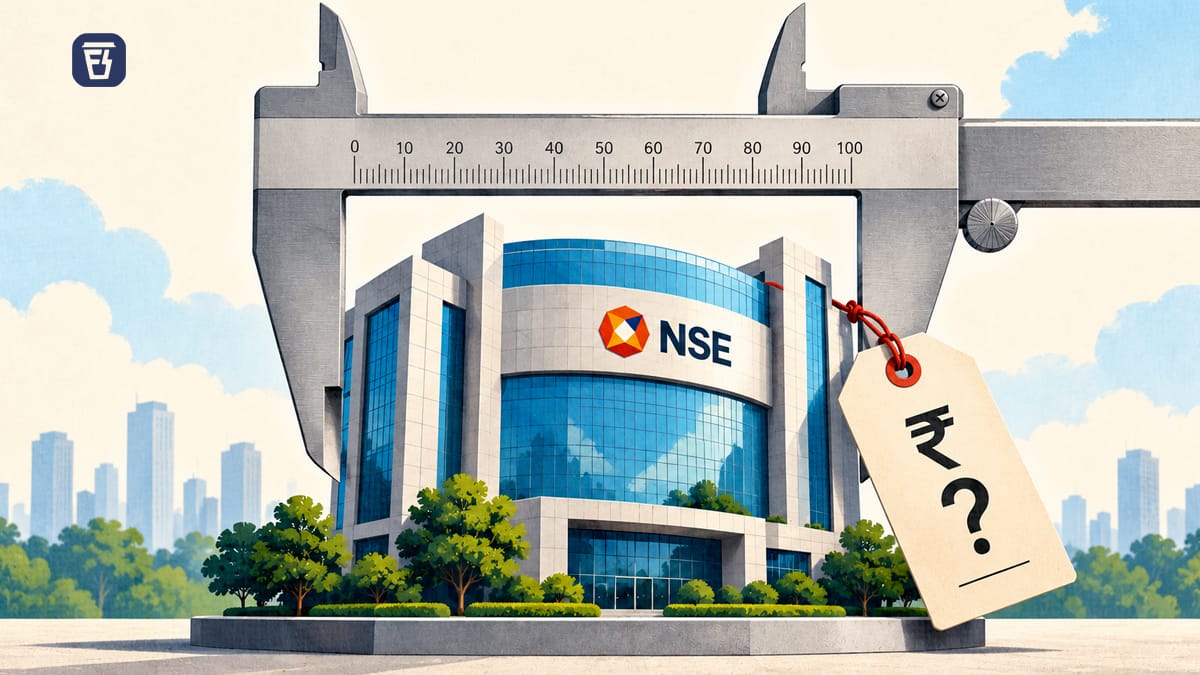
In today’s Finshots, we talk about the NSE IPO and whether it’s fairly valued.
 Love our insights? Add Finshots as a Preferred Source on Google ⭐
But before we begin, if you’re someone who loves to keep tabs on what’s happening in the world of business and finance, then hit subscribe if you haven’t already. We strip stories off the jargon and deliver crisp financial insights straight to your inbox. Just one mail every morning. Promise!
If you’re already a subscriber or you’re reading this on the app, you can just go ahead and read the story.
The Story
NSE needs no introduction. It’s India’s largest stock exchange and, by extension, one of the country’s most important financial businesses. It dominates stock trading, has built a formidable position in derivatives and earns handsome profits.
Yet, until now, you, as a retail investor, couldn’t simply buy NSE shares on the stock market because its listing had been delayed for nearly a decade.
That changes today as NSE’s IPO opens for subscription. And while we wrote about the IPO a few months ago, a few things have changed since then. But before we get there, let’s give you some context.
The IPO is entirely an offer for sale (OFS), which means existing shareholders such as the State Bank of India, The New India Assurance Company, Bank of Baroda, etc. are selling their shares. NSE itself won’t receive any of the roughly ₹22,500 crore being raised. And at the upper price band of ₹1,785, that values the IPO at roughly ₹4.42 lakh crore.
And that brings us back to what has changed in the three months since NSE filed its DRHP and RHP.
For starters, the size of the offer and the valuation. NSE had initially planned to sell about 14.8 crore shares through its existing shareholders. That has now been cut to 12.6 crore shares after a bunch of selling shareholders reduced the number of shares they wanted to sell.
The valuation has also come in lower than what the market had been expecting. For context, NSE shares were trading at around ₹2,000 per share in the unlisted market last year. But the IPO price band right now tops out at ₹1,785.
So, does that mean NSE is finally being offered at a fair price?
Well, there are a few ways to look at it.
Let’s start with the most basic one: the price-to-earnings, or P/E, ratio. Simply put, it tells you how much investors are paying for every rupee of profit the company earns. NSE made a profit of ₹10,302 crore in FY26 and reported EPS (Earnings Per Share) of ₹41.62. That effectively translates into investors paying about 43 times its FY26 earnings.
That’s quite a hefty valuation.
But to understand just how hefty that valuation is, we need something to compare it with. And there’s only one obvious peer: India’s only other listed stock exchange, BSE. It trades at about 54 times its FY26 earnings.
Looked at through that lens, NSE is actually entering the market at a lower P/E multiple.
That might seem strange. After all, NSE is much larger. In FY26, it earned ₹16,601 crore in revenue from operations and ₹10,302 crore in profit, as we mentioned earlier. BSE, by comparison, reported total income of ₹4,834 crore and a profit of ₹2,487 crore. NSE also handles much larger trading volumes across most major segments.
So why isn’t NSE commanding a premium?
The first thing you’d know by now is options — NSE’s biggest strength and, right now, also its biggest risk.
NSE’s business is remarkably profitable because it doesn’t need to spend a lot of capital to grow. After all, it’s an exchange, not a company that manufactures something. Once the technology and infrastructure are in place, adding another financial product doesn’t cost much. More trading can simply flow through the same platform.
And NSE has plenty of trading. In FY26, transaction charges accounted for nearly 79% of its revenue from operations. Equity options alone contributed ₹9,998 crore, or 60%.
We’re stressing this number because regulators have become increasingly uncomfortable with the rapid growth of short-term derivatives trading.
SEBI changed the rules around index derivatives in 2024, including larger contract sizes and restrictions on weekly expiries. More changes followed last year. That led to lower derivatives volumes and a 4% decline in NSE’s transaction-charge revenue in FY26.
And it showed up in the earnings too. NSE’s overall profit fell 15% year on year, even as BSE’s profit jumped 88%.
The reason for this is that SEBI’s new rules allowed each exchange to have just one weekly-expiry product. Before that, NSE had weekly options on four indices — Nifty 50, Bank Nifty, Nifty Financial Services and Nifty Midcap Select, creating an “expiry day” frenzy on almost every day of the week. BSE, on the other hand, had weekly expiries on just Sensex and Bankex.
So NSE went from four weekly products to one, while BSE went from two to one. In other words, NSE lost 75% of its weekly products, while BSE lost 50%.
As a result, NSE’s EPS fell from ₹49.24 in FY25 to ₹41.62 in FY26.
So investors are being asked to pay 43 times earnings even as earnings are falling. And viewed from that lens, the valuation starts looking a little less comfortable.
But here’s the thing. NSE hasn’t suddenly become a weaker business. Between FY24 and FY26, its revenue grew from ₹14,780 crore to ₹16,601 crore. Profits grew too, while its operating EBITDA margin stood at an extraordinary 66.85% in FY26. Its PAT margin was also a healthy 50.98%.
And now we have the June 2026 quarter numbers, which weren’t available when NSE filed its DRHP. They offer a glimpse of where the business could be headed. In Q1 FY27, revenue rose 13% year-on-year, while transaction charges jumped 15%, helped by stronger cash-market and options volumes. So perhaps this is more about NSE adjusting to regulatory changes than the beginning of a business decline.
But even after all this, there’s probably one thing you’re still scratching your head about: something we told you about earlier. NSE’s price per share for the IPO is set below what it was trading at in the unlisted market.
That might look like a discount. But there’s a logic behind that as well. Unlisted shares don’t have the same price-discovery mechanism as listed shares. There are fewer buyers and sellers, less liquidity and, in NSE’s case, a long-running expectation that the company would eventually list. So it’s difficult to treat the higher unlisted-market price as a definitive measure of what NSE is truly worth.
In other words, the fact that NSE is being offered below its unlisted price doesn’t automatically mean IPO investors are getting a bargain.
So, where does that leave the valuation?
To be honest, there isn’t one magical number that tells us whether ₹1,785 is “fair”.
Because there’s one thing you may not have noticed yet. NSE compares itself only with BSE in its RHP. Not with global exchanges. The reason is simple. India doesn’t have another listed, multi-asset exchange to make a direct comparison with. The RHP also points out that global exchanges such as LSEG and Nasdaq have more diversified businesses, which don’t make them direct peers.
But that doesn’t mean we can ignore them altogether. NSE is the world’s largest derivatives exchange by the number of contracts traded and ranked third globally in equity trades.
And when you look at global exchanges, exchanges such as Nasdaq and NYSE’s parent, ICE, trade at P/E multiples well below 30 — around 26 times for Nasdaq and 22 times for ICE. In other words, some much larger global exchange businesses are being valued at lower multiples than NSE.
But there’s some nuance here that’s worth noting. India is a fast-growing developing economy, with GDP growth of around 6-7%, while a developed market like the US typically grows much more slowly. So when investors value NSE, they’re not just looking at the company’s earnings today. They’re also pricing in the possibility that NSE could benefit as India’s financial markets grow.
There’s another important thing. In India, NSE operates as part of a duopoly with BSE, which gives it a very strong position in the market. In the US, exchanges such as Nasdaq and NYSE operate in a much more competitive landscape. And businesses with a stronger market position can command a higher valuation multiple than those constantly fighting for market share.
So yeah, in the end NSE is undoubtedly a good business. But the bigger question is how much you’re willing to pay for it when a large chunk of its earnings depends on derivatives — a segment where regulation can change the economics pretty quickly.
If derivatives recover after the recent regulatory changes, NSE’s growth story could look very different. If they don’t, investors may find that even a very good exchange business could be an expensive stock.
Until next time…
If this story helped you understand the NSE IPO’s valuation in a little more depth, spread the knowledge by sharing it on WhatsApp, LinkedIn and X.
🚨 ATTENTION: FINSHOTS FAMILY
This weekend, we’re hosting a free 2-day Insurance Masterclass that helps you build real financial security by understanding health and life insurance the right way.
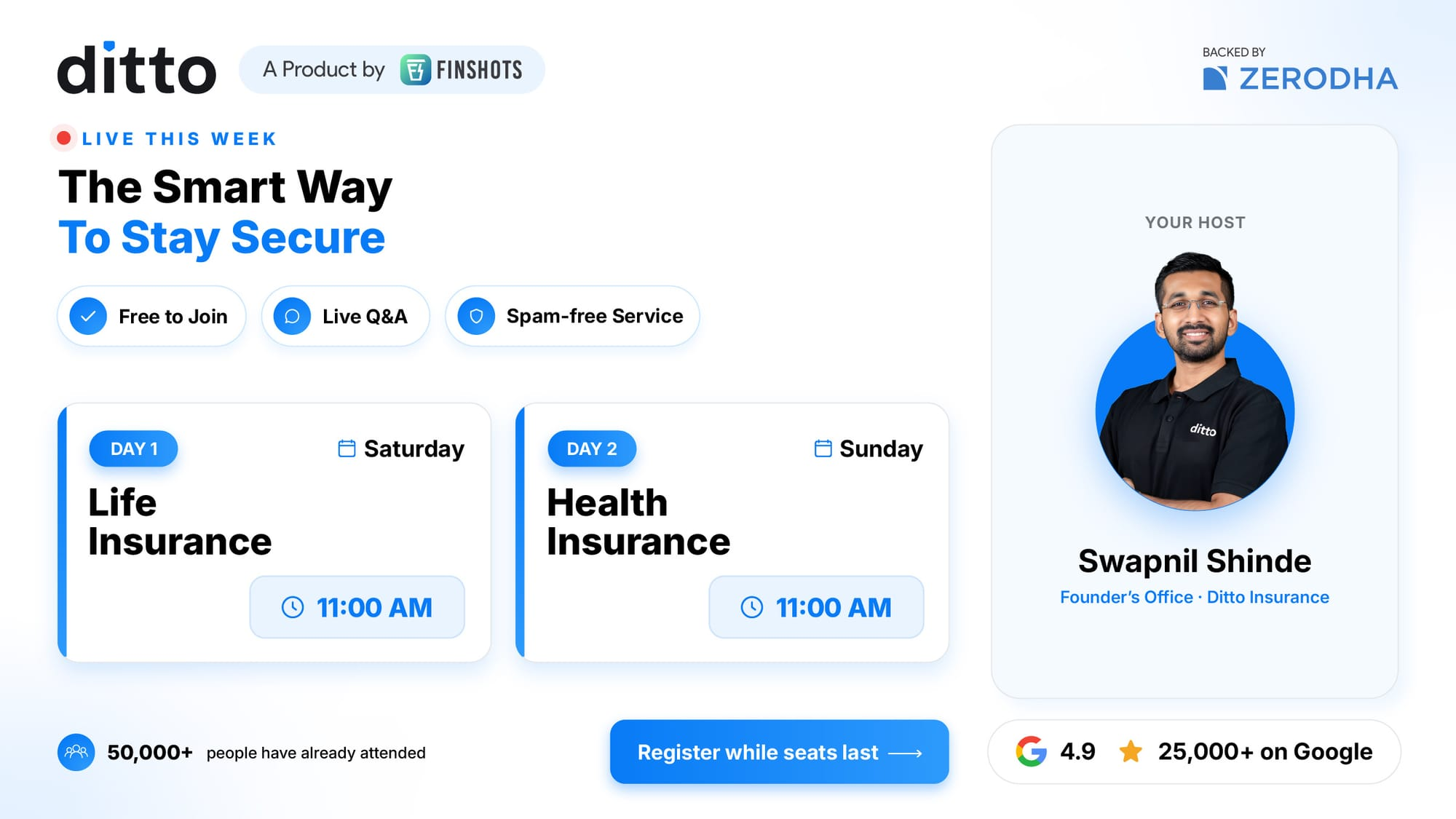
📅 Saturday, 19th September at 11:00 AM: Life Insurance: How to protect your family, choose the right cover amount, and understand what truly matters during a claim.
📅 Sunday, 20th September at 11:00 AM: Health Insurance: How hospitals process claims, common deductions, the mistakes buyers usually make, and how to choose a policy that won’t disappoint you when you need it most.