
The US Treasury wants lower bond yields. But will it work?
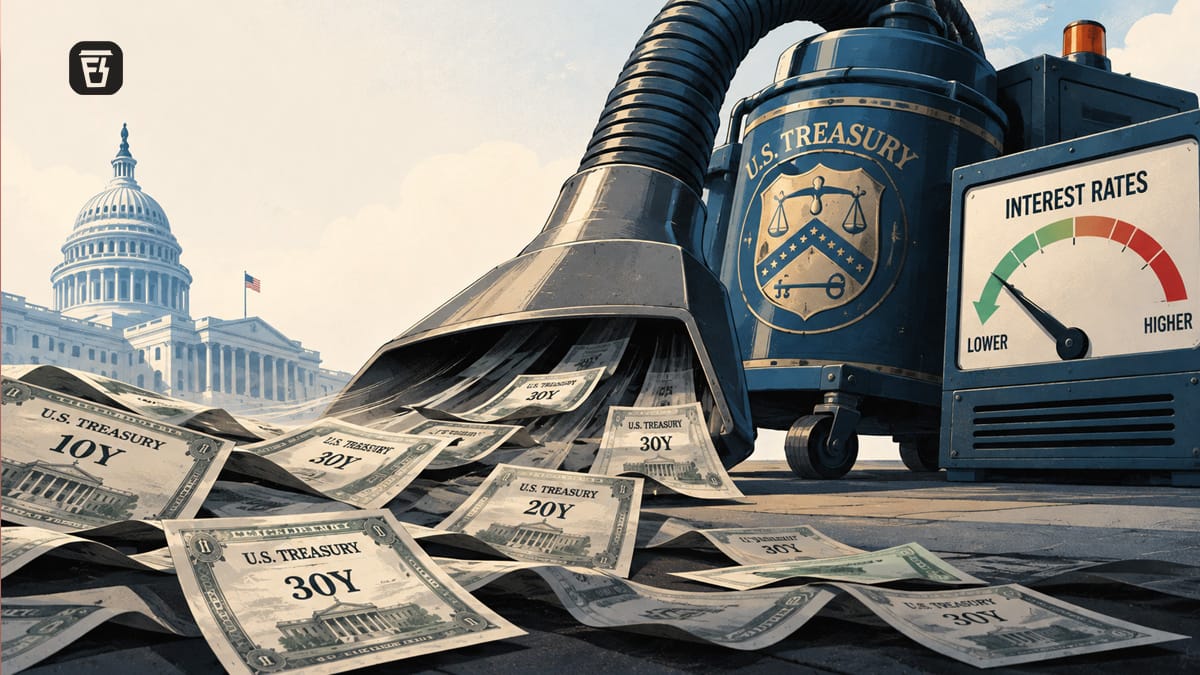
In today’s Finshots, we explain what the US Treasury is doing with bonds and why it doesn’t seem to be working as intended.
 Love our insights? Add Finshots as a Preferred Source on Google ⭐
But here’s a quick sidenote before we begin. The moment you became a parent, insurance stopped being optional.
It’s the one thing you keep meaning to sort out but never quite get to. And the longer you wait, the more expensive and complicated it gets.
Our 2-day Insurance Masterclass will help you figure out what to buy, how much cover you need, and how to avoid common mistakes.
📅 Tuesday, 15th September at 6:30 PM: Life Insurance
📅 Wednesday, 16th September at 6:30 PM: Health Insurance
Only few seats left. 👉🏽 Click here to save your spot.
Now, on to today’s story.
The Story
Last month, the US Treasury announced that it would expand the buyback programme for its own long-term bonds.
But this isn’t anything new. The Treasury keeps buying back bonds. What was different this time was that it said it would double the size of its buyback. So, if it normally bought $2 billion worth of long-term bonds each week, it would now buy back $4 billion or more for a few months.
We’re saying “more” because 30-year Treasury yields (interest rates) had touched 5.31% last month, their highest level since before the 2008 financial crisis. And because these yields affect borrowing costs across the US economy, Treasury Secretary Scott Bessent had signalled larger buybacks to help tame borrowing costs.
Basically, when there’s a large buyer for long-term bonds, bond prices rise and yields fall. That’s because bond prices and yields move in opposite directions. If prices rise, yields fall. If prices fall, yields rise.
And the Treasury believed that this larger buyback would bring down yields and provide liquidity to older long-term bonds, which can become harder to trade. The logic is simple. When new bonds come in, investors tend to focus on them, while older bonds see less trading. So, with fewer buyers and sellers for old, long-dated Treasury bonds, the market becomes less liquid.
The announcement immediately brought 30-year bond yields down to 5.19%.
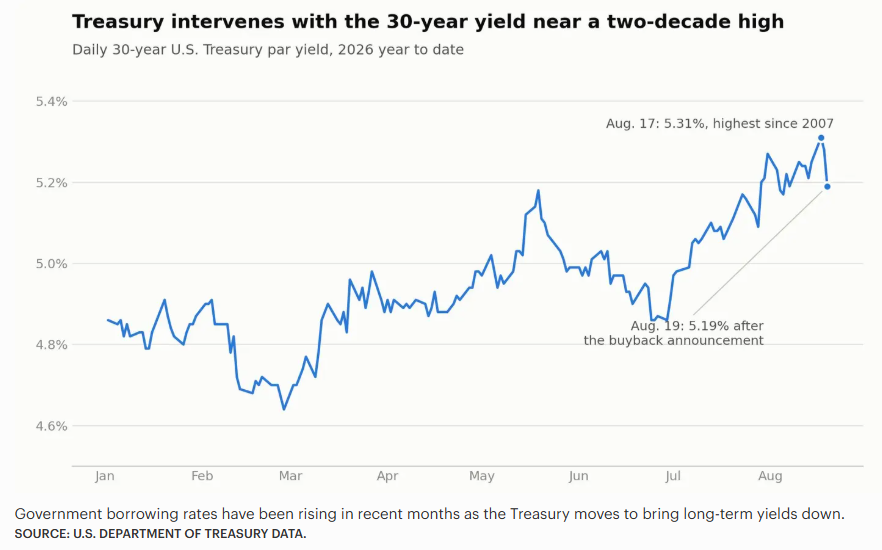
But last week, when the actual size of the larger buyback was announced, 30-year bond yields climbed back up to 5.29%. That’s because investors expected the US Treasury to buy back at least $10 billion worth of long-dated bonds. But the actual size came in at just $6 billion.
Sure, it was larger than the $4 billion that the Treasury had promised. But here’s the thing. Bond yields have also been rising because of global uncertainty, including inflation fears from tariffs and the US-Iran war, as well as oil prices topping $100 a barrel. So investors assumed the Treasury would buy even more long-dated bonds than promised. When that didn’t happen, yields started climbing again.
Now, what we told you so far was just the context. But buyback-size expectations aren’t the only reason why 30-year Treasury bond yields went back up. There’s more to it. So, let’s break it down.
First, let’s start with how two institutions, the US Treasury and the Federal Reserve, influence interest rates, which in turn decide how much a borrower in the US, or indirectly worldwide, pays for long-term loans such as mortgages, bonds and private credit.
The Federal Reserve, or Fed, is the US central bank. One of its main jobs is setting a target for the interest rate banks charge each other for loans. This one figure ripples through the economy because other interest rates, such as those for credit cards, business loans and savings accounts, are priced relative to it. So when the Fed raises or lowers this rate, it influences the cost of borrowing everywhere.
But there’s another tool at the Fed’s disposal: quantitative easing (QE). This is when the Fed creates new money and uses it to buy long-term bonds.
The US Treasury, on the other hand, has a completely different job. It’s the government’s accountant and borrower. It doesn’t set interest rates. Instead, it manages how the government borrows money to fund its spending. Its tools include deciding how much debt to issue, what maturities to issue it in — like short-term bills or long-term bonds, and occasionally buying some of its own older bonds back.
Now, the bonds it issues are considered one of the safest investments (almost risk free) in the world, backed by the full faith and credit of the US government. And because they’re considered so safe, they offer relatively low interest rates. That means Treasury yields affect things like home and corporate loans. So when lenders price these loans, they start with:
Treasury yield (the risk free rate) + a spread to compensate for the extra risk of lending to these borrowers.
That’s why the US Treasury wants to buy back old bonds — to support bond prices, lower yields and, in turn, borrowing costs.
But remember, unlike the Fed does with QE, the Treasury cannot create new money. So every dollar it uses for a buyback has to come from money it has raised elsewhere.
With this in mind, let’s apply this mechanism to the situation in question. The Treasury is buying back old long-term bonds (with 10 to 30 years left to mature), to improve liquidity. That should help push yields down. But where is this money coming from?
Well, it can’t print new money like the Fed. So it has to borrow money elsewhere to fund the buyback, like from issuing more short-term Treasury bills. And more reliance on short-term bills means the Treasury has to keep refinancing them at whatever new rate the market demands. So if short-term rates spike, borrowing costs jump too.
That means it’s not really solving the problem. It’s just swapping one type of debt for another. So it doesn’t do much to push rates down, even though yields fell immediately after the Treasury announced the larger buyback, largely because of investor expectations.
There’s another thing to look at too: the size of this so-called larger buyback. See, we know it sounds huge. But if you look closely, it’s actually tiny. Think about it. The entire 10- to 30-year US Treasury bond market that the Treasury is targeting is worth about $5.5 trillion. And last week’s buyback was $6 billion. If you do the math, that works out to a measly 0.1% of the entire long-term bond market.
That’s like trying to shift the price of something worth $10,000 by spending just $10 on it.
And the logic here is simple. Bond prices and yields move based on demand and supply. Millions of trades happen every day between pension funds, foreign governments, banks, mutual funds and everyone else buying and selling US bonds. So whatever is worrying those buyers right now — things like inflation fears, oil prices and so on, is influencing far more buying and selling than one $6 billion purchase could possibly counteract. Which means mathematically, this purchase is too small to outweigh what everyone else in the market is doing.
So what could bring yields down the way the US government intends, you ask?
Well, there are three main ways to do it.
First, the government could tackle the problems pushing yields higher, such as supply shortages driving up inflation and the growing budget deficit, which is pushing US debt higher. That debt has now crossed $40 trillion, or a whopping 123% of GDP.
Second, the most powerful option would be QE, where the Fed buys bonds with newly created money, increasing demand and pushing yields lower. But the caveat is that fresh money could also push inflation higher.
And third, the economy itself could change. If investors expect slower growth or lower inflation, yields generally fall. For now, the most realistic hope is that the US-Iran war ends, easing supply disruptions through the Strait of Hormuz, particularly for oil.
Otherwise, shuffling debt around may not do much beyond taking yields down on expectations, and then pushing them back up again.
Until then…
If you liked this story, consider sharing it with your friends, family, colleagues, or even strangers on WhatsApp, LinkedIn, or X.
Also, if you’re someone who loves keeping tabs on the world of business and finance, hit subscribe if you haven’t already. And if you’re already a subscriber, thank you! Maybe forward this to someone who’d enjoy our stories but hasn’t discovered us yet.