
The Dedicated Freight Corridor's last mile challenge
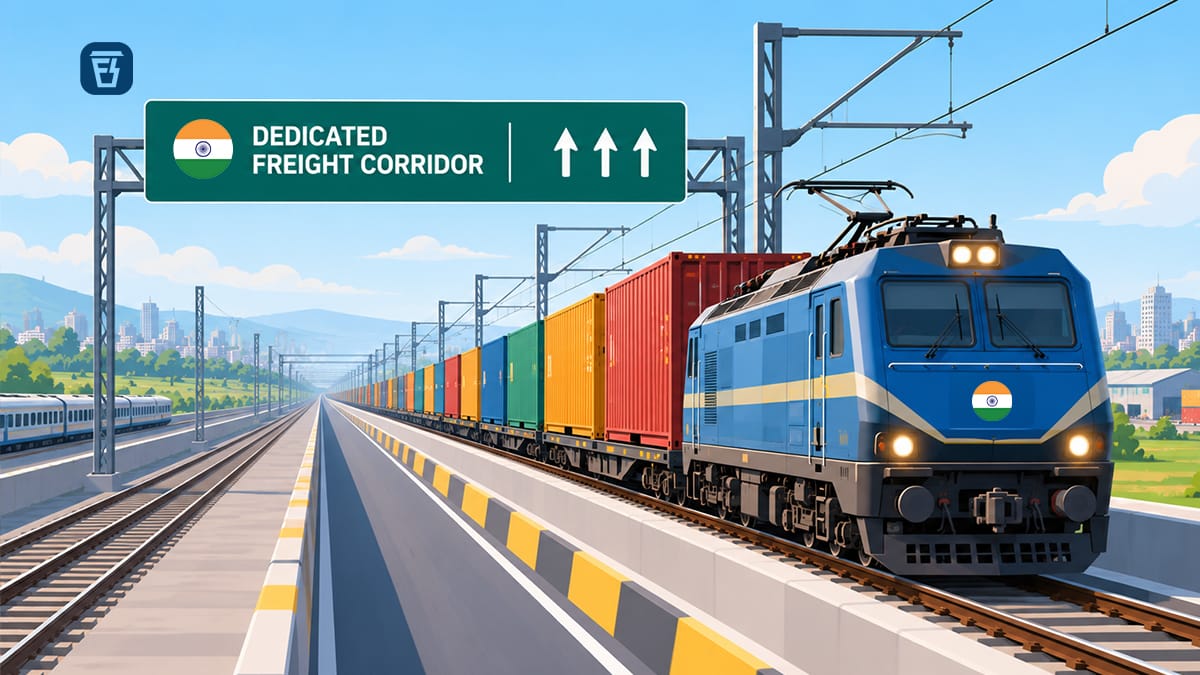
In today’s Finshots, we look at India’s newly completed Dedicated Freight Corridor (DFC) and the hurdle that will decide if cargo efficiently moves on it.
But before we begin, if you love keeping up with the buzz in business and finance, make sure to subscribe and join the Finshots club, loved by over 5 lakh readers.
Already a subscriber or reading this on the app? You’re all set. Go ahead and enjoy the story!
The Story
Last week, Prime Minister Narendra Modi declared India's 2,800 km Dedicated Freight Corridor (DFC) complete.
DFC is the Indian railway network built exclusively for goods trains, running in two halves. The Eastern Corridor from Punjab to West Bengal and the Western Corridor from Uttar Pradesh to Maharashtra’s Jawaharlal Nehru Port Terminal (JNPT). And the idea for India’s DFC was first floated in 2004, with a company called DFCCIL set up in 2006 to build it.
To put the project in perspective, a single train on the DFC recently carried as much cargo from JNPT to Vadodara as 250 or more trucks would have.
Now, the question is, why build a whole separate rail network just for freight?
To understand that, look at India's regular railway network. Freight and passenger trains share the same tracks. And freight almost always loses in that arrangement. A goods train gets parked in a siding (a short track branching off from and adjacent to the main track that allows trains to be parked, loaded or unloaded) to let a passenger train pass. Then does it again a few stops later, and again after that. Repeat that a few dozen times, and those delays add up. At some point, shipping by road, despite the traffic and the fuel cost, is often the quicker option.
That is where the DFC comes in. The idea is to give freight trains their own tracks so that they can move faster, carry more and, most importantly, stop getting pushed aside for passenger trains.
And the potential payoff is huge. A recent IIM Mumbai study estimates that DFCs, when combined with Multi-Modal Logistics Parks (a large hub that integrates multiple modes of transport into a single location for moving goods), could reduce India’s logistics costs by nearly ₹7 lakh crore every year.
But there’s a catch. A faster railway line only helps if the cargo can actually get to it on time. The real bottleneck lies on the roads and terminals connected to these tracks.
In India, that means taking a truck just to reach the freight terminals. And taking another for the final mile delivery. A faster train doesn't help much if trucks still take too long to move goods to and from the terminals.
So right now, the connecting road and terminal network remains the weak link. This is a lot like the entire explanation for why India's railways, which move over 85% of the country's coal, iron ore and cement, carry only a sliver of everything else. Researchers studying the shift point to poor service quality and a lack of last-mile connectivity as the two biggest reasons shippers stay away.
You can see this play out clearly with consumer goods. Rail's per-tonne rate for moving goods is actually lower than road's, costing roughly ₹1.4 per tonne-km compared to ₹2.5 for trucks. Yet, trucks still dominate with a 70% share of India's freight, while rail handles only about 25%. That’s simply because, while railways can’t reliably promise when a wagon will arrive, a truck can leave the moment it’s loaded.
But, how did we come to this structural mismatch in the first place?
Well, it is built directly into Indian Railways’ business model. Passenger fares are kept artificially low and cross-subsidised using freight revenue, leaving Indian Railways short on money for anything else. And when the railway budget does get allocated, most of it goes toward new lines, track upgrades and bridges, leaving only a small share for the freight terminals that decide whether that track actually gets used.
The terminals that do exist were built for big, captive industries, like steel plants and mines, that could guarantee huge volumes for the railways. A small manufacturer, the kind of company that actually makes up India's general cargo, was never really who this system was built for. Even natural rail customers, the massive industries, barely used the system. As of 2018-19, only around 28% of India's cement was actually moving by rail.
India has tried to fix this before, more than once. The Indian Railways’ Private Siding Policy, let big industries build and pay for their own rail link, or private sidings, straight to the factory gate. In one sense, it worked. India now has nearly 1,200 private sidings, and they carry roughly 75% of all freight that moves by rail today. But it mostly worked for companies that could already afford it. A basic siding costs upwards of ₹20 crore before land, which is exactly why it never reached the smaller manufacturers this corridor needs.
The latest attempt, the 2021 Gati Shakti policy let any registered company or individual apply, not just industrial giants, and allowed them to lease railway land instead of buying their own. As of September 2026, 147 such terminals are operational, with over 300 more approved and roughly ₹10,000 crore in private investment already committed.
The potential is already visible at JNPT. Before the port was connected to the western corridor, it dispatched about 27 freight trains a day. With full access in place, that number is estimated to jump to nearly 100, pushing rail's share of the port’s container traffic from 18% toward 30%.
But, building more terminals, however successful, isn't the only way to solve the last-mile puzzle. An ingenious workaround is already being tested on a section of the corridor.
It's called Trucks-on-Trains (ToT), and the idea is almost too simple. Instead of asking every shipper to build a terminal, they can load the entire truck onto a specially built flat wagon and let the corridor carry it. The truck only drives the short first and last mile itself; while the rail line covers the long haul in between. Right now, the service runs a single 636 km stretch between New Rewari and New Palanpur on the western corridor, cutting a journey that takes 30 hours by road down to about 12.
Since it launched, the service has completed over 1,955 trips, carried more than a million tonnes of freight, and earned over ₹131 crore in revenue. And guess who one of its biggest customers is? Not a steel or cement giant. It’s Amul, shipping milk tankers across the country on flatcars.
That's what happens when the last mile gets built alongside the main line, instead of after it. But, the real test remains whether the same success that the container traffic at JNPT or Amul’s milk tankers saw, can be replicated for a mid-sized factory in Ludhiana or Coimbatore that has never owned a siding and never will.
India isn't done building either way. A new corridor connecting the east coast directly to the west, cutting out the long detour through Delhi, was announced earlier this year and is already moving through the early stages of planning.
So, in the end, while we can judge the effectiveness of these projects by kilometres of track, construction speed or the number of trains they can handle, the harder metric is: what does the shipper choose?
If the answer slowly shifts from roads to rail, then we can truly say that the DFC has become a game changer for freight.
Until then…
If you liked this story, consider sharing it with your friends, family, colleagues, or even strangers on WhatsApp, LinkedIn, or X.
🚨 ATTENTION: FINSHOTS FAMILY
This week, we’re hosting a free 2-day Insurance Masterclass that helps you build real financial security by understanding health and life insurance the right way.

📅 Thursday, 17th September at 6:30 PM: Life Insurance: How to protect your family, choose the right cover amount, and understand what truly matters during a claim.
📅 Friday, 18th September at 6:30 PM: Health Insurance: How hospitals process claims, common deductions, the mistakes buyers usually make, and how to choose a policy that won’t disappoint you when you need it most.