
Is Hindustan Copper's "Green Shoe" really a Green Shoe?

In today’s Finshots, we simply explain what a green shoe option really is.
The Story
Two days ago, the government announced that it would sell a 6% stake in Hindustan Copper. It initially planned to sell just 3% through an Offer for Sale (OFS). But demand from institutional investors was higher. They bid for 3.41 times the shares on offer. So, the government decided to sell another 3%, potentially raising nearly ₹3,000 crore.
And if you read the exact post that the DIPAM Secretary put out on X, you’ll see that it says:
The Government has decided to exercise the entire green shoe option. Retail investors and employees get to bid on Wednesday, August 26, 2026. Good luck!
It’s just a fancy way of saying that the government will sell more shares because demand is high.
But here’s the thing. The explanation we just gave you isn’t technically correct. Sure, the term may often be used in conversations around share sales. But in capital markets, it has a much more specific meaning. Something entirely different, really.
So what is it, you ask?
In brief, a green shoe option is simply a provision that allows a company to sell additional shares during an IPO (Initial Public Offering) to help stabilise the stock price once it’s listed.
If you’re wondering how that works, let’s go by how market regulator SEBI defines it in its ICDR (Issue of Capital and Disclosure Requirements) Regulations.
When a company plans to go public, it can choose to use a green shoe option by getting shareholder approval before the IPO. It then appoints one of the lead managers as a stabilising agent (SA). For the uninitiated, a lead manager is someone like a merchant banker or investment banker who helps the company manage and execute the entire IPO. If you’ve ever read an IPO prospectus, you’ll usually find the list of lead managers somewhere in the first couple of pages.
And the SA has one job ― try to prevent excessive falls in the stock price after listing. But how?
Well, they start by borrowing additional shares from the company’s existing shareholders. These borrowed shares can increase the number of shares sold in the IPO by up to 15% of the original issue size.
Just to give you an oversimplified example, if a company sells 100 shares in an IPO and has a green shoe option, the SA could effectively make up to 115 shares available for sale by borrowing 15 shares from existing shareholders, such as the company’s promoters.
That’s because nobody can perfectly predict how a newly listed stock will behave once it starts trading freely. If demand is weaker than expected, the price could fall sharply in the first few days or weeks. Which is where these extra shares come in.
If the stock price falls, the SA can buy shares from the market using the money raised from the extra shares sold through the green shoe. This creates demand and can help support the stock price. The shares bought back are then returned to the shareholders from whom they were originally borrowed (the promoters in this case).
This price-support mechanism lasts for up to 30 days. If the SA can’t buy enough shares from the market to return the borrowed shares, the company creates additional shares equivalent to the shortfall and issues them to the original shareholders at the IPO price.
Now, we know that some of this can sound a little confusing. So let’s make it simpler by continuing with the 115-share IPO example we used earlier.
Let’s say investors buy all 115 shares at ₹100 each, including the 15 shares borrowed from the promoter. The SA then watches the stock after it lists.
Suppose the price falls from ₹100 to ₹90, the SA can step in and buy 15 shares from the market at ₹90, or slightly higher, and return them to the promoter. This sudden buying can help support the falling stock price, while the promoter gets their 15 shares back.
But the stock isn’t guaranteed to fall, right? It could stay at ₹100 or even rise to ₹110. In that case, the SA won’t buy shares because their job is to support the price when it falls. So let’s say that during the stabilisation period, the SA manages to buy back only 10 of the 15 shares.
Now there’s a problem ― a shortfall of 5 shares.
That’s where the company steps in and says, “No problem. We’ll issue 5 new shares at the original IPO price of ₹100 and give them to the promoter.” In other words, the company creates new shares to make up for the shares the SA couldn’t buy back.
And that, in a nutshell, is what a green shoe option actually means. TCS was the first Indian company to use one during its IPO in 2004. But since then, relatively few Indian companies have opted for it compared with companies in markets like the US.
One reason is the way the money is handled. In India, the money raised from the extra shares has to be kept in a separate account. And once the stabilisation period ends, any leftover profit can’t go to the SA or the promoters. It has to be transferred to SEBI’s Investor Protection and Education Fund (IPEF). So the SA earns only a fixed fee, regardless of the outcome. In the US, however, the SA can keep any profits from the price-stabilisation exercise.
That helps explain why green shoe options remain relatively uncommon in India’s mainboard IPO market.
But now you could say, “Hey Finshots, Hindustan Copper isn’t conducting an IPO. It’s been listed for decades.” And you’d be right.
The government, which is the majority promoter, is simply selling part of its stake. There’s no SA, no share-lending arrangement with promoters, and no 30-day post-listing stabilisation window or buyback obligation if the stock price falls.
In fact, Hindustan Copper’s business has been doing pretty well. In the latest quarter (Q1 FY27), net profit jumped 163% year-on-year to ₹353 crore, while revenue surged 81% to ₹936 crore, helped by operational leverage and elevated global copper prices since the start of 2026.
So calling this a “green shoe” could make it sound like the government is trying to support the stock price. But that’s not what’s happening.
The government instead is selling the additional stake because it needs to meet its FY27 disinvestment target of ₹80,000 crore. It has raised about ₹52,700 crore so far this financial year, making Hindustan Copper one of several PSU stake sales helping it get there. And with institutional investors showing strong demand, the government is simply using the opportunity to sell more shares and potentially get more value per share.
That’s why, when DIPAM calls the additional 3% a “green shoe option”, just remember that the term is being used much more broadly than the actual green shoe mechanism we just explained.
So the next time someone uses this jargon outside the context of an IPO, you know they’re talking about a simple option to sell more shares if there’s demand. And you can always send them this story to tell them what the term actually means.
Also, before we end this story, if you’ve been wondering all along why it’s even called a “green shoe” option, well, there’s a story behind that too.
Back in 1963, a US company called Green Shoe Manufacturing (later Stride Rite Corporation) went public on the NYSE. It was the first company to include an over-allotment clause that let its underwriters sell more shares than originally planned if demand was strong and use the proceeds to support the stock price if things went haywire. The provision became so closely associated with the company that the term “greenshoe” stuck.
So yeah, that’s probably why everyone casually calls any kind of over-allotment a greenshoe. You can be the smart exception. :)
Until next time…
If this story helped you understand what the term “green shoe” really means in the capital markets, share it with your friends, family, colleagues or even strangers on WhatsApp, LinkedIn or X, and help spread the knowledge.
Also, if you’re someone who loves keeping tabs on the world of business and finance, hit subscribe if you haven’t already. And if you’re already a subscriber, thank you! Maybe forward this to someone who’d enjoy our stories but hasn’t discovered us yet.
Our co-founder asked people why they avoid term insurance. The top reason? Right here. 👇🏽
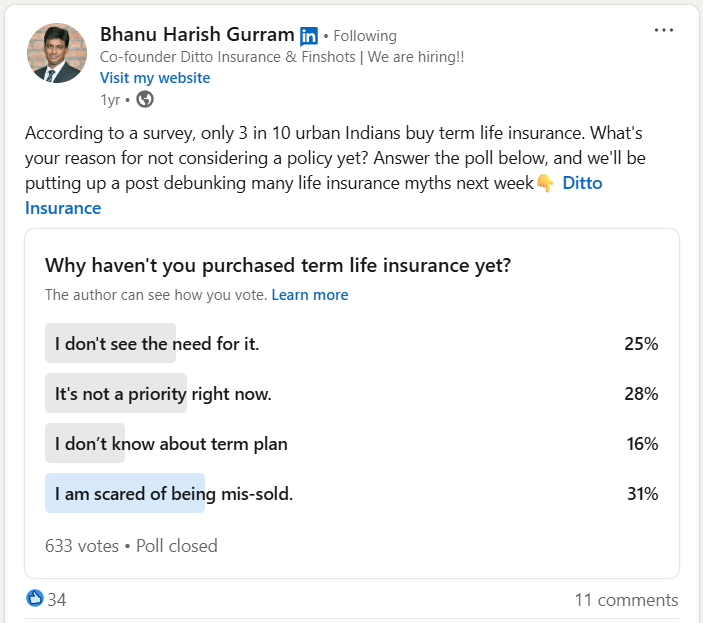
31% said their biggest fear is being mis-sold. Many worry that agents may push costly plans or add confusing extras without full transparency.
That’s a valid concern. After all, how can you trust something you don’t completely understand?
That’s why Ditto, a product of Finshots, has pioneered India’s #1 Spam-Free insurance platform. Our IRDAI-Certified advisors offer honest advice and help you find the right plan. Click here to book a FREE consultation today.