
Why capital is moving from bits to atoms
In today's Finshots, we take a look at how AI and advanced robotics are changing the economics of global manufacturing and what this transition means for India's industrial strategy.
But before we begin, if you love keeping up with the buzz in business and finance, make sure to subscribe and join the Finshots club, loved by over 5 lakh readers.
Already a subscriber or reading this on the app? You’re all set. Go ahead and enjoy the story!
The Story
History has a rather uncomfortable lesson about what happens when a society starts running out of people.
Take the Roman Empire, for instance. At its peak, agricultural workers produced food, craftsmen manufactured goods, and merchants transported them across regional borders. Soldiers secured trade routes, and workers paid taxes that funded state infrastructure.
Then Rome grappled with repeated shocks such as invasions, wars and food supply problems, that led to a population decline.
Historians say these demographic contractions affected agricultural production, wages, prices, and government revenues. Because a smaller population meant that you had fewer people to cultivate the land, manufacture goods, and fewer taxpayers.
This situation highlights the core problem of demographic decline. An economy doesn’t just need money, but also needs people to create things, provide services, and consume what others produce.
So, if a working-age population continues to shrink over several decades, the negative economic effects compound over time, across the entire system.
Economists actually have a more formal version of this problem. Stanford economist Charles Jones argues that long-term growth ultimately depends partly on people producing new ideas. Fewer people can therefore mean not just fewer factory workers, but fewer researchers pushing the technological frontier forward.
But now, AI introduces a strange possibility into that equation. If machines eventually become capable of performing research, managing production, and operating other machines, economic capacity could increasingly be manufactured like capital, shifting some of the constraint on growth away from population and toward things such as chips, factories, and energy.
If that sounds like science fiction, wait until you look at what is happening in China.
A couple of days ago, Chinese humanoid robot manufacturer Unitree Robotics debuted on the Shanghai Stock Exchange. The stock surged almost sixfold on its first day of trading, briefly valuing Unitree at more than $50 billion. For context, the company generated only about 1.7 billion yuan (~ USD 250 million at today’s exchange rate) in revenue in 2025.

And the interesting part isn’t the robots themselves, but what they could do to manufacturing. Chinese factories are already testing humanoid robots for inspection, sorting, assembly, and logistics.
Over the last few decades, if a company wanted to manufacture something at scale, it went to a country where workers were cheap. In the 1970s, China became the world's factory because it had an enormous workforce, low wages, and a huge network of suppliers that could turn raw materials into everything from electronics to cars.
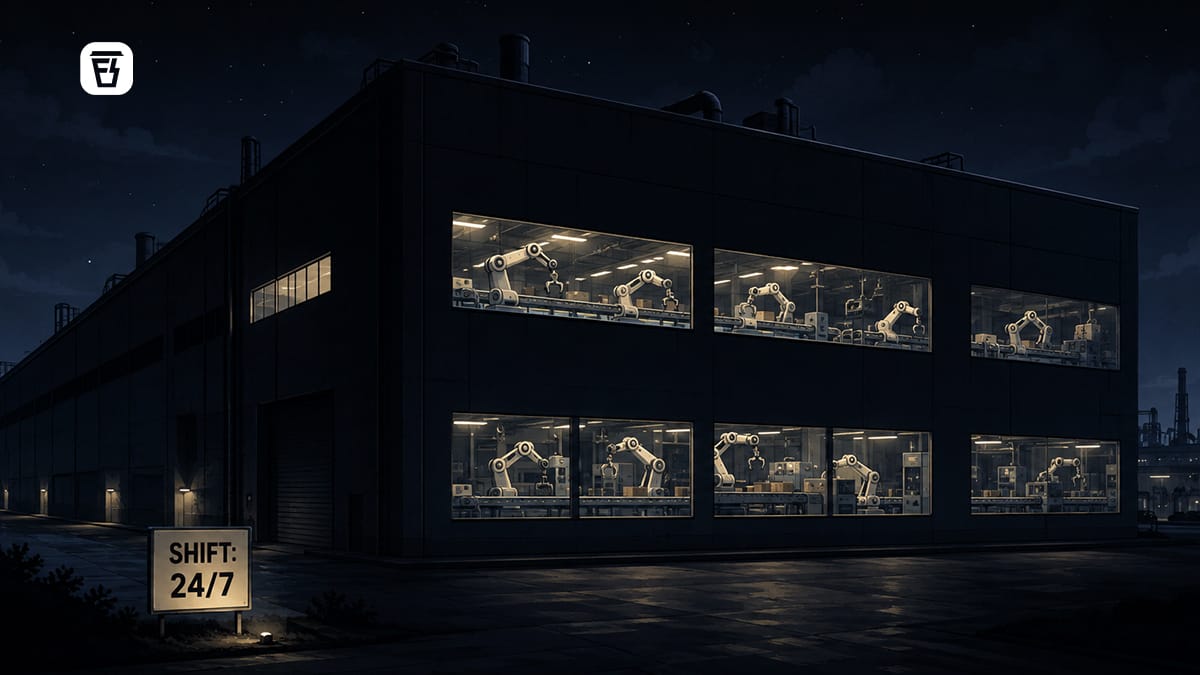
But now, automation has started to change that equation. China has spent years building increasingly automated factories. Some have even gone so far that they are called dark factories, where manufacturing facilities can operate with very little human intervention.
At BYD’s Zhengzhou manufacturing complex, the company says that automated robots handle 98% of the welding, assembly, and quality inspection.
And this isn't limited to China. Even in India, at Polymatech's semiconductor facility in Kancheepuram, robots assemble chips inside a cleanroom through the night while engineers largely just monitor operations from outside.
But hyper-automation creates a different kind of vulnerability too. Polymatech's director estimates that a serious power fluctuation could destroy around $1 million worth of production.
That’s where humanoid robots come into the picture. They are being designed around the physical environments humans already use. A conventional industrial robot is usually built for one very specific task. If you want it to perform another task, you may have to redesign the production line around it. A humanoid robot, at least in theory, could walk into a workstation designed for a human and perform several different tasks without requiring the entire factory to be rebuilt.
And that could mean that if a robot can perform the same repetitive task for longer hours, with greater consistency and without needing breaks, companies may eventually stop thinking about where they can find the cheapest workers and focus more on where they can produce the cheapest.
For instance, a factory in China may have higher wages than one in India. Still, if it has better automation, cheaper robots, a better component ecosystem, reliable electricity, and engineers who can integrate AI into production, it could still manufacture a product at a lower total cost. In that world, cheap labour is no longer enough to guarantee that factories will move to India.
This is where China's advantage becomes particularly interesting. China installed roughly 295,000 industrial robots in 2024 alone, accounting for 54% of all new installations globally, while India installed a record 9,100.
So, essentially China is building a new ecosystem. It has manufacturers producing the components, engineers developing the software, factories where robots can be tested, and an enormous industrial base capable of adopting them at scale.
As more factories automate, demand for robotic components increases. As more robots are deployed, manufacturers collect more data and improve their systems. And finally, as production scales, the cost of the technology falls.
All of this makes automation viable for even more factories and creates a feedback loop that countries without a large human-centric industrial base struggle to replicate.
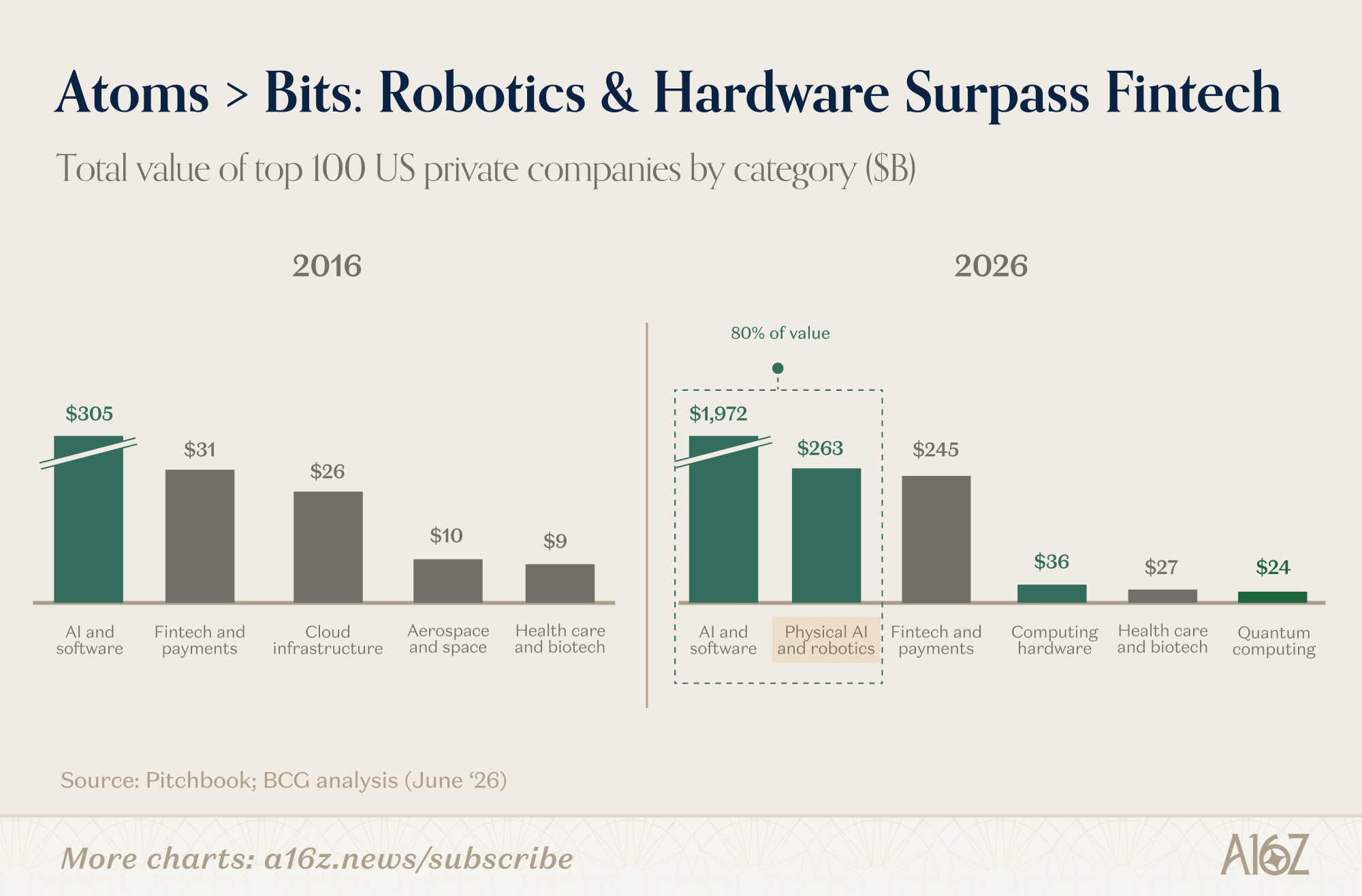
And investors appear to be betting that this feedback loop is becoming commercially important. According to Crunchbase, companies broadly classified under “physical AI”, including robotics, autonomous vehicles, drones, industrial automation and sensors, attracted $47.4 billion of venture funding across 521 deals in the first half of 2026. That was nearly 80% higher than the first half of 2025 and almost four times the amount raised in the second half.
Robotics itself has seen an extraordinary surge. In fact, they have also surpassed fintech companies in new investments, as of H1 2026.
And that could indicate that the AI investment story is beginning to move beyond companies that produce information on screens and towards companies that can manipulate the physical world.
India, however, has a different opportunity. We don't necessarily need to beat China at building humanoid robots. Our advantage could lie further up the stack.
Someone still has to design the production system, maintain the machines, train the AI, integrate different pieces of equipment, and troubleshoot the factory when something inevitably goes wrong. Those jobs require very different skills from the repetitive factory work that automation is replacing. A country that buys robots without developing the workforce to operate and improve them could end up with highly automated factories but little domestic capability to build or manage that technology.
That means India's real challenge isn't choosing between people and machines. It is making sure that its people move up the value chain quickly enough as machines take over the lower end.
Another economic question also lies beneath all of this. If machines eventually allow companies to produce more goods with fewer workers, productivity could rise dramatically. Consumers could benefit from cheaper products, companies could earn higher profits, and countries could produce more without needing a proportionate increase in their labour force.
But the gains would not necessarily be distributed evenly. A factory worker whose job disappears because of automation doesn't automatically become an AI engineer. Without enough new opportunities, the economy could become significantly more productive while a section of its workforce becomes economically redundant.
That is why the transition matters so much for India. Our demographic advantage has always been one of the biggest arguments for why manufacturing should move here. A large working-age population can be an enormous asset when factories need millions of workers. But it can become a liability if the economy creates fewer jobs than the number of young people entering the workforce.
The countries that win the next manufacturing race may not simply be the ones with the cheapest workers. They may be the ones that can combine labour, robots, energy, software and industrial know-how at the lowest total cost.
The goal, therefore, shouldn't be to replace India's workers with robots or to protect every job from automation. It should be to make the combination of an Indian worker and an intelligent machine more productive than either one could be on its own.
Because if China is building factories where robots do most of the work, India's opportunity may be to build an economy where people become exceptionally good at telling those robots what to do.
And that could determine whether India becomes merely the world's next low-cost manufacturing hub, or one of the world's most efficient manufacturing hubs.
Until then...
If you liked this story about the shift from bits to atoms, feel free to share this with your friends, family or even strangers on WhatsApp, LinkedIn or X.
For All Those Who Provide for Their Family
You work hard, you provide, and make sacrifices so your family can live comfortably. But imagine when you're not around. Would your family be okay financially? That’s the peace of mind term insurance brings. If you want to learn more, book a FREE consultation with a Ditto advisor today.