
Can Onida make a comeback?
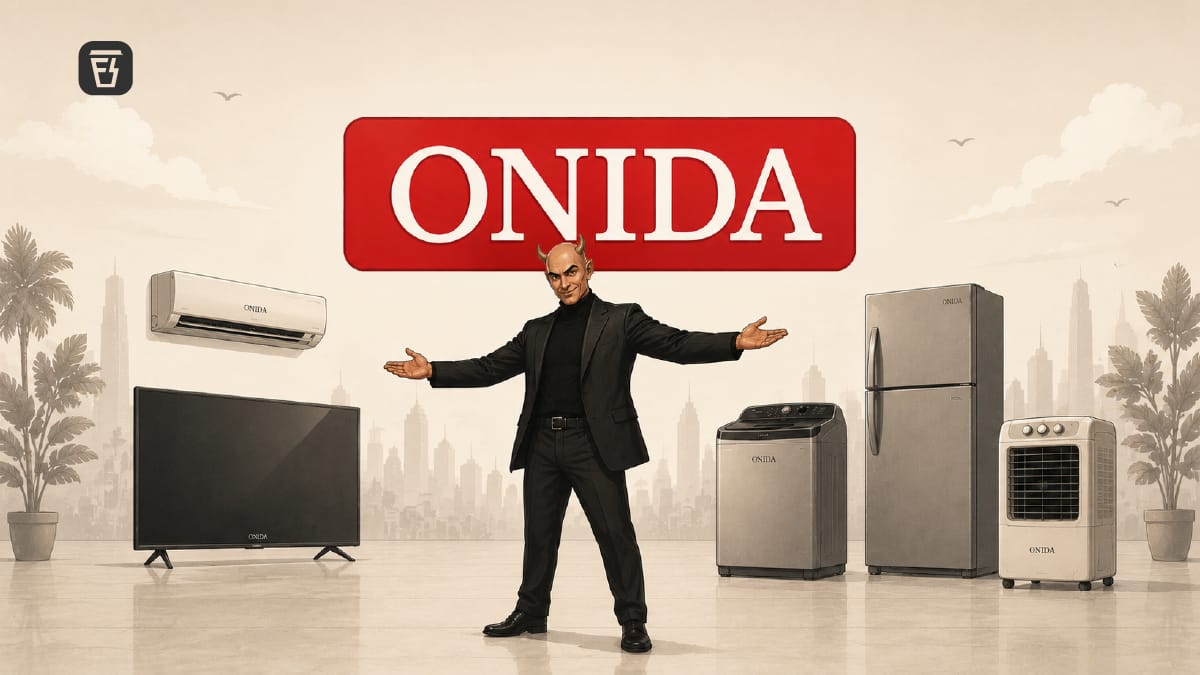
In today’s Finshots, we talk about Onida’s attempt at making a comeback and whether it could succeed.
But here’s a quick sidenote before we begin. Getting insured costs less now than it did a year ago. Yet, most people are still waiting for the “right time”.
With GST on insurance premiums gone, the math has shifted in your favour. The only thing standing between you and a solid plan is actually making the decision.
Our 2-day Insurance Masterclass will help you do exactly that.
📅 Tuesday, 21st July at 6:30 PM: Life Insurance
📅 Wednesday, 22nd July at 6:30 PM: Health Insurance
Only 400 seats remaining. 👉🏽Click here to save your spot.
Now onto today’s story.
The Story
Back in the 1980s and 1990s, there was one electronics brand with a rather unusual way of selling TVs. Its mascot was a bald, green, horned devil with a sharp tail and long nails, who warned that if you compromised on the TV you bought, it would haunt you every evening. If you’re a millennial or older, you probably already know we’re talking about Onida.
And honestly, neither adults nor kids really liked these ads. In fact, research by Advertising Avenues, the agency that created the iconic Onida devil, found that nearly half the people who watched them hated them.
But that was exactly the point. The devil was impossible to ignore.
Over time, the ads evolved to suggest that you should own a TV your neighbours envied. Hence the famous tagline: “Neighbour’s envy, owner’s pride.” It was a sharp contrast to rivals like Videocon and BPL, whose ads focused on technical specifications that sounded like Greek and Latin to most buyers. Onida, instead, tapped into something far more relatable — the Indian middle-class dream of owning what your neighbours did, without spending a fortune.
The strategy worked. Combined with its Japanese-sounding name (despite being truly Indian) and TVs that looked sleeker than most at the time — thanks in part to its early collaboration with Japan’s JVC, which helped it build quality colour TVs, Onida’s market share jumped fourfold to 20% between 1981 and 1995.
But that dominance didn’t last. Liberalisation brought South Korean giants like LG and Samsung into India with deeper pockets, aggressive pricing and stronger distribution networks that older competitors including Onida struggled to match. Which means that today, its market share is down to the low single digits. Revenues have mostly declined over the past decade from ₹775 crore in FY16 to ₹670 crore in FY26, while net losses have nearly tripled to ₹74 crore.
But now, Onida is back in the spotlight, trying to script a comeback.
In May, the company officially rebranded itself, changing its name from MIRC Electronics to Onida Electronics. It also brought in a new leadership team, appointing Gunjan Srivastava, who spent over a decade at Bosch Home Appliances, as its MD and CEO.
On top of that, Onida raised ₹149 crore from a Mumbai-based investment firm called Authum Investment and Infrastructure and secured approval to issue around ₹65 crore worth of convertible warrants. Simply put, warrants are special financial instruments that companies use to attract capital and give investors the right to buy its shares at a fixed price in the future, making them more valuable if the stock price rises.
And with this Onida wants to begin its revival by expanding its distribution. For context, today its products are sold through around 4,000-4,500 retail outlets, without a single exclusive Onida store. But armed with fresh capital, over the next six months, it plans to double that retail footprint, focusing on markets where the brand still enjoys strong recall. And over the next couple of years, it hopes to open 100 exclusive brand outlets across the country.
But here’s the thing. This isn’t the first time that Onida has tried to stage a comeback. In fact, since the early 2000s, it has attempted a revival roughly every five years. And while almost every effort sparked a wave of nostalgia, none managed to restore the brand to its former glory.
Which naturally makes you wonder, “Why would this time be any different?”
To answer that, we first need to understand what broke Onida in the first place.
See, it’s true that rising competition in the consumer electronics market hurt Onida. But that was just an external shock. What actually turned that pressure into a two-decade decline was largely self-inflicted.
It all began with a bitter ownership dispute that dragged on for years. For some context, Onida was founded by Gulu Mirchandani and his brother-in-law Vijay Mansukhani. Gulu’s brother, Sonu Mirchandani, was also part of the promoter group. The three jointly controlled the company through a holding firm called Guviso, with each owning a one-third stake.
But despite the equal ownership, Gulu Mirchandani remained Chairman and MD, enjoying complete operational control. According to media chatter, the other two promoters believed this was unfair because they had little say in key decisions despite owning the same stake. In fact, Sonu Mirchandani wasn’t even on the company’s board.
Over time, both reportedly began looking to exit by selling their stakes to Videocon and Kishore Biyani’s Future Retail, both powerful brands at the time.
And you can imagine what this meant for Onida. Just when it needed quick, united decisions to fend off global rivals like LG and Samsung, it was busy fighting over its own ownership. And a company caught in internal battles rarely moves fast enough on pricing, product development or manufacturing investments.
The second problem was that, over the years, Onida seemed confused about its own brand identity.
You see, over nearly four decades, it kept switching ad agencies in an attempt to reinvent itself. And while there’s nothing wrong with that, the company also seemed unsure about whether its iconic devil mascot still fit the products it was selling.
To be fair, you could give Onida the benefit of the doubt. Because by now, TVs and consumer electronics have become commonplace in most Indian homes. So selling a TV as something that inspired “neighbour’s envy” probably doesn’t carry the same appeal anymore.
But instead of making products that could still live up to that promise, Onida first dropped the “Neighbour’s envy” part of its famous tagline, leaving just “Owner’s pride.” Then, around 2016, it went as far as replacing the devil with… god. Yes, god!
The campaign obviously never really resonated with the masses, and a few years later the company had to bring the iconic devil back.
Now, that may sound like a very tiny detail. But consumers take brand identity seriously. You could look at it this way. If the Amul Girl suddenly disappeared from your butter pack tomorrow, you’d probably wonder what happened, right? That’s the power of mascots and consistent storytelling. And Onida may have weakened that trust by constantly changing both.
And through all of this, the biggest thing is that the most important problem never really got fixed. We’re talking about Onida’s broken financial structure.
As of FY26, the company remains under serious financial stress. In Q3 FY26, it posted a net loss of ₹13 crore, 149% worse than the same quarter a year earlier, despite higher revenue. By the March 2026 quarter, losses had widened to ₹47 crore, which is a staggering 4,100% deterioration from the modest profit it reported a year ago, while net sales fell 28% year-on-year.
The longer-term picture isn’t encouraging either. Over the past five years, sales have grown by an average of just 3-4% annually, while EBIT (Earnings Before Interest and Tax) has shrunk at an average rate of 240%.
In other words, even when Onida manages to grow revenue, its cost structure and operating model struggle to turn that into profits. And that’s not something a fresh brand identity or a new mascot can fix. Instead of repairing the engine, Onida mostly seemed to focus on giving the car a fresh coat of paint.
And maybe that’s exactly what Onida is trying to do differently this time.
For starters, there’s real outside money involved. Mumbai-based Authum Investment now holds a meaningful stake in the company after investing fresh capital.
The second change, as you may have noticed, is who’s running the business. Day-to-day operations are no longer being led by a family member or a marketing executive. Instead, they’re in the hands of Gunjan Srivastava, who spent over a decade leading Bosch’s home appliances business across India, South Asia and the UK. A new CFO, Manish Desai, with nearly three decades of finance experience and a previous stint at VIP Industries, has also come on board. Meanwhile, a member of the founding family, Kaval Mirchandani, has stepped down from the MD’s role, marking what could be a meaningful governance shift after years of family control.
And finally, Onida is exiting non-core businesses such as its contract manufacturing business for third-party TV panels, something it took up before the pandemic to boost revenues. That allows it to focus entirely on the Onida brand while expanding into categories like air conditioners and washing machines, where there’s still plenty of room to grow in India.
So yeah, for the first time in decades, this comeback attempt isn’t just about reviving the devil, but about fixing real problems that made its magic fade in the first place.
Whether that’s enough, is only something the next few years of financial results will tell.
Until then…
If you liked this story, feel free to share it with a friend, family member or even strangers on WhatsApp, LinkedIn, and X.
And if you’re someone who loves keeping tabs on the world of business and finance, hit subscribe if you haven’t already. And if you’re already a subscriber, thank you! Maybe forward this to someone who’d enjoy our stories but hasn’t discovered us yet.