
Can better seeds solve our farmers' monsoon problem?
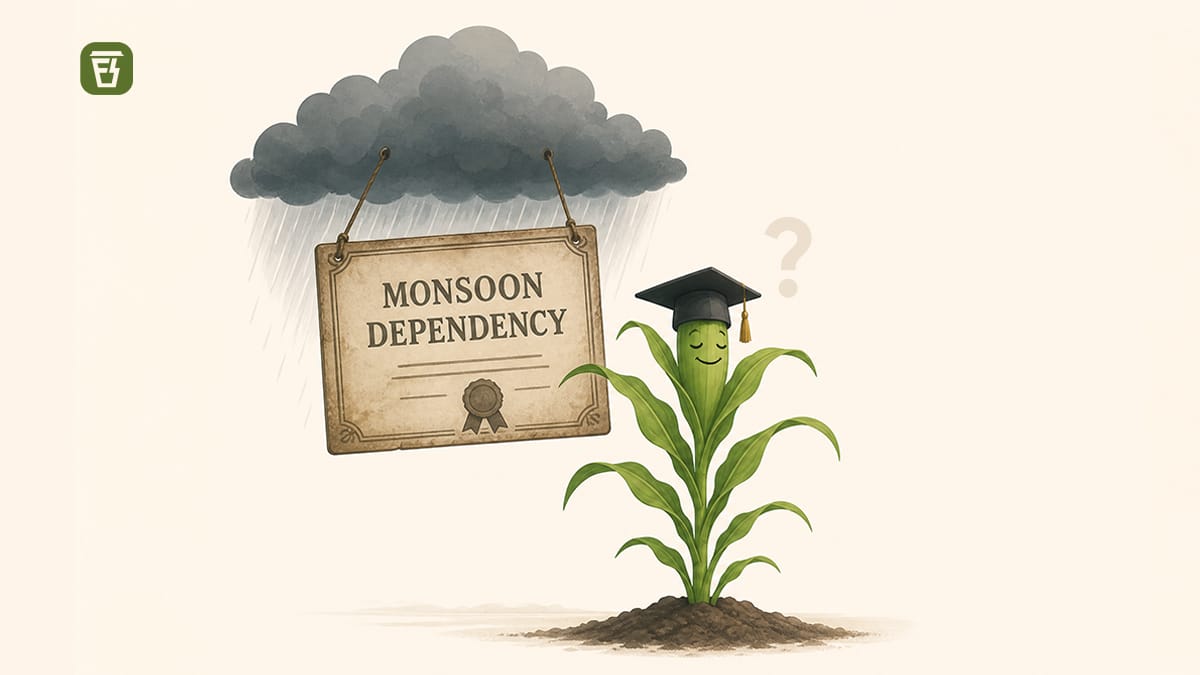
In today’s Finshots, we find out whether our agricultural system can finally break free from total dependence on rainfall.
But here’s a quick sidenote before we begin. If you’re someone who loves to keep tabs on what’s happening in the world of business and finance, then hit subscribe if you haven’t already. We strip stories off the jargon and deliver crisp financial insights straight to your inbox. Just one mail every morning. Promise!
If you’re already a subscriber or you’re reading this on the app, you can just go ahead and read the story.
The Story
Every July, a familiar anxiety settles over rural India. Farmers across the country collectively hold their breath, eyes turned toward the sky, waiting for the monsoon to arrive.
And this year is no different.
In Rajasthan, kharif sowing is running behind schedule because erratic, delayed rainfall has disrupted planting across vast stretches of the state. Down south in Karnataka, the situation is equally tense. The state is staring at a significant monsoon deficit, reservoir levels are under immense pressure, and worried farmers are actively postponing their sowing plans in the fervent hope that the next spell of rain arrives before it is too late.
At first glance, this annual nail-biting exercise feels perfectly normal. After all, traditional kharif crops are essentially monsoon crops, meaning they inherently rely on seasonal rainfall to survive. But when you step back, you realise there is a massive paradox at play here.
Over the last few decades, India has poured billions of rupees into its agricultural backbone. We have built massive dams, carved out extensive canal networks, heavily subsidised electricity to power millions of groundwater pumps, and aggressively invested in agricultural logistics and research. Because of these efforts, India has transformed into a global agricultural powerhouse, standing tall as the world's largest producer of rice and the second-largest producer of wheat, sugarcane, and a host of other vital crops.
Around 46% of India’s population depends on agriculture for their livelihood. Yet, the entire sector remains completely at the mercy of something as volatile and uncontrollable as the monsoon.
So, instead of trying to build bigger concrete dams or drill deeper borewells, why can't we simply change what we bury in the soil?
In May 2025, it seemed like Indian agricultural science had delivered the ultimate answer to that exact question.
The Union Agriculture Ministry officially released India’s first genome-edited rice varieties: Pusa DST Rice 1 and DRR Rice 100 (AKA Kamala). Developed by the Indian Council of Agricultural Research, they were engineered using the CRISPR-Cas9 gene-editing technology specifically to tackle climate stress.
Pusa DST Rice 1 targeted a specific gene to confer superior drought and salinity tolerance in plants, allowing rice crops to survive in water-scarce or salt-degraded soils. Meanwhile, DRR Rice 100 targeted the gene that controls grain formation, allowing the plant to mature nearly 20 days faster than its parent variety, Samba Mahsuri. ICAR estimated that widespread adoption of the new varieties could collectively save 7.5 billion cubic metres of irrigation water and reduce greenhouse-gas emissions.
And because genome editing simply tweaks the plant’s existing DNA without inserting foreign genetic material from other species, these seeds were approved under simplified biosafety rules. And because they contain no foreign DNA, they qualify for a streamlined regulatory pathway rather than the full framework applied to genetically modified crops in India.
On paper, this was a monumental breakthrough. It offered a drought-resistant, water-saving seed that could insulate millions of farmers from unpredictable rainfall.
Yet, as we navigate another uncertain monsoon season a year later, these revolutionary seeds are nowhere to be seen on a commercial scale.
So, what went wrong between the lab and the land?
The first hurdle is physical and logistical. You cannot simply invent a seed in a research laboratory and distribute it to millions of fields in a short span of time.
Agriculture operates on a slow implementation cycle. A handful of breeder seeds produced by scientists must first be grown into foundation seeds, which are then multiplied into certified seeds by state corporations and private companies before reaching local retail shops. And this process takes multiple farming seasons. Without a massive, coordinated seed-rolling plan to rapidly scale up production, even breakthrough technologies remain trapped in research stations.
The second issue is a growing gap between laboratory claims and real-world field conditions.
When scientists tested the seeds in controlled environment trials, the results were spectacular. However, the trial data later became the subject of a public dispute. Advocacy groups argued that ICAR had highlighted favourable locations, while the edited lines failed to outperform their parent varieties consistently elsewhere. ICAR rejected the allegation, saying the varieties must be judged within the stress environments for which they were developed.
Under unpredictable field conditions, weather fluctuations, and varied soil types across different states, the performance of these new lines was inconsistent. In fact, at several trial sites, the gene-edited lines did not significantly outperform conventional, popular parent varieties such as MTU 1010 or Samba Mahsuri.
For an average farmer who risks their entire livelihood on a single harvest, any doubt about a seed's consistency under actual farm conditions is an immediate dealbreaker.
That brings us to the most important piece of the puzzle, which is the economic reality of Indian farming.
From a cost perspective, seeds account for a relatively small percentage of a farmer's total input costs compared to fertilisers, labour, diesel, and land preparation. However, choosing the wrong seed carries 100% of the financial risk.
If a new variety underperforms or fails during a dry spell, the farmer absorbs the catastrophic loss alone.
Furthermore, Indian agriculture does not exist in a vacuum. It is driven by deeply entrenched market incentives. Rice cultivation is not just about growing grain, but also about selling it profitably.
That is why ICAR has recommended “advance seed rolling” plans, where governments identify suitable contingency crops and multiply their seeds before a delayed monsoon creates an emergency.
But making the seed available only solves half the problem. A farmer will not switch from a familiar crop to a shorter-duration millet, pulse, or oilseed merely because of a shorter yield time.
This is because the government's Minimum Support Price (MSP) procurement framework is built around well-known, traditional crop varieties. Local rice millers, traders, and wholesalers know exactly how popular varieties like Samba Mahsuri cook, store, and sell. They pay predictable prices for them.
If a farmer adopts a new, unfamiliar crop, they face a very real market-safety-net problem. If local traders are hesitant to buy the grain, the farmer loses money even if the crop survived the drought. So, asking a farmer to switch to a new crop without guaranteeing that the market will buy the produce at a profitable price is basically asking them to take a gamble.
But better seeds are only one way to reduce the farmer’s monsoon risk. India also needs two other shock absorbers: one that protects farm income when the rains fail and another that stretches the limited water that remains.
The first could be rainfall futures. In May 2026, the National Commodity and Derivatives Exchange launched RAINMUMBAI, India’s first exchange-traded weather derivative. The contract is settled using rainfall recorded by the India Meteorological Department. So, in theory, someone financially exposed to a weak monsoon could take a position that gains value when rainfall deviates from expectations, partly offsetting weather-related losses.
Of course, one rainfall contract linked to a Mumbai weather station cannot protect a farmer in Rajasthan or Karnataka. And expecting individual farmers to understand margins, futures prices, and trading accounts is unrealistic.
So, the practical solution would be district-level rainfall contracts aligned with local sowing and flowering periods, with Farmer Producer Organisations, cooperatives, insurers, banks, and food companies aggregating farmers’ risks and hedging on their behalf. The goal should be to ensure that when the monsoon fails, weather risk does not remain entirely on the farmer’s balance sheet.
The second shock absorber is micro-irrigation. Drip and sprinkler systems deliver water directly to the plant rather than flooding the entire field, allowing farmers to produce more with a limited water supply. But despite years of subsidies and the government’s “Per Drop More Crop” push, adoption has remained far below its potential.
Between 2016 and 2025, the scheme covered about 1.09 crore hectares, while a government task force estimated that nearly 6.95 crore hectares could potentially be brought under micro-irrigation.
The problem is that a subsidy alone does not ensure the installation and maintenance of a working irrigation system. Farmers must still cover their share of the upfront cost, navigate application processes, clean clogged filters, replace damaged pipes, and find technicians when the system breaks down.
So, governments could use networks that already reach farmers, including PM-KISAN, cooperatives, and FPOs, to bundle financing, equipment, training, repairs, and rainwater storage into a single package.
A farm pond or community tank could capture one spell of heavy rainfall, while drip or sprinkler systems could conserve that water for the ten-day dry spell that threatens the crop later.
Put these three solutions together, and the strategy becomes clearer. Genome-edited seeds can reduce the crop’s biological vulnerability. Micro-irrigation can reduce the amount of water it needs. And rainfall futures can soften the financial blow when both measures are overwhelmed by extreme weather.
Sure, none of them can “eliminate” India’s dependence on the monsoon. But together, they can stop a delayed spell of rain from becoming an all-or-nothing gamble for the farmer.
Until then…
If you liked this story, feel free to share it with a friend, family member or even strangers on WhatsApp, LinkedIn, and X.
🚨 ATTENTION: FINSHOTS FAMILY
This weekend, we’re hosting a free 2-day Insurance Masterclass that helps you build real financial security by understanding health and life insurance the right way.

📅 Saturday, 18th July at 11:00 AM: Life Insurance: How to protect your family, choose the right cover amount, and understand what truly matters during a claim.
📅 Sunday, 19th July at 11:00 AM: Health Insurance: How hospitals process claims, common deductions, the mistakes buyers usually make, and how to choose a policy that won’t disappoint you when you need it most.