
Tribhovandas Bhimji Zaveri is now GRT's jewel
In today’s Finshots, we break down GRT Jewellers’ acquisition of Tribhovandas Bhimji Zaveri.
But here’s a quick sidenote before we begin. Most new parents are so caught up in the chaos of a newborn that insurance keeps getting pushed to “next month”.
But next month has a way of becoming next year.
That’s why we’re running a 2-day Insurance Masterclass, so you can finally stop postponing and understand what’s the best for you.
We’ll break down health and life insurance in simple, jargon free steps so that you can avoid costly mistakes.
📅 Saturday, 5th September at 11:00 AM: Life Insurance
📅 Sunday, 6th September at 11:00 AM: Health Insurance
Only few seats left. 👉🏽Click here to save your spot.
Now, on to today’s story.
The Story
This week, we’ve seen yet another important M&A deal after Happiest Minds and ITC Infotech.
This one’s in the jewellery space. Tribhovandas Bhimji Zaveri, or TBZ — The Original, as you might popularly know it, is being taken over by GRT Jewellers, a Chennai-based jewellery brand known across South India.
But as soon as news of the acquisition broke, the markets were asking two questions:
- Why sell a family business that has made its mark for over 160 years?
- And why sell it at a nearly 30% discount?
Well, let’s answer the second question first. And it’s actually no rocket science.
This is a private sale of a large 74% controlling stake valued at over ₹1,000 crore in a thinly traded company. TBZ has very little institutional ownership, and relatively few shares change hands every day. So while the stock may be trading at a certain price, that price is based on relatively small quantities of shares being bought and sold. But it doesn’t necessarily mean that there are enough buyers willing to buy shares worth thousands of crores at that same price.
And if the promoters tried to sell their entire stake in the open market, the sheer supply of shares hitting the market could push the stock price down sharply.
That’s why they’re selling the stake privately to a strategic buyer like GRT. So you could think of it this way. GRT is taking a huge block of shares off their hands in one go. So it can negotiate and say, “I’ll buy the whole thing, but I’ll pay a little less than the current market price.”
For the promoters, that trade-off makes sense. They avoid flooding the market with shares and potentially having to sell a large part of their stake at much lower prices. Which explains the discount.
Now, to answer the first question, let’s first give you a bit of background.
TBZ was started by Bhimji Zaveri as a single store out of Mumbai’s Zaveri Bazaar in 1864. Later, his son, Tribhovandas Bhimji Zaveri, expanded that one store into several new showrooms. And over the years, nearly five generations of the family have taken the business from a few showrooms to 37 stores across 28 cities, most of them clustered in Maharashtra and Gujarat.
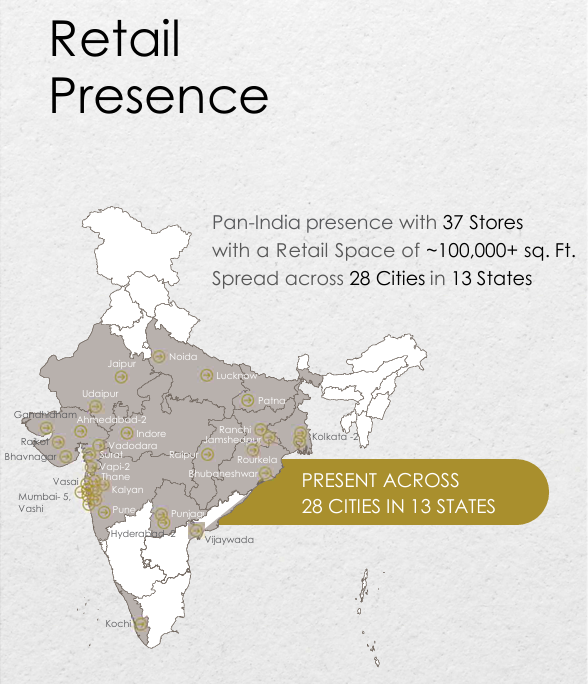
The company makes roughly 65% of its revenue from wedding and occasion-related jewellery purchases. It also claims several firsts in the Indian jewellery industry — from promoting lightweight precious jewellery and offering lifetime buyback on gold and diamond jewellery, to providing certified solitaire diamonds and introducing 100% BIS-hallmarked 22-karat gold jewellery.
And now, after more than 160 years in the business, the family is striking a deal with GRT Jewellers.
GRT has proposed to buy 74% of TBZ from the existing promoters in an all-cash deal worth ₹1,033 crore. And because that gives GRT a controlling stake, SEBI’s takeover regulations kick in. That means GRT must also make an open offer to the public shareholders, giving them an opportunity to sell their shares too.
Now, if you’ve noticed, we mentioned that TBZ has a stronghold in western India, while GRT has one in South India. And that, right away, gives us a clue as to why this acquisition is happening.
Because you see, despite being in the business for decades, scale seems to have been a real challenge for TBZ.
Sure, the brand may be recognised across India. But its actual expansion didn’t quite live up to its ambitions.
For context, when TBZ went public in 2012, it explicitly raised IPO money to fund an aggressive expansion plan. It wanted to have 57 showrooms within three years — roughly tripling its size at the time.
Except, that didn’t quite happen.
Fourteen years later, TBZ has just 37 stores. In other words, an IPO that was supposed to be the launchpad for national scale instead resulted in relatively modest expansion over the next decade and a half.
And there are a couple of reasons for that.
To begin with, jewellery retail is a very capital-intensive business. Every new store needs a large and expensive inventory of gold and diamonds before it can sell a single piece. So scaling nationally means replicating that capital requirement dozens of times over.
And since TBZ was largely funding its expansion through internal accruals and debt rather than large equity infusions, scaling up quickly wasn’t easy.
To make this easier to understand, compare that with Tanishq. Tanishq was able to scale the way we know it today partly because it had the Tata Group’s backing. That gave it the financial muscle to absorb years of losses while it built customer trust through innovations such as transparent purity testing, before eventually becoming profitable at scale.
Then there’s Kalyan Jewellers, which, by the way, is also a family business like TBZ. But Kalyan took a much more aggressive route to expansion. It became India’s first non-corporate backed jeweller to go pan India, backed first by private equity money and later by an IPO. It also deliberately localised its stores and designs to suit the needs of different regions.
That strategy helped Kalyan build a much wider national footprint. Today, about half of its revenue comes from outside its home South Indian market.
TBZ, on the other hand, didn’t take quite as aggressive an approach. And without the kind of financial backing that Tanishq or Kalyan had, expanding at the same pace was always going to be difficult.
But there was another problem too: working capital.
TBZ makes a large part of what it sells itself. It has a manufacturing facility that handles diamond jewellery production and gold refining, along with its own network of artisans and vendors, rather than simply buying finished jewellery wholesale.
And while it does have a partly asset-light model, with a mix of company-owned stores and franchise-owned, franchise-operated (FOFO) stores where the franchisees absorb the operating expenses, a lot of money still ends up getting tied up in inventory.
The problem was that TBZ’s inventory wasn’t selling quickly enough. And as gold prices rose, the inventory it needed to keep became more expensive too. So TBZ had to borrow more money simply to maintain enough gold inventory to run the business.
And you can see the impact on its balance sheet. According to ICRA, its leverage or the measure of how much the company relies on debt, rose from 1.4 times in 2024 to 1.9 times by 2025.
Now, that doesn’t mean the business itself is inherently bad.
Over the years, TBZ’s revenue has grown at a CAGR of 12% to ₹3,202 crore over the last five years. EBITDA has grown five times to ₹358 crore over the same period, while net profit has increased twelve fold to ₹200 crore.
But there’s an important catch. A lot of that growth has come from rising gold prices, because the actual sales volumes haven’t really gone up. In fact, gold sales volumes have fallen over the last three years, from 3,424 kg to 2,249 kg. Diamond volumes have also dropped, from 47,371 carats to 39,031 carats.
So the business is making more money, but it hasn’t necessarily been selling a lot more jewellery.
Which brings us to the earlier question we asked: Could an acquisition finally help TBZ become the pan India brand it once aspired to be?
Well, there’s a slight chance.
For starters, look at the geographical fit. GRT’s stronghold is in South India, while TBZ gives it access to western India, along with a few stores peppered across other parts of the country. So overnight, GRT does get a much broader retail footprint.
There’s also another interesting factor. GRT’s southern business is skewed heavily towards plain gold jewellery, which tends to have lower margins. TBZ, on the other hand, has a stronger hold in wedding jewellery, diamonds and design-led products. Getting access to that higher-margin business could give GRT another avenue for growth.
But the real challenge, of course, is acceptance. TBZ’s store network may give GRT the distribution it needs. But you’d agree when we say that jewellery is deeply local. Wedding customs, preferences for gold versus diamonds, designs people like, and even the relationship customers have with their jeweller can vary sharply from one region to another. So GRT can’t simply take the playbook that worked in South India and plug it into TBZ’s stores and expect the same results.
So yeah, whether it can actually turn TBZ into a genuinely pan India jewellery business is something we’ll have to wait and see.
Until then…
If you liked this Markets Edition, don’t forget to share it with your friends, family, colleagues, or even strangers on WhatsApp, LinkedIn, or X.
Also, if you’re someone who loves keeping tabs on the world of business and finance, hit subscribe if you haven’t already. And if you’re already a subscriber, thank you! Maybe forward this to someone who’d enjoy our stories but hasn’t discovered us yet.