
Can LT Foods become a global FMCG company?

In today’s Finshots Markets, we talk about how LT Foods, the parent company of rice brands like Daawat and Royal, is expanding its footprint to become a global FMCG company.
But here’s a quick sidenote before we begin. If you’re someone who loves keeping tabs on the world of business and finance, hit subscribe if you haven’t already. If you’re already a subscriber, thank you! Maybe forward this newsletter to someone who’d enjoy our stories but hasn’t discovered us yet.
Now onto today’s story.
The Story
For decades, LT Foods built its business on a model that looks simple on the surface but is actually quite complex in practice.
It buys paddy, ages it for over a year, and then sells premium basmati rice under brands like Daawat in India and Royal in the US and Canada. And that model has worked exceptionally well. The company today commands roughly 55% market share in the US basmati segment. Its Royal brand alone has grown from $35 million in revenue in 2007 into a $400 million business today.
But beneath all this success lies an important structural constraint.
The rice business, in general, is capital-intensive and slow-moving. Because it needs to be aged for at least 12 to 24 months to achieve the aroma and quality that premium consumers expect, it locks up a lot of working capital. That means inventory just sits on the balance sheet for a year or two without generating revenue. Sure, revenues may grow steadily, but cash flows often lag because money is tied up in this long inventory cycle.
There is also exposure to agricultural volatility. Because Basmati prices primarily depend on the Southwest monsoons from June to October, and the crop is vulnerable to unpredictable weather disruptions during critical stages, which affects profitability.
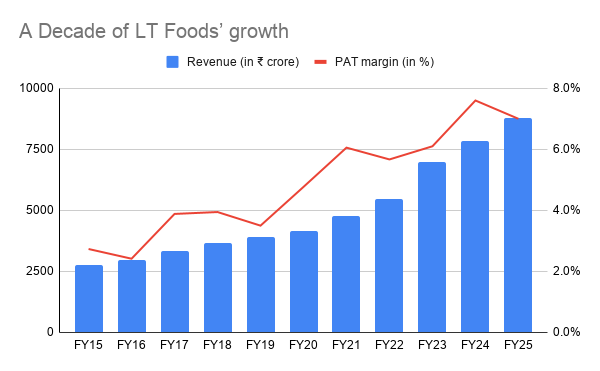
For instance, shifting climate patterns can result in sudden, unseasonal heavy rainfall and flooding, which damage crops, reduce yields, and ultimately drive price volatility.
And this combination of long cash cycles and external dependence is exactly what LT Foods is now trying to fix.
So, the company is gradually shifting toward higher-margin, faster-moving categories such as organic foods, ready-to-heat meals, and convenience products. These segments do not require long ageing cycles, so inventory turns faster. And perhaps more importantly, they align with evolving consumption patterns, especially in international markets where consumers increasingly prefer convenience.
As incomes rise, food habits tend to shift in predictable ways. Consumers are moving away from time-intensive home cooking toward convenience, packaged, ready-to-eat meals. This pattern is already well established in the US, which is the largest market for ready-to-cook and fast-food products globally.
And India is beginning to follow a similar trajectory. With more dual-income households, urban migration, and a growing population of young professionals living alone, the demand for quick, hassle-free meals is steadily rising. For many, cooking is no longer a daily routine but a trade-off, and the convenience of packaged, healthy food is winning out.
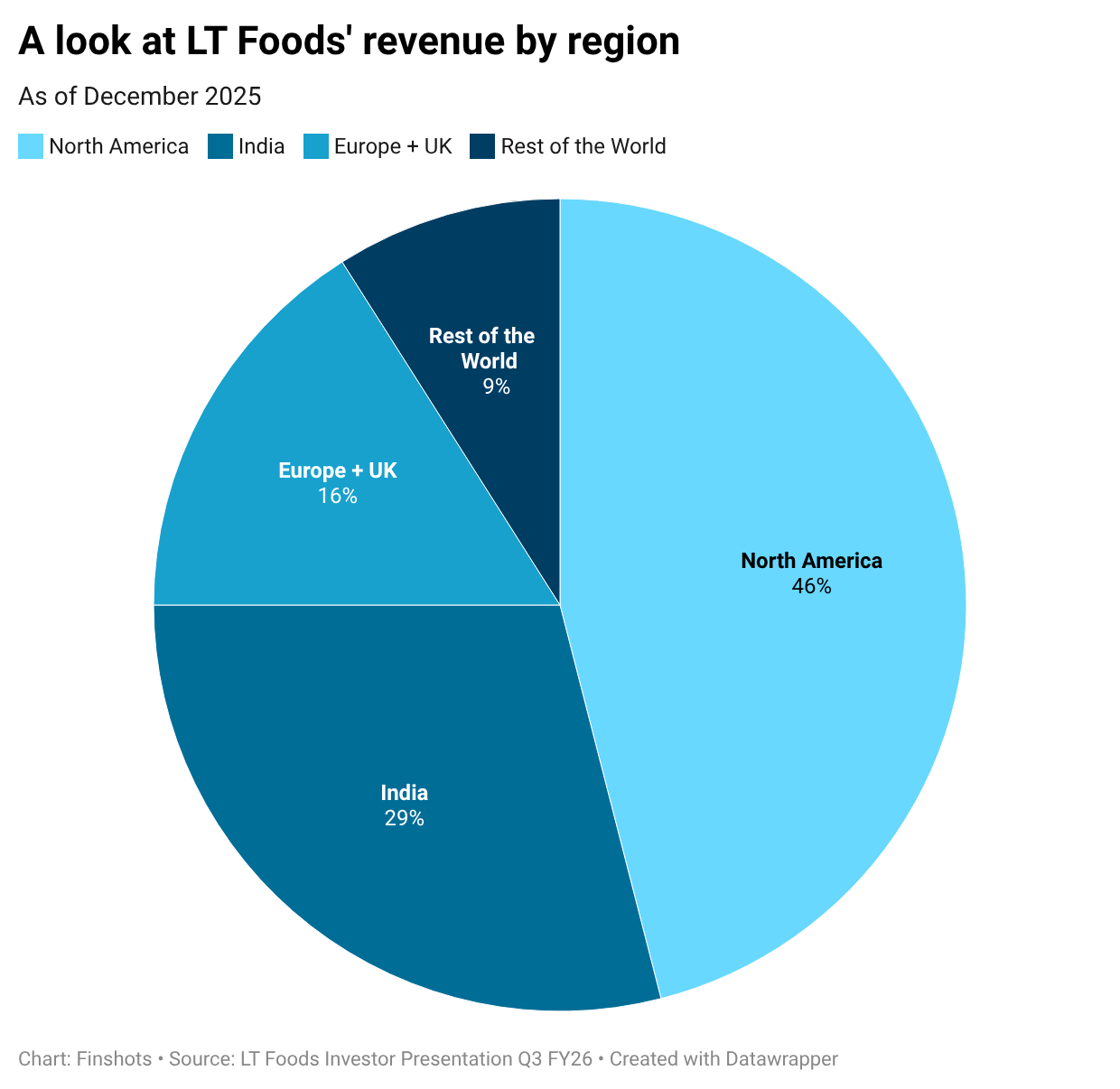
This shift is particularly relevant because North America already accounts for 46% of LT Foods’ revenue. It is where premium basmati has scaled successfully, but it is also where future growth is expected to come from convenience and branded food products.
So, the logic behind the pivot is clear.
But the transition is not as straightforward as one would think. Moving from a commodity-linked business to a branded FMCG-style company requires a whole other playbook.
Because, you see, selling rice relies heavily on supply chain efficiency and brand familiarity within a defined category. However, selling ready-to-eat meals requires building new consumption habits. It demands deeper distribution networks, sustained marketing, and consistent product innovation.
In markets like the United States, this means competing with well-entrenched players. Companies such as McCormick, along with large retailers like Costco, already have strong brand recall, shelf space, and pricing power. Entering this space is less about product availability and more about consistently winning consumer attention.
At the same time, LT Foods is not starting from zero. It has already demonstrated its ability to build and scale brands in international markets. The Royal brand in the US is a strong example of that capability. The company has also expanded its portfolio through acquisitions such as Golden Star and 817 Elephant, which hold leading positions in North America.
The ready-to-heat business in the US is also growing, generating around $14 million (₹130 crore) in revenue and expanding at approximately 25% year-on-year. To support this demand, LT Foods is investing $36 million (₹340 crore) to expand its Ready-to-Cook and Ready-to-Heat (RTC/RTH) facilities in the US, which is expected to add capacity of around 15 million pouches annually by FY27. This expansion alone could translate into an additional $20 million in revenue every year.
Apart from this, the company is also expanding its retail footprint. For instance, its Royal Biryani Kits (a pre assembled kit that makes biryani in 30 minutes) are now available in more than 2,400 Loblaws stores in Canada, indicating growing acceptance of its convenience offerings.
However, the shift is not just about execution. External risks also shape it.
One of the most important is geopolitics. With nearly half of its revenue coming from North America, LT Foods remains exposed to trade policies and tariff changes. The company has previously navigated such challenges. When the US imposed a 50% tariff on basmati rice, LT Foods was able to pass on a significant portion of the cost to consumers through price increases of about 20-25%, supported by the premium positioning of its products.
But tariffs do not only affect pricing. They can influence demand, alter competitive dynamics, and disrupt supply chains. A change in trade policy can quickly shift the economics of exports, especially in categories where competition from countries like Pakistan exists.
Recent tariff adjustments of 10% base have, in fact, worked in LT Foods’ favour by restoring competitive parity and improving margins. But relying on favourable policy is not a long-term strategy, especially when it could be changing every few weeks (IYKYK). This is why the company is increasingly focusing on localising operations, strengthening distribution in the US, and building brands that are less sensitive to price fluctuations.
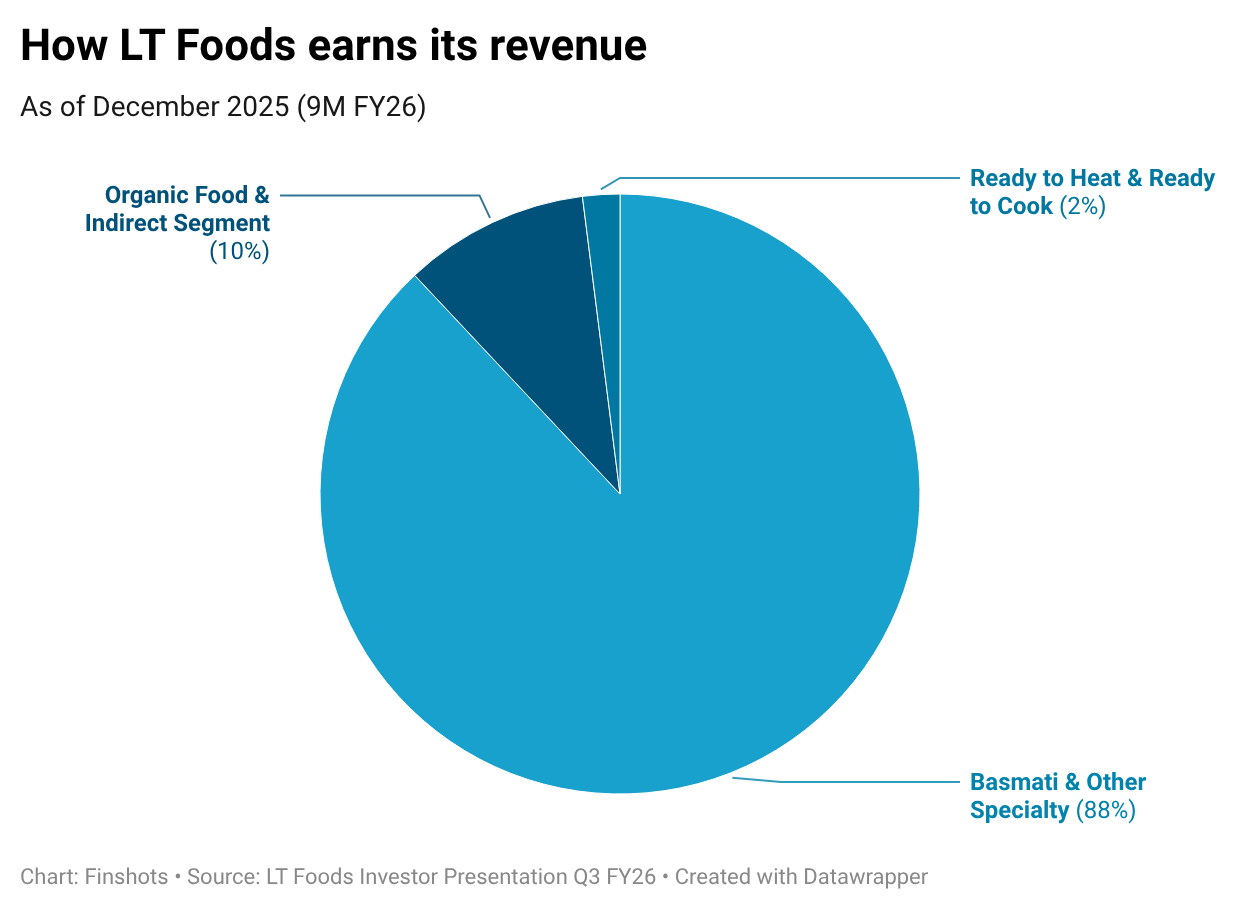
There is also a structural challenge in managing the transition itself. The legacy basmati business, despite its limitations, still generates about 88% of the company’s revenue and provides the financial base required to invest in new categories. At the same time, the new business segments require capital, attention, and time to scale.
Balancing these two is not easy because moving too quickly away from basmati could strain cash flows. Moving too slowly could mean missing the opportunity to establish a foothold in higher-margin categories. What LT Foods is attempting, therefore, is not just diversification. It is a gradual shift in identity.
We can say the company is trying to move from being just a rice exporter to becoming a global food brand. That transition aims to address its core structural challenges:
- long inventory cycles,
- high working capital intensity, and
- dependence on a single product category.
If the strategy works, LT Foods could emerge with a more balanced business model. Faster inventory turns, higher margins, and a broader product portfolio could make earnings more predictable and less dependent on agricultural cycles.
But before we jump to conclusions, there is a strong case for why this transition could actually work. LT Foods isn’t starting from scratch. It already operates in over 80 countries with a diverse distribution network. Brands like Royal, 817 Elephant, and Golden Star give it the brand value and pricing power, something it demonstrated when it passed on tariff-led cost increases in the US without a meaningful hit to volumes. Add to this its early push into ready-to-heat meals, organic foods, and international B2C markets, and the building blocks of a global FMCG company are clearly in place.
But the reality is that the transition is still in its early stages, contributing to only around 2% of the company’s revenue. And despite healthy topline growth, profit growth has been far more muted, suggesting that the benefits of this shift have yet to fully materialise. So while LT Foods has the ingredients to become a global food brand, whether it actually gets there will depend entirely on how well it executes this pivot over the next few years.
Until then…
Liked this story? Share it with a friend, family member or even strangers on WhatsApp, LinkedIn, or X.
A leading insurer is revising its health insurance premiums!
Policies issued after April 28th, 2026 (midnight) will reflect the updated premiums.
If you've already generated a quote, the premium may change once the revision comes into effect.
So, book a free call with Ditto to understand your options.