
Why short selling may be good for investors
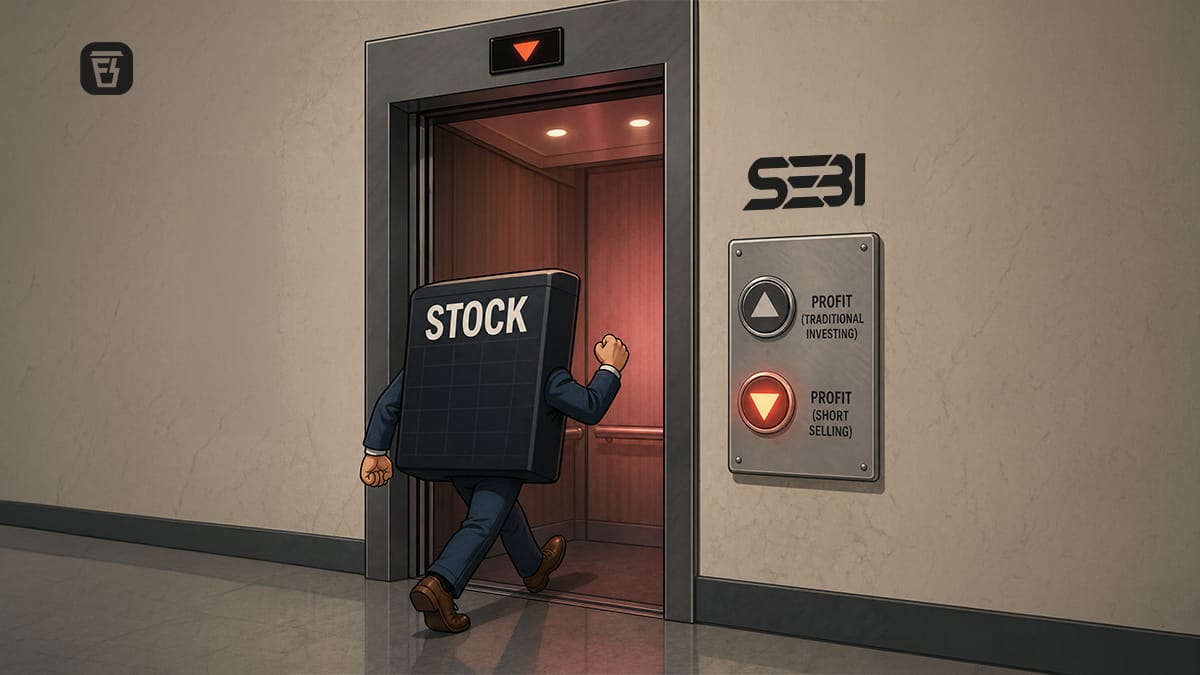
In today’s Finshots, we explain why SEBI is planning to make short selling easier in Indian markets.
The Story
Short sellers are like smoke detectors. Most people only appreciate them after something has gone terribly wrong.
That’s because they’re usually the first to point out when something isn’t right. Maybe a company’s finances don’t add up. Maybe its valuation has become absurd. Or maybe investors have simply become too optimistic. By betting against stocks, short sellers force markets to confront uncomfortable questions long before everyone else does.
And for decades, India has kept short sellers on a pretty short leash. However, according to a recent report, SEBI may finally be loosening the rules. According to a report, SEBI is considering doubling the number of stocks eligible for short selling, along with making it easy for investors to short stocks.
Which is a little surprising. After all, why would any regulator make it easier for people to bet against companies? Wouldn’t that simply invite more speculation, panic and market crashes?
Well, not necessarily.
In fact, many market veterans argue that restricting short sellers can create a very different problem. When everyone can easily bet that prices will rise, but very few can conveniently bet they’ll fall, markets can become one-sided. Optimism faces little resistance. And prices don’t always reflect reality.
That’s exactly the point Zerodha* founder Nithin Kamath made last year. He argued that India’s market has become tilted toward long-only investing. That’s not because investors don’t hold negative views, but because expressing those views through short selling remains cumbersome.
Economists call this price discovery: the process by which markets figure out what a stock is truly worth. That only works when both optimistic and pessimistic views can compete on equal footing. If one side is much harder to express than the other, prices can drift away from reality.
To understand why, it helps to know how short selling actually works.
Imagine you believe shares of Company X, currently trading at ₹1,000, are wildly overpriced. If you simply avoid buying the stock, you don’t make any money if you’re right. So instead, you borrow one share from another investor and immediately sell it in the market for ₹1,000.
A few weeks later, suppose the stock falls to ₹800. You buy back the same share for ₹800 and return it to the original owner. You pocket the ₹200 difference (minus borrowing costs and other charges). That’s short selling in its simplest form.
Of course, there’s a catch. If the stock rises instead of falling, you still have to buy it back to return the borrowed share. Except now you’re buying it at a higher price. Unlike a regular investor, whose maximum loss is limited to the money invested, a short seller’s losses can theoretically keep growing as the stock price climbs.
So if short sellers help markets function better, why has India never fully embraced them?
Part of the answer lies in history.
During the 2008 global financial crisis, governments across the world temporarily banned or restricted short selling, firm in their belief that it was accelerating the collapse of stocks. Regulators feared that bearish bets could turn panic into a full-blown crash.
Interestingly though, later studies found little evidence that these bans actually helped calm markets. But by then, the damage to short sellers’ reputation was already done.
However, India wasn’t exactly eager to roll out the red carpet either.
Sure, short selling was eventually allowed but it came with plenty of caveats:
First, you had to find someone willing to lend you the shares. Then hope that the stock was even eligible under the Securities Lending and Borrowing (SLB) mechanism. And, of course, you’d have to pay for the privilege of borrowing those shares in the first place.
In other words, betting for a stock was easy. Betting against one came with a lot more homework.
So what did traders do instead?
Well, if they believed a stock was going to fall, they simply took a different route. One that was faster, simpler and already sitting right in front of them — F&O (futures and options).
Traders could either sell call options or buy put options.
Selling a call option is essentially a bet that a stock won’t rise much. If the price stays below a certain level, the seller pockets the premium. Buying a put option, on the other hand, gives traders the right to sell a stock at a fixed price in the future, making it more valuable when the stock price falls. In both cases, traders can profit from falling prices without ever borrowing or selling the actual shares.
Today, India’s equity derivatives segment sees an average daily turnover of nearly ₹2.64 lakh crore, while the cash market records around ₹1.21 lakh crore. In other words, the easier route has become the busier one.
Of course, bigger participation didn’t necessarily translate into better outcomes.
Between FY22 and FY24, 93% of individual F&O traders lost money, collectively wiping out more than ₹1.8 lakh crore. In FY24 alone, over 91% of retail traders ended up in the red.
Now, to be clear, we’re not saying these losses happened because short selling in the cash market was difficult. Markets usually aren’t that simple.
But if betting against a stock in the cash market feels like navigating an obstacle course, it’s not surprising that many traders moved towards derivatives instead.
And that’s what makes SEBI’s step so interesting. It is considering doubling the number of stocks that can be borrowed through the Securities Lending and Borrowing (SLB) mechanism while also lowering collateral requirements. Today, only about 176 stocks are eligible. That’s barely a fraction of the thousands listed on Indian exchanges.
In simple terms, it’s trying to make short selling in the cash market less inconvenient. If approved, it would be one of the biggest attempts in years to revive cash-market short selling.
Which brings us to the irony. After spending years trying to cool speculative trading, why would it now make it easier to bet against stocks?
But maybe that’s looking at it the wrong way. Perhaps this isn’t about encouraging more speculation. It’s about giving traders a better alternative.
Because think about it from SEBI’s perspective. Over the last two years, the regulator has repeatedly tightened the screws on the derivatives market. It increased lot sizes. Reduced the number of weekly expiry contracts. Published study after study showing how retail investors were losing money.
But making one market less attractive doesn’t automatically make another one more useful.
If traders still don’t have a practical way to express a bearish view in the cash market, they’ll continue to move towards derivatives.
In other words, maybe SEBI has realised that fixing India’s derivatives problem isn’t just about discouraging speculation.
It’s about completing the cash market. After all, a market isn’t truly complete if it’s easy to bet on prices rising but unnecessarily difficult to bet on them falling.
So yeah, you could say that short sellers question popular narratives and challenge lofty valuations. Sure, sometimes they’re spectacularly wrong. But when they’re right, they help markets correct themselves before this overoptimism turns into a bubble.
Until next time…
*Zerodha through its fund Rainmatter, is an investor in Finshots.
If this story helped you understand the importance of short selling, share it with a friend, family member or even strangers on WhatsApp, LinkedIn and X.
And subscribe to Finshots, if you haven’t already. Plis!
How strong is your financial plan?
You've likely ticked off mutual funds, savings, and maybe even a side hustle. But if Life Insurance isn't a part of it, your financial pyramid isn't as secure as you think.
Life insurance is the crucial base that holds all your wealth together. It ensures that your family stays financially protected when something unpredictable happens.
If you’re unsure where to begin, Ditto's IRDAI-Certified insurance advisors can help. Book a FREE 30-minute consultation and get honest, unbiased advice. No spam, no pressure.