
Why is ration rice of such bad quality?
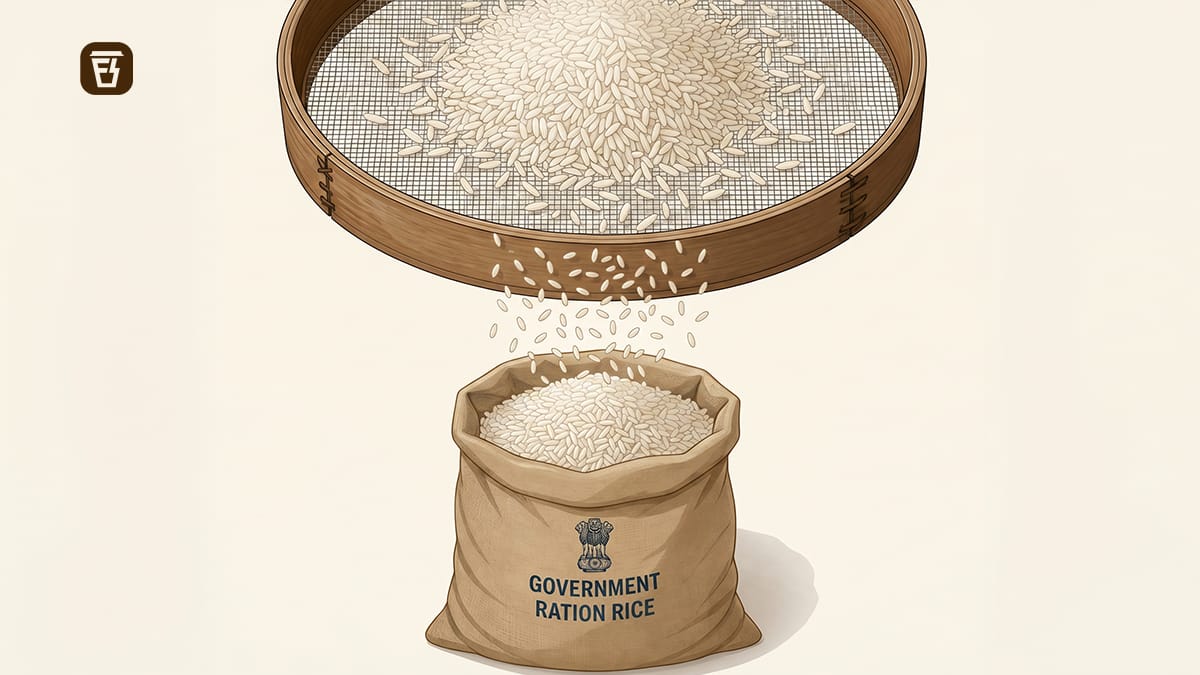
In today’s Finshots, we tell you how the government is trying to improve the quality of the foodgrains distributed through India’s Public Distribution System (PDS) and why that alone won’t be enough to fix the deeper problems within it.
But here’s a quick sidenote before we begin. We’re hosting a free 2-day Insurance Masterclass that helps you build real financial security by understanding health and life insurance the right way.
📅 Saturday, 18th July at 11:00 AM: Life Insurance
How to protect your family, choose the right cover amount, and understand what truly matters during a claim.
📅 Sunday, 19th July at 11:00 AM: Health Insurance
How hospitals process claims, common deductions, the mistakes buyers usually make, and how to choose a policy that won’t disappoint you when you need it most.
👉🏽 Click here to register while seats last.
Now onto today’s story.
The Story
In the small town where I live, mornings often begin with the sound of a woman cycling through the neighbourhood, calling out, “Phool, phool!” (Bengali or even Hindi for flowers). Let’s call her Nandini. Some days we buy flowers from her, and we’ve been doing that for a few years now. Naturally, we’ve gotten used to exchanging a bit of small talk every now and then.
Our local ration shop is also just ten steps from our home. So during the first week of every month, Nandini collects her share of rice and leaves it at our place. That way, she can finish her morning round of flower sales first and then pick up the rice on her way back home.
But over the years, I’ve often noticed that the rice doesn’t look particularly clean. Every now and then, there are a few uninvited insects crawling around in it. So one day, I asked her about its quality.
Her answer surprised me. She said that her family rarely consumes the rice that she gets from the ration shop. Instead, she takes it to a local rice dealer and exchanges it for better-quality rice. Of course, since the rice she wants is more expensive than the subsidised ration rice, she gets a smaller quantity in return. But, as she puts it, that’s still enough to reduce her family’s monthly food expenses.
Now, the story I just told you isn’t an isolated incident. It’s the reality for many underprivileged households across India. And while this practice is illegal, it is surprisingly common in many states, with ration shop dealers and rice traders often working in a nexus that profits from the vulnerabilities of people like Nandini.
And the reason we’re talking about this now is because, a few days ago, the government announced that it would improve the quality of rice distributed under the Pradhan Mantri Garib Kalyan Anna Yojana (PMGKAY) and other welfare schemes by reducing the amount of broken rice in it.
Broken rice is simply a byproduct of the rice milling process. And the more broken rice a batch contains, the cheaper it is. That’s why it helps keep procurement costs low for the government’s Public Distribution System (PDS).
Right now, the raw rice distributed under these schemes can contain up to 25% broken rice, while parboiled rice can have up to 16%. But from the Kharif Marketing Season 2027–28, which begins in October, the rice procured by the government will be allowed to contain only up to 10% broken rice in raw rice and 5% in parboiled rice.
That’s genuinely a welcome move because better-quality ration rice not only improves the diets of over 80 crore beneficiaries under PMGKAY alone, but also diverts the portion of broken rice that’s no longer included in PDS rice — about 8–9 million tonnes, towards ethanol production. And although diverting broken rice to ethanol remains a contentious issue (because of the obvious public backlash), all of this could save the government around ₹2,161 crore.
But here’s the thing. This is only one piece of the puzzle.
Reducing the amount of broken rice by itself, doesn’t address the deeper problems within the PDS that may be compromising the quality of food that crores of underprivileged Indians rely on every day. Nor does it address the leakages and inefficiencies that could be wasting taxpayer money along the way.
Just look at how foodgrains are stored and handled in FCI (Food Corporation of India) warehouses. On paper, WDRA (Warehousing Development and Regulatory Authority) and FSSAI (Food Safety and Standards Authority of India) guidelines require these foodgrains to be stored in clean premises, away from dirt, waste, weeds and grassy areas. Warehouses must be cleaned regularly and treated for pests. Sounds like the bare minimum, right?
But a 2022 CAG audit of 18 FCI warehouses in Karnataka painted a very different picture. More than half the warehouses weren’t clean or cleaned regularly and lacked proper pest control. Grains were stored in poorly maintained facilities, some were simply kept on the floor, stray animals roamed around the stocks, ventilation and fire safety were inadequate, and nearly 74% of sanctioned staff positions were lying vacant.
The problems don’t stop there. Damaged warehouses often remained unrepaired for up to two years. That meant foodgrains either deteriorated or had to be shifted to hired godowns. And there are numbers to back this up. FCI’s own storage capacity was utilised at just about 61%, while hired warehouses operated at around 85%. That pushes up storage costs, forces the FCI to seek higher subsidies from the government and ultimately uses taxpayer money that could have otherwise gone towards public infrastructure, healthcare or education.
Besides, the losses aren’t small. Another CAG report on the FCI’s storage and movement of foodgrains estimated losses of over ₹975 crore between 2018 and 2022 due to poor storage alone, apart from the harder-to-measure impact on food safety and quality for beneficiaries.
Transportation is another major issue. According to the Karnataka audit, grain isn’t always moved through the cheapest or most efficient routes. The department didn’t always source grain from the nearest depot, and even allowed unauthorised vehicles and overloaded trucks to transport foodgrains. GPS tracking was also missing, making it impossible to monitor consignments in real time. That, in turn, increases the risk of diversion and black marketing.
Now, you’d think this is bad news. And it is, for you and me. But not necessarily for the nexus of ration shop dealers, rice traders and millers who, in many places, profit from a broken system.
To explain what we mean, let’s circle back to Nandini. If the rice supplied through the PDS is of poor quality, people like her naturally look for alternatives. That’s where this nexus steps in. In Telangana, for instance, investigations found that some rice dealers and ration shop operators persuaded beneficiaries to sell their free ration rice back to them for around ₹6 a kilo in exchange for better-quality rice. The dealers then diverted that rice to roadside eateries or poultry farms at much higher prices. In some cases, unclaimed rice bags were also sold back to the FCI for as much as ₹20 a kilo with the help of manipulated records and corrupt officials.
When you connect all these dots, you see a clear pattern: while the government is trying to improve the quality of rice under the PDS, central audit reports suggest that large parts of the storage, transportation and distribution system continue to fall short of basic food safety and storage standards.
And unless those root problems are fixed, simply improving the quality of the rice being procured can only go so far.
So yeah, if the government truly wants to improve the quality of food reaching crores of Indians, it means investing faster in modern silos and scientific storage, fixing transportation bottlenecks, plugging leakages with technology while ensuring genuine beneficiaries aren’t left out because of authentication failures, and, most importantly, holding officials and everyone involved in diversion accountable.
Because unless the entire chain from procurement to the beneficiary’s plate is fixed, people like Nandini will continue to find ways around a system that was meant to help them in the first place.
Until then…
If this story helped you understand the issues crawling around India’s Public Distribution System (PDS) like pests in a warehouse, share it with someone who should read it, or even with random strangers on WhatsApp, LinkedIn, and X.
And if you’re someone who loves keeping tabs on the world of business and finance, hit subscribe if you haven’t already. And if you’re already a subscriber, thank you! Maybe forward this to someone who’d enjoy our stories but hasn’t discovered us yet.