
Why India’s Competition law has Apple on edge
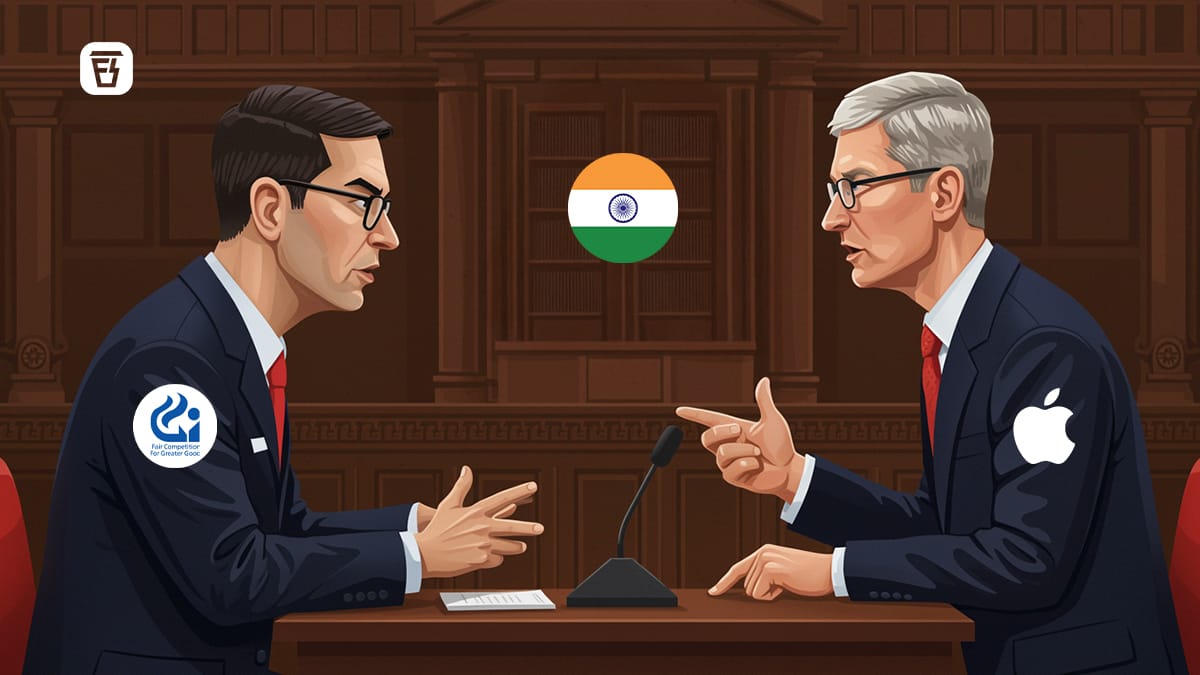
In today’s Finshots, we break down why Apple is suddenly sweating over the Competition Commission of India’s (CCI’s) new penalty rules, and why it has taken the regulator to court.
But here’s a quick sidenote before we begin. Insurance actually matters only in one moment — when your family needs to make a claim. Most people never hear real claim stories until it’s too late.
But choosing the right plan is just as important. Many people buy policies that don’t fit their needs, miss key features, or overlook small details that cause trouble later.
So this weekend, we’re hosting a free 2-day Insurance Masterclass built around real cases we’ve handled and simple rules for shortlisting the right plan.
📅 Saturday, 6 Dec ⏰at 10 AM: Life Insurance
How to protect your family, choose the right cover amount, and understand what truly matters during a life claim.
📅 Sunday, 7 Dec ⏰at 10 AM: Health Insurance
How hospitals process claims, common deductions, the mistakes buyers usually make, and how to choose a policy that won’t disappoint you when you need it most.
👉🏽 Click here to register while seats last.
Now, on to today’s story.
The Story
If you noted the biggest antitrust penalties ever imposed worldwide, the US and European Union (EU) would dominate the list. Some of the biggest penalties imposed have been by their anti-trust courts, like the EU’s €2.95 billion fine on Google for abusive practices in online advertising technology, or the landmark $2.5 billion settlement by Amazon over Prime subscriptions.
Historically, India hasn’t appeared on that list — at least not publicly. For a long time, anti-trust or competition laws in the US and EU have been iron-clad, and that keeps companies in check.
That’s why when firms get fined there, the penalties climb into the billions. Follow the law and you operate freely. Breach it and you bleed money in settlements and penalties.
But that opened up one grey area: operating in countries with weaker competition laws while evading scrutiny back home. For a long time, companies enjoyed this grey area, breaking rules in smaller markets without worrying that it would dent their bottom line. Until now.
Apple became the first multinational company to publicly challenge India’s revamped Competition law penalty. One of the biggest names in tech locked horns with the Competition Commission of India, and it sounds strange until you hear the details.
It started back in late 2021, when a complaint from a group of Indian startups called the Alliance of Digital India Foundation and later Tinder-owned Match went to the CCI over Apple’s App store rules. On the surface, in-app payments seem simple. You buy a subscription or a one-time upgrade, and the developer gets paid. But Apple took a flat 30% commission on every transaction and required developers to use its own billing system.
That made everything expensive for both developers and end users. According to the group, it hurt competition and became a solid entry barrier. Some big names have fought Apple over this in the past as well, including Fortnite.
Then came the turning point in 2024, when the CCI put its new law into operation: Determination of turnover or income. Under this, penalties could be calculated based on the global turnover of the company. That’s great news for Indian consumers because it means tech giants would play by the rules and penalties wouldn’t just be the ‘cost of doing business’. The updated Competition Act was published in April 2023 but took effect the following year.
Of course, Apple is fighting back because the amended law exposes the company to far higher penalties than before, and it has taken the matter to the Delhi High Court. The CCI, for its part, has accused Apple of trying to stall the antitrust proceedings.
But what has Apple truly on edge isn’t a single dispute over a 30% commission. Under the new framework, the potential penalty could theoretically be up to 10% of its global revenue or roughly $38 billion across the last three fiscal years. Suddenly, even a case arising from India — a relatively small market for Apple (at least when compared to China and the US), carries the threat of a multibillion-dollar fine.
Regulators like CCI exist to keep markets fair and stop any one company from becoming a monopoly with predatory practices. Even then, when companies do play unfairly, penalties curb bad behaviour and put a number to the price of their actions. Each case sends a message: Play fair or pay fines.
Here’s the catch though. India wasn’t imposing fines as heavily as regulators across the globe. That’s why foreign companies are now worried.
Before, penalties were tied only to their smaller India operations and revenue. How does that work?
Say you’re driving through traffic and get pulled over by the traffic police for jumping a signal or not wearing your seatbelt. Whether the car you’re sitting in is a small Maruti or Hyundai or an imported Rolls Royce, the fine is the same and it’s only for the penalty you committed then and there. A billionaire wouldn’t feel the same pinch as a college student or regular office-goer. Translation: the punishment didn’t match the violator’s wallet.
This meant that big companies could break the rules here in India and be held accountable for a small, manageable cost.
Now imagine the rules changed and your fine is 10% of your annual income. Now, the billionaire has as much, if not more, to lose than the college student.
This is exactly what the Competition Amendment Act’s penalty would now work like. The penalty isn’t proportional to its local revenue, but to its global turnover and scale of the company that’s breaking the rules. From this shift, India has become a jurisdiction where penalties aren’t as simple as tax write-offs and can actually start impacting quarterly filings and global annual reports.
Naturally, companies are afraid of this for a number of reasons. It increases compliance costs and paperwork, their risk and, most importantly, reduces their ability to absorb any impact as just another expense.
But wait, how did we get here and where did it all start?
To understand why India rewrote its penalty rules, we need to go back to a courtroom in 2017. It was a case that most people hadn’t heard of, related to pesticide tablets, and a few companies that thought they were being clever. It was called the Excel Crop Care case, and it set the stage for everything happening with Apple in India today.
Back in 2011, the Food Corporation of India (FCI) accused four companies — Excel Crop Care, United Phosphorous Ltd (UPL), Sandhya Organics Chemicals and Agrosynth Chemicals of bid-rigging and cartelisation.
These companies were manufacturing something called aluminium phosphide tablets (APT) and supplying it to the FCI. Going by their names, you’d think they were four different companies but in reality, they moved as a pack, quoting similar prices, backing out of tenders altogether. The CCI investigated this, and slapped a penalty on all of them.
That’s where things got interesting. The CCI didn’t just look at what these companies earned from their APT business. Instead, it went after a percentage of their entire turnover.
Take Excel Crop Care, for instance. Its average three-year turnover was about ₹710 crore, so the penalty came to ₹63 crore. But here’s the twist. The turnover from its APT business was only around ₹32 crore. UPL faced a similar fate. Its overall turnover stood at roughly ₹2,804 crore, but its APT revenue was barely ₹77 crore. Yet the CCI slapped a penalty of ₹252.44 crore.
The punishment had ballooned far beyond the scale of the wrongdoing. This form of penalty is similar to penalising a supermarket with the sales of the whole chain, because they overcharged on selling one item. The case made it to the Supreme Court which ruled that fines and penalties cannot be shocking or disproportionate to the actual revenues. Going by this logic, Excel Crop Care’s penalty dropped from ₹63 crore to just ₹2.9 crore, and UPL’s from ₹252 crore to ₹6.9 crore.
That judgment exposed the loophole. For conglomerates and multinationals with multiple product lines, penalties tied only to the relevant turnover could become too small to matter. Even when violations were proven, the financial hit could be insignificant. That case set the ball rolling for the reform that finally arrived in 2023.
Ironically, when the Supreme Court restored the idea of relevant turnover, India actually moved away from global practice. But the European Union — one of the world’s strictest regulators — uses turnover-based antitrust fines (up to 10% of global turnover) to force behavioural change.
So while this might feel new in India, the EU and US have followed such models for years.
But the goal was never simply to impose heavier penalties or make businesses feel the sting. It was to ensure companies played fair — both with consumers and within the industry. India is now a major market with millions of customers. The old rules weren’t built for an economy of this size, which meant reform was less a question of “if” and more of “when”.
Whether Apple wins its legal battle remains to be seen. But until then… India’s message is simple: If you want to build here, you have to play fair.
If this story helped you make sense of India's Competition law, share it with a friend, family member or even strangers on WhatsApp, LinkedIn and X.
Last few days left to register for Finshots Idea Lab Season 2!🥳
Students, this is your chance to bag ₹2.25 lakh in cash, pre-placement interviews, cool goodies, and serious bragging rights.

Click here to apply. You don’t want to miss this!