
Can tyre makers keep rising costs from puncturing their profits?
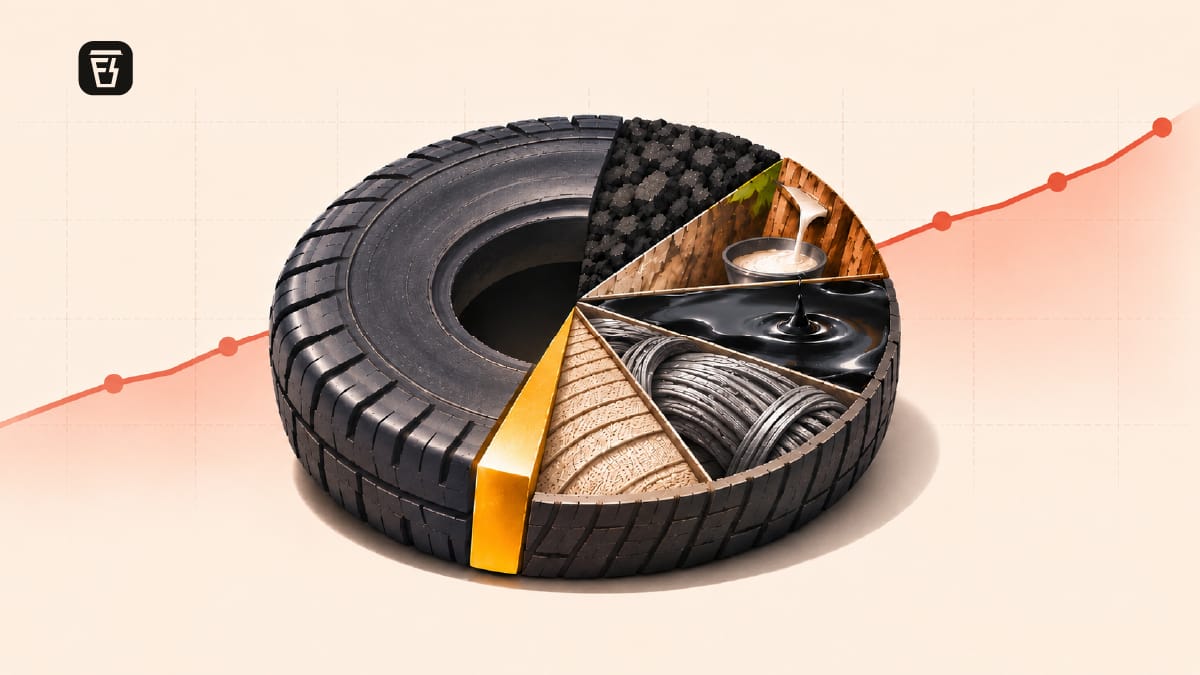
Tyre prices have been rising for a while now, thanks to the surge in crude oil prices and increasing rubber costs. So in today’s Finshots, we give you an overview of India’s tyre sector and how they’re holding up amidst all the chaos.
But here’s a quick sidenote before we begin. You read Finshots to understand financial and economic updates better than most people. But when it comes to insurance, even the most financially aware people are winging it.
Knowing about insurance and knowing what you actually need are two very different things. Our 2-day Insurance Masterclass closes that gap.
📅 Saturday, 14th November at 11:00 AM: Life Insurance
📅 Sunday, 15th November at 11:00 AM: Health Insurance
👉🏽 Click here to save your spot.
Now, onto today’s story.
The Story
Last month, Ceat announced its latest quarterly results. And if you looked only at its revenue growth, the numbers looked fantastic. It made ₹4,762 crore, which is 26% higher year on year (YoY) and also its highest ever quarterly revenue. In terms of volumes, it sold 10% more tyres than it did last year.
But all that growth didn’t translate into better profits.
For context, its consolidated EBITDA margins dropped from 13.5% to 9.5% YoY, while net profits fell by 40% to ₹112 crore in Q2FY27. Similarly, if you look at the half yearly figures, revenues grew by 24% YoY to ₹9,080 crore, but EBITDA and net profit margins fell by 3.2 and 2.8 percentage points, respectively, to 9.1% and 1.3%.
And this isn’t just a Ceat problem. It’s pretty much the story across India’s listed tyre and rubber products industry. The other big players in the space, MRF, Balkrishna Industries, Apollo Tyres and JK Tyre, have all reported rising sales, both QoQ (quarter on quarter) and YoY. But their EBITDA and net profit margins have been falling.
To understand why, let’s first look at how the tyre business works. India’s tyre industry has an estimated annual turnover of about ₹1 lakh crore. And companies earn this money through three main markets.
The first is the OEM (Original Equipment Manufacturer) market. Here, tyre companies supply tyres directly to vehicle manufacturers such as Maruti Suzuki, Tata Motors, Mahindra, etc. Since these orders come in bulk, sales volumes are usually large. But profit margins can be thin because a handful of big automakers have considerable bargaining power and can negotiate lower prices.
Then there’s the replacement market. This is where tyre companies sell tyres to dealers and distributors, who then sell them to vehicle owners looking to replace worn out or damaged tyres.
In fact, this is the core of the tyre business. According to ratings agency ICRA, the replacement market accounts for nearly two-thirds of India’s tyre market. And it tends to be more profitable too because replacement tyre prices can be 20–50% higher than OEM prices, leaving companies with better margins even after accounting for dealer costs.
There’s another advantage here. Unlike the OEM market, where a few large vehicle manufacturers negotiate prices, replacement buyers are spread across thousands of dealers and customers. Strong brand loyalty and an established dealer network also make it harder for new players to enter the market. And demand tends to be steady because every vehicle on the road will eventually need new tyres.
Finally, there’s the export market. More than 25% of the tyres produced in India are exported to other countries. The US is still the largest single export market, accounting for 15% of India’s tyre exports by value, or ₹4,082 crore. But its share has fallen from 17% earlier because demand in the US, especially in the replacement segment, has weakened after the country imposed higher tariffs.
But right now, demand or sales are hardly an issue. For context, FY26 was a record year for the Indian automobile industry. Passenger vehicles, commercial vehicles, three-wheelers and two-wheelers all recorded their highest ever annual domestic sales. And when more vehicles are being sold, the demand for tyres naturally goes up. Even tyre exports hit an all time high of ₹27,312 crore. Which means tyre companies have had plenty of business coming their way.
The problem, as we mentioned earlier, is that they’re not making enough money from all these sales.
The reason?
Rising input costs.
You see, a tyre is made using several raw materials, but rubber is the most important one. There are two kinds of rubber used in tyres: natural and synthetic. Natural rubber comes from trees, mainly grown in Kerala in India. Synthetic rubber, on the other hand, is made using crude oil. Then there’s carbon black, a material produced by burning crude oil at a particular temperature. It gives tyres their black colour and makes them stronger. Steel provides the structure and strength, while oils and chemicals help bring all these materials together.
And if you’ve noticed, crude oil is the common link in a lot of these materials. In fact, the Automotive Tyre Manufacturers’ Association (ATMA), the industry body representing tyre makers, estimates that oil based materials account for 60–70% of a tyre’s raw material costs.
Even if you think, hey, natural rubber isn’t made from oil, its price still follows oil. That’s because when crude oil becomes expensive, synthetic rubber becomes costlier too. So manufacturers around the world start switching to natural rubber as a cheaper alternative. This increases demand for natural rubber and pushes its prices up as well. Which is why when crude oil prices rise, the cost of making tyres can go up even if you’re using natural rubber.
And India has another problem on top of this. Our tyre makers use a lot more natural rubber than most of their global counterparts. About 60% of the rubber they use is natural rubber, while synthetic rubber accounts for around 60% of rubber use globally.
But India doesn’t produce enough natural rubber to meet this demand. In FY26, the country produced 9.05 lakh tonnes against a requirement of 14.27 lakh tonnes. The shortfall is met through imports from countries such as Indonesia, Vietnam and Thailand. And imports, as you know, are paid for in dollars. So when the rupee depreciates against the dollar, these imports become more expensive even if global rubber prices haven’t changed.
Now, in 2026, many of these problems hit the industry all at the same time. The West Asia conflict pushed crude oil prices above $100 a barrel and disrupted shipping routes, increasing freight costs. Natural rubber prices climbed to around ₹300 per kg, about 58% higher than in December last year, as the domestic shortage worsened. On top of that, prices of other key raw materials rose by an average of 35–40%.
And all of this directly eats into tyre makers’ profits. That’s because raw materials account for roughly two-thirds of their total production costs. For instance, MRF’s raw material costs rose to 75% of its sales in Q2FY27, compared to 63% in the same quarter last year.
Sure, companies can pass these higher costs on to buyers by simply increasing tyre prices. But it’s not quite that easy.
For starters, tyre companies can’t always increase prices immediately when selling to OEMs. That’s because prices are often negotiated through contracts that use raw material price indices as benchmarks. These contracts also specify when and how prices can be revised based on changes in those indices. So even if rubber or crude oil prices rise today, a tyre company may have to wait until the next scheduled price revision before it can charge an OEM more.
In the replacement market, companies can increase prices faster. But the catch here is that if one company raises prices sharply while its competitors don’t, customers could simply switch to cheaper alternatives.
And even if all companies increase prices around the same time, it could hurt demand. In fact, that’s something we’re beginning to see. Some large buyers of replacement tyres, such as fleet operators, are choosing to retread their old tyres instead of buying new ones. Retreading simply means refurbishing and reusing a worn out tyre by adding a fresh layer of rubber to its surface.
So tyre makers are in a bit of a bind. They need to raise prices to protect their margins, but they can’t do it too quickly without risking a loss of customers. Which means they have to increase prices gradually and absorb at least some of the higher input costs in the meantime.
Which brings us back to the puzzle we started with. Despite selling more tyres and generating higher revenues, companies are seeing their profits take a hit.
For instance, JK Tyre’s EBITDA margin fell to 6.9% in the first half of FY27 from around 12.1% during the same period a year earlier. MRF’s margin dropped to about 13% from 15%. Even Balkrishna Industries, the most profitable among the five leading listed players, saw its margin fall by more than 3 percentage points to 19.4%. All in all, CRISIL estimates that industry margins could fall to around 12% this year.
So how does the industry deal with all this, you ask?
Well, one way is to keep raising prices gradually. And even when rubber and crude oil prices eventually come down, companies don’t necessarily reduce tyre prices immediately. So the price increases they’ve already passed on to customers tend to stay in place even as their input costs start normalising. This gives companies some breathing room and helps their margins recover after a few difficult quarters.
Another way to protect profits is to sell more premium products. For instance, companies can push sales of premium SUV tyres, fleet services and replacement tyres. These products and services generally command better prices, giving companies more room to absorb increases in rubber and other raw material costs.
Companies can also prepare for sudden cost increases by keeping a few extra days’ worth of imported raw materials in stock. They could even hedge against currency fluctuations to protect themselves from a falling rupee. So when prices suddenly spike, the older inventory they’ve bought at lower prices can cushion the impact for the first few months.
Besides, ATMA is apparently lobbying the government to allow tyre makers to import natural rubber duty free for some time to make up for the domestic shortfall. If the government agrees, it could take some of the burden off their shoulders and put a few extra percentage points of profit in their pockets.
But of course, nothing could revive margins to the 13.5% that CRISIL expects in FY28 unless oil and rubber prices cool off. We’ll just have to wait and see whether and when that happens.
Until then…
If you liked this story, feel free to share it with your friends, family or even strangers on WhatsApp, LinkedIn or X.