
What happens to the AI industry if Nvidia falters
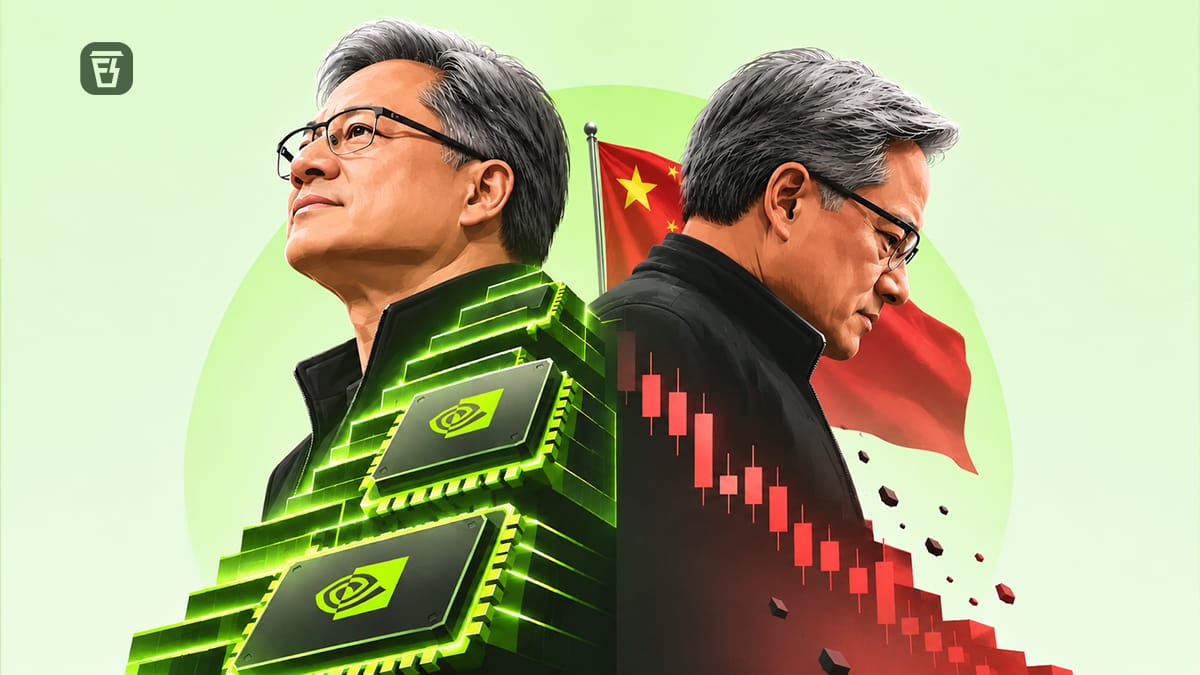
In today’s Finshots, we look at what’s happening with Nvidia and try to reason about how this tale of two Huangs could reshape the AI industry.
But before we begin, if you love keeping up with the buzz in business and finance, make sure to subscribe and join the Finshots club, loved by over 5 lakh readers.
Already a subscriber or reading this on the app? You’re all set. Go ahead and enjoy the story!
 Love our insights? Add Finshots as a Preferred Source on Google ⭐
The Story
It’s not every day that you wake up to the news that the CEO of the world's most valuable chipmaker is at the centre of a Chinese espionage operation. For the uninitiated, Jensen Huang had an illicit relationship with Alice Huang, a businesswoman who was allegedly linked to Chinese intelligence.
She was also associated with Singapore-based cloud-computing company Megaspeed International, which had become an Nvidia partner and was under scrutiny for allegedly helping divert restricted AI chips from the US to China.
According to reports, Alice Huang and her associates built a network of companies across Singapore and China to acquire Nvidia chips. When orders for restricted chips stalled, her connections allegedly helped secure supplies. The Information reported that Nvidia H100, H200 and A100 chips, worth at least $7.5 billion, were moved into China through this network. US authorities have been examining the alleged diversion. At the same time, Nvidia's independent directors have appointed former acting US attorney Joon H. Kim to lead an investigation into whether a foreign intelligence operation targeted Jensen Huang.
The controversy has raised questions about its internal controls, its relationship with government officials and whether its leadership has been exposed to foreign influence. Lawmakers are calling for tighter export restrictions, while reports suggest that US agencies had pushed to place Megaspeed on the government's trade blacklist. Nvidia has said it has no reason to believe that its trade secrets or US national security interests were compromised.
But the bigger question is what happens if the investigation eventually puts Jensen Huang's position as CEO in jeopardy. Against the backdrop of these fears, Nvidia has lost around $1.46 trillion in market value over 24 trading sessions, with its share price falling from $239 on October 6 to $169 on November 10, a decline of roughly 29%.
Granted, some of that fall reflects the broader sell-off in AI-linked stocks, but the allegations have added another layer of uncertainty to a company that has become quite important to the global AI industry.
And this is where the story gets interesting. Because apart from selling chips, Nvidia's fortunes are also built around Jensen Huang himself and the larger ecosystem of businesses built around AI, and this brings us to three important questions:
- What happens if Jensen Huang is forced to step down?
- How exposed is Nvidia to the massive infrastructure commitments it has made to support future AI demand?
- And, more importantly, what happens to the rest of the AI industry if Nvidia falters?
Let's start with the first question. Jensen Huang owns only around 3.5% of Nvidia's shares, and unlike Zuckerberg or Elon, he doesn't have special voting rights that allow him to retain control of the company. This means the board and shareholders can remove him if they believe his conduct has put the company at risk.
That said, replacing him could be a much bigger challenge. This is because Huang has led Nvidia for more than three decades. During this time, he has transformed it from ‘just a graphics-chip maker’ into the company powering much of the AI revolution.
He has built relationships with tech companies, investors and policymakers, and has become one of the most influential voices in the global AI industry. His influence is particularly important in Washington, where he has repeatedly argued that Nvidia should be allowed to compete in China despite growing restrictions on advanced chip exports (ahem ahem, I wonder why 🤔).
Apart from this, Huang has built Nvidia around an unusually flat organisational structure, with most senior executives reporting directly to him. Former executives have also suggested that he was reluctant to formalise succession planning, believing that naming a successor could create internal rivalries. So, while Nvidia has several capable executives, there isn't an obvious replacement who can immediately replicate Huang's technical understanding, strategic vision and political influence.
For instance, CFO Colette Kress has earned Wall Street's trust after years of managing Nvidia's finances, but her experience is primarily financial. Ian Buck, who oversees accelerated computing and has been closely associated with Nvidia's CUDA ecosystem, has deep technical credentials, but less experience as the public face of a global company. Rene Haas, the CEO of Arm and a former Nvidia executive, could be another contender. But these are potential candidates, not a confirmed succession shortlist.
In other words, Nvidia may have the institutional ability to replace Huang, but whether it has someone who can replace the influence he wields is a different question. And at a time when the company is negotiating with governments, suppliers, customers and investors across the world, even a temporary leadership vacuum is not exactly ideal.
And this brings us to the second question.
Until recently, we could think of Nvidia primarily as a company that designed chips and sold them to customers. But its role has expanded considerably. It is now investing in AI companies, helping finance data-centre projects and entering into long-term agreements to secure the computing infrastructure needed to meet future demand.
For context, Nvidia disclosed around $99 billion in equity investments and another $25 billion in investment commitments as of July 2026, apart from $279 billion in supply and capacity commitments, largely to secure manufacturing and memory for future generations of chips.
It has also entered into cloud-service agreements worth another $29 billion. And has agreed to provide guarantees of up to $105 billion to support a large data-centre project in Ohio that is expected to serve OpenAI.
So, Nvidia is trying to secure scarce manufacturing capacity, ensure that data centres get built and support the infrastructure required to sustain demand for its chips. But they also reveal how interconnected its business has become with the rest of the AI ecosystem.
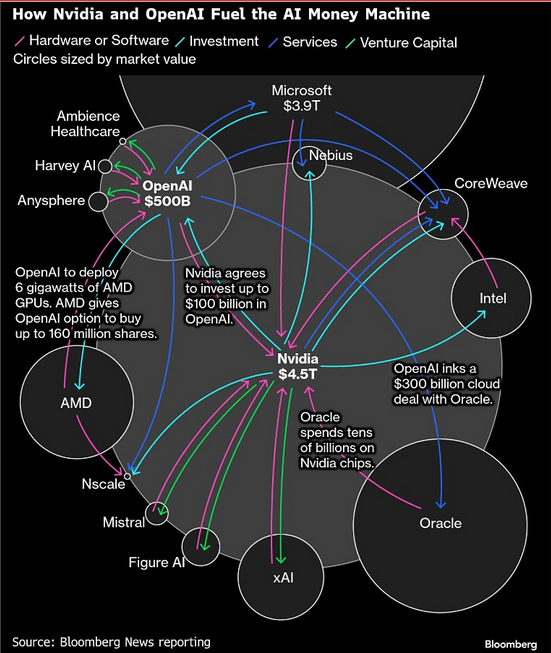
This brings us to a debate that has been gaining traction on Wall Street. Investors such as Michael Burry have questioned whether Nvidia's investments and financing arrangements are creating a circular flow of capital, and whether this is a sign of a bubble waiting to burst or even worse, a fraud.
To put it simply, consider a cloud-computing company that needs billions of dollars to build data centres. Nvidia invests in the company or helps arrange financing. That company then uses that money to purchase Nvidia's GPUs, which helps generate revenue for Nvidia. And the entire arrangement depends on AI companies eventually renting enough computing capacity to make the data centres profitable.
That doesn't automatically mean Nvidia is manufacturing demand or engaging in accounting fraud. But it does mean that the company's fortunes are increasingly tied to whether its customers can monetise the computing infrastructure they are building.
And that brings us to the third question: what happens to the wider AI industry if Nvidia falters?
Nvidia's position is difficult to overstate. Its GPUs power much of the world's AI infrastructure, and companies across the industry have built their products and expansion plans around access to its chips. If the company faces a prolonged leadership crisis, tighter export restrictions, or supply-chain disruptions, the consequences could extend well beyond its own stock price. AI startups could face uncertainty over computing capacity, cloud providers could reconsider expansion plans, and data-centre operators could find it harder to raise capital.
But Nvidia's problems are arriving at a time when the industry is already undergoing a shift (mind you, the broader selloff in tech stocks started well before the honeytrap came to light).
China, for instance, is increasingly turning to domestic chipmakers such as Huawei as US export restrictions limit access to advanced Nvidia GPUs. Meanwhile, Chinese models such as DeepSeek's R1 have shown that improvements in algorithms and computing efficiency can reduce the hardware required for certain AI tasks. And as alternative chipmakers such as AMD and Broadcom gain investor attention, large tech companies are becoming more interested in diversifying their computing infrastructure rather than relying entirely on Nvidia.
This doesn't mean that Nvidia's dominance is about to disappear. Its software ecosystem, particularly CUDA, and its integrated hardware and networking systems are some of the best in class. But it does suggest that the AI industry may be entering a phase where customers have more reasons to explore alternatives.
Either way, at the end of the day, Nvidia is unlikely to disappear because of one controversy. Even if Huang eventually steps aside, the company has the best products, intellectual property, and a large team of executives that will ensure a smooth transition.
However, this episode exposes a risk that the AI industry may have underestimated: the dependence on a company whose influence extends far beyond the chips it sells, and on a leader who has become difficult to separate from the company itself, which highlights the perils of a monopoly.
The real question, then, is not simply whether Nvidia can weather the tale of two Huangs. But whether the AI industry has become so dependent on a handful of companies that a crisis at one could change the direction of the entire AI boom.
If you liked this story, feel free to share it with your friends, family or even strangers on WhatsApp, LinkedIn or X.
🚨 ATTENTION: FINSHOTS FAMILY
This week, we’re hosting a free 2-day Insurance Masterclass that helps you build real financial security by understanding health and life insurance the right way.
📅 Saturday, 14th November at 6:30 PM: Life Insurance: How to protect your family, choose the right cover amount, and understand what truly matters during a claim.
📅 Sunday, 15th November at 6:30 PM: Health Insurance: How hospitals process claims, common deductions, the mistakes buyers usually make, and how to choose a policy that won’t disappoint you when you need it most.