
Why do wealth taxes keep failing?
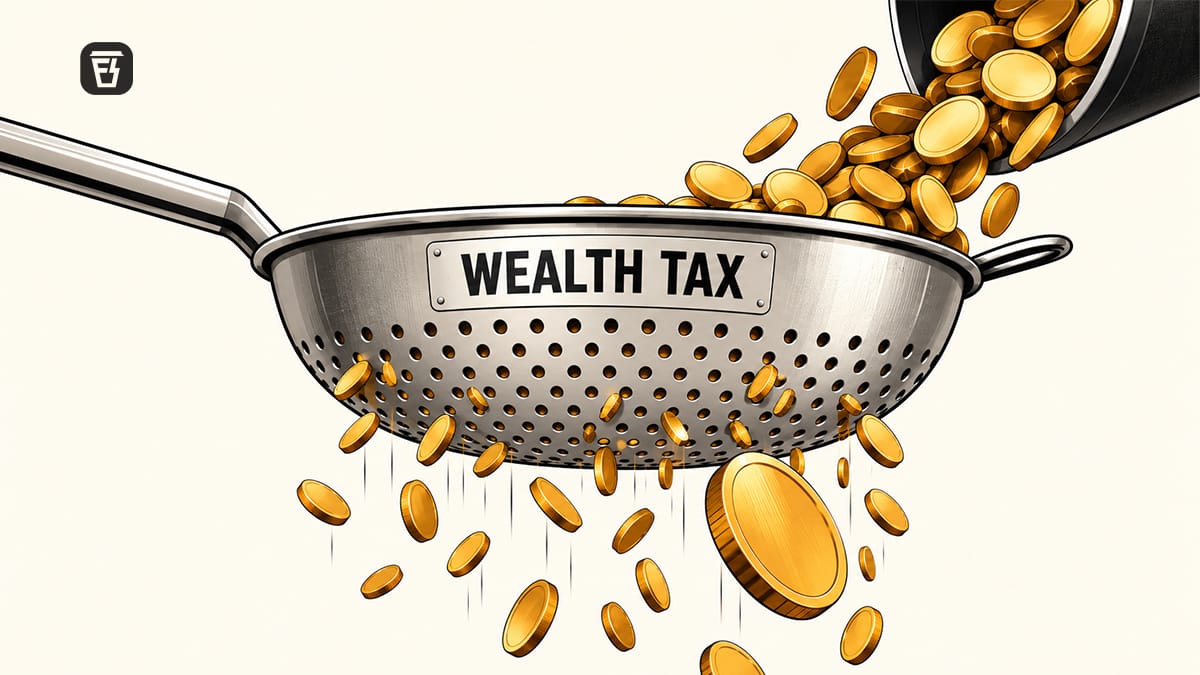
In today's Finshots, we look at why wealth taxes keep failing, and whether there's a version of this idea that could actually work.
Also, a quick note: The Jio IPO opens today, and we've broken down its DRHP and valuation to understand what the company could be worth. If you’re curious, you can check out our stories here: The Jio IPO Explained and A few more things about the Jio Platforms IPO.
The Story
Imagine taxing the world's richest man at a mere 0.1% of his wealth. At the time of writing, it’s Elon Musk. And Forbes puts his net worth at about $936 billion. So 0.1% comes to $936 million. That is enough to fund the Ayushman Bharat PM-JAY, India's flagship public health insurance scheme. Or the USA’s entire budget for global health security in 2025.
So if the amount is big enough to benefit the public purse this much, why can't governments simply collect a wealth tax?
Well, this is a little more complicated than just taxing ‘income’ because income and wealth are two very different things. Income tax applies to the money you earn, whether through a salary, dividend, or taxable income. But much of a billionaire’s wealth exists on paper, in the form of shares, businesses, and other assets that may change dramatically without them drawing a salary.
Take Elon, for instance. A large part of his fortune is tied to his stake in companies such as Tesla and SpaceX. If their valuations rise, his net worth increases even if he doesn't sell a single share. And as long as he doesn’t sell, he doesn’t incur a tax. This creates a peculiar situation in which a billionaire can become substantially wealthier without seeing a corresponding increase in taxable income.
Which begs the question: how exactly do you impose a tax when wealth keeps fluctuating regularly?
Well, economist Gabriel Zucman may have a solution. His proposal is to introduce a minimum tax of 2% on billionaires’ wealth.
The idea is to establish an effective tax rate of a minimum of 2% of their total wealth. If the taxes they pay fall short of that, they would have to pay the difference. So, even if a billionaire holds most of their fortune in shares and pays relatively little tax on their annual income, their overall tax bill would still have to meet the minimum 2%. According to Zucman's estimates, the proposal could raise $200–250 billion annually from around 3,000 billionaires worldwide.
But a wealth tax is easier said than done because it comes with a few caveats.
First, all major countries would have to implement it together to make it work. Otherwise, billionaires could simply move their wealth to places where the tax doesn’t apply.
In fact, several OECD countries show why wealth taxes have struggled to deliver. According to the OECD, 12 countries levied a recurring tax on individuals’ net wealth in 1990. By 2017, that number had fallen to just 4. Norway offers a useful example of this trade-off. After the country raised its top wealth-tax rate from 0.85% to 1.1% in 2022, several billionaires and multimillionaires left, taking fortunes estimated at roughly $56 billion with them. Yet Norway's wealth-tax collections grew by around 25% between 2022 and 2025, suggesting that the departures did not necessarily wipe out the tax's revenue potential.
In other words, a wealth tax can raise revenue, but only if governments can identify, value, and tax enough wealth to make it worthwhile. And that’s precisely where many countries have struggled.
Another struggle in implementing a wealth tax is valuing the wealth itself.
You see, income is easy to measure because it is an amount credited to your bank account regularly. Wealth is different altogether. As explained earlier, a lot of it is in either a stock portfolio or real estate, and it’s tricky to measure this.
A good example is when Michael Jackson passed away. His estate told the IRS his name and likeness were worth $2,105. But the IRS said it’s worth $434 million. The Tax Court eventually settled on roughly $4.15 million. Now picture that argument repeating every single year for every wealthy person in the country.
Tax authorities would need specialised teams to value private businesses, artwork, real estate and other assets. That would take a significant amount of resources, not just for the tax department, but also a lot of time in court, if (or rather, when) they decide to contest the taxman’s decision.
Then there’s the cash flow problem. A wealth tax must ultimately be paid with money available to the taxpayer, even when most of their wealth is tied up in assets that generate little or no cash.
Consider someone who owns a flat worth ₹10 crore and earns ₹50 lakh a year in rent. A 2% annual wealth tax on the flat would amount to ₹20 lakh, consuming 40% of the rental income before income tax and maintenance costs. The problem becomes more acute for a startup founder whose shares are valued at ₹1,000 crore but who receives no dividends. A 2% wealth tax would mean finding ₹20 crore every year, potentially forcing the founder to sell shares just to pay the tax, even if the business isn't generating cash for them personally.
And these issues aren’t a problem Europe or the US has grappled with alone. India has had its own experience with wealth taxes, and it offers an interesting lesson.
The Wealth Tax Act ran for 58 years until the 2015 Budget scrapped it, after it yielded just ₹1,008 crore in 2013-14. One of the reasons behind this was that the tax generated relatively little revenue compared with the administrative effort required to assess and collect it.
So in its place came income surcharges, capped at 25% under the new tax regime. And it worked, because income surcharge revenue has increased from ₹9,347 crore in 2017-18 to ₹85,000 crore for Budget 2025-26.
Now, the next question you might have is why does a surcharge work but not a wealth tax? Well, because the surcharge is based on India’s existing income-tax machinery. Instead of arguing over the shifting valuation of real estate, art, or private stock, it simply adds an extra percentage onto an already-reported income number.
So, is there a way in which a wealth tax can be implemented?
One alternative is the approach India took: levy higher income taxes (after a threshold) rather than trying to value every asset a person owns. Another is to tax wealth at specific moments, such as when an asset is sold or inherited. California has also explored a different route through a proposed one-time wealth tax on billionaires, estimated to raise around $100 billion. But that proposal has raised concerns that wealthy residents will leave the state, taking away a substantial share of the potential tax base.
Ultimately, the problem is that governments must solve three difficult problems at once:
- Valuing assets accurately,
- Collecting the tax without imposing disproportionate costs, and
- Preventing the tax base from moving elsewhere.
The harder these tasks become, the more attractive alternatives such as income surcharges and capital-gains taxes begin to look.
India's experience perfectly illustrates this trade-off. Rather than repeatedly assessing the value of every asset owned by the wealthy, the government chose to rely more heavily on the income-tax system. Other countries may prefer different combinations of annual wealth taxes, one-time levies, or taxes on wealth when it changes hands. There is no universal solution, because the answer depends on how a country structures its tax system and how easily its wealth can move across borders.
A coordinated global minimum tax could, at least in theory, reduce the incentive for billionaires to move to places with lower taxes. However, getting different governments to agree on the rules, enforce them consistently, and resolve disputes over valuation would be a formidable task in itself.
Either way, do you think a global minimum tax on billionaires could work, or would wealth simply move to whichever country refuses to participate?
Until then…
If you liked this story on wealth taxes, feel free to share this with your friends, family or even strangers on WhatsApp, LinkedIn or X.
And if you’re someone who loves keeping tabs on the world of business and finance, hit subscribe if you haven’t already. And if you’re already a subscriber, thank you! Maybe forward this to someone who’d enjoy our stories but hasn’t discovered us yet.
Trust Finshots for Finance? You'll love Ditto for insurance.
Built by the same four friends behind Finshots, Ditto is here to make insurance simple. No spam, only honest advice to help people make smart insurance decisions.
✅Backed by Zerodha
✅Rated 4.9 on Google (34,000+ reviews)
✅Over 7 lakh customers advised
Click here to talk to an IRDAI-Certified advisor for FREE.