
A few more things about the Jio Platforms IPO
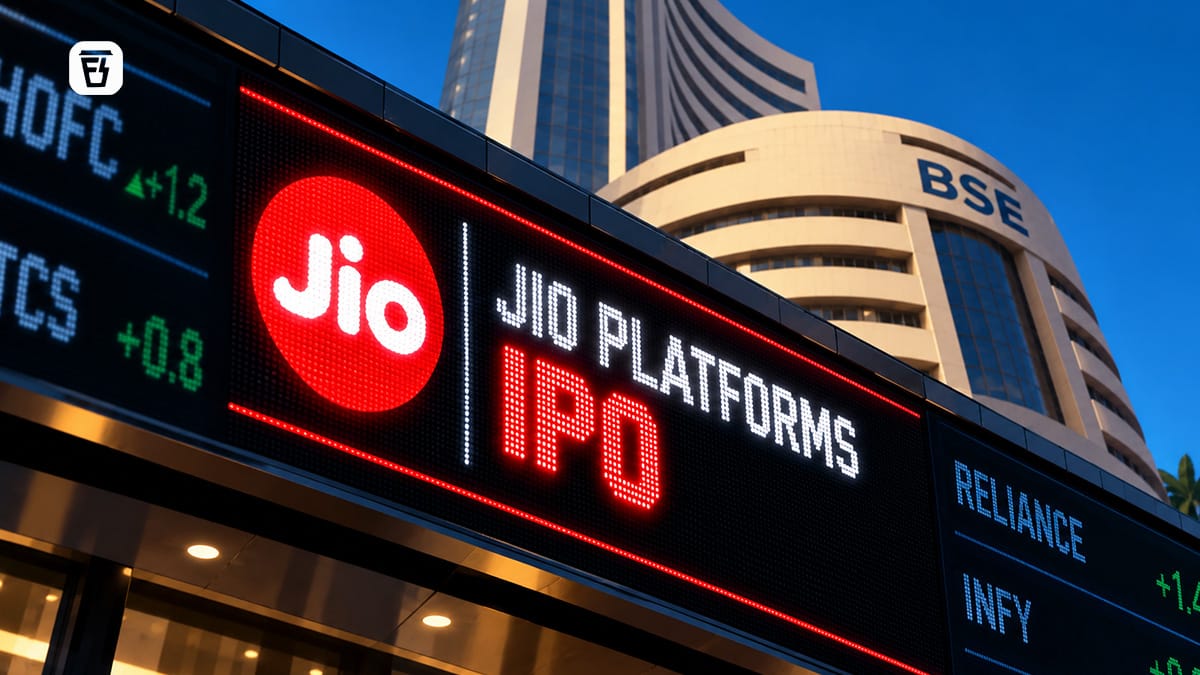
In today’s Finshots, we talk about the Jio Platforms IPO again, which opens for subscription on Wednesday, October 21st, and closes on October 23rd, 2026. But this time, we’ll look at a few risks and things you should understand before thinking of investing in it.
Also, before we get to the story, here’s a quick note. We’ll be taking a publishing holiday tomorrow, October 20th, for Dussehra. We’ll be back with a new story on October 21st. We hope you enjoy the festivities. Happy Dussehra!
Now, onto today’s story.
The Story
The Jio Platforms IPO opens for subscription the day after tomorrow. We’ve already written about its business when the Draft IPO Prospectus came out. But just to set the context, Jio Platforms is a tech and connectivity business that makes most of its money through its subsidiary, Reliance Jio Infocomm, which as we all know is India’s largest mobile network operator. And it’s going public primarily to repay some of its debt. The IPO is entirely a fresh issue of shares worth ₹30,200 crore.
But amidst all the buzz, we thought we’d focus on a few things you should look at carefully before hopping on the IPO hype train. If you need some background first, you can read our previous story and come back to this.
But if you have a fair idea of what we wrote earlier then the first thing to look at is Jio’s dependence on a single distribution channel and how it recognises revenue.
When you recharge your Jio plan, the money doesn’t go straight to Jio. Instead, Jio sells recharge vouchers in bulk to Reliance Retail, its sister concern. Both companies are subsidiaries of Reliance Industries. Reliance Retail pays Jio an advance, which Jio records as an advance rather than immediate revenue. In FY26, this advance was about ₹1.13 lakh crore. Then, as Reliance Retail sells the vouchers through distributors, stores and online channels, and customers use up their recharges, Jio recognises the revenue over time in its books.
But here’s the thing. Reliance Retail is Jio’s only distributor for prepaid plans. It also helps with customer acquisition, KYC verification, marketing and payment collection. And as we mentioned in our previous story, prepaid plans are central to Jio’s telecom business, which accounts for around 77% of its revenue.
This dependence could be risky for two potential reasons. First, if the agreement between Jio and Reliance Retail changes or falls through, Jio may have to find another distributor. That wouldn’t be easy. It would need a network of distributors across India, along with the systems and training to get them up and running.
Second, Jio sets voucher prices so that Reliance Retail’s share is what it calls “in line with industry practice”. But those terms could change. And if they shift in Reliance Retail’s favour, Jio could earn less from the arrangement even if the wider Reliance group doesn’t take much of a hit.
Sure, these are only possibilities, not problems that exist today. But as an investor, it’s worth looking beyond the IPO buzz and considering what this dependence could mean for Jio over the long run.
That said, there’s a positive side to this arrangement too. Jio doesn’t have to wait long for its money because Reliance Retail pays upfront. Jio then recognises that money as revenue as customers use up their recharges. This is also one reason why its cash position remains strong.
That brings us to cash. For a telecom company, one useful metric to look at is EBITDA minus capex (capital expenditure). That’s because a telecom company earns money from a network it must constantly build and upgrade. Towers, fibre, radio equipment and spectrum all need investment. So, a large chunk of its earnings goes right back into the network. EBITDA tells us how much the business earns from its operations, while EBITDA minus capex shows what remains after spending on the network.
And between FY24 and FY26, Jio spent about ₹1.32 lakh crore on its network. But its annual spending has been falling, from ₹53,510 crore in FY24 to ₹34,184 crore in FY26. And when spending falls, more cash is left over. In FY26, this difference between EBITDA and capex stood at ₹42,071 crore. In fact, Jio overtook Airtel’s India business on this metric for the first time in Q1FY27, with Jio’s figure standing at ₹16,681 crore, compared to Airtel’s ₹14,102 crore.
That sounds exciting. But Jio’s profits haven’t grown at the same pace. While EBITDA minus capex grew 111% over the past year, profits rose by just 15%. Why’s that, you ask?
The answer lies partly in timing. While a network is being built, interest on the loans funding it can be added to the asset’s cost. But once it becomes operational, that interest starts showing up as an expense. As a result, Jio’s finance costs jumped 76% to ₹8,653 crore in FY26. Depreciation also rose 13% as newer equipment began to be written off.
And remember, EBITDA minus capex isn’t entirely free cash. Taxes, future spectrum purchases and the AI investments Reliance has promised over the coming years could all take a bite out of it.
And now that we’ve covered a few things to watch out for, there’s one more important aspect to consider: valuation.
At around 34 times earnings, Jio’s price-to-earnings (P/E) ratio is lower than Airtel’s 41 times. But for a telecom company, enterprise value (EV) to EBITDA can be a more useful valuation metric. That's because telecom companies carry heavy debt and depreciation charges, which can make P/E comparisons tricky. EV/EBITDA helps compare their core operating earnings before these costs. On this measure, Jio trades at about 12 times EBITDA based on FY28’s expected earnings, only slightly higher than Airtel’s 10.
That might make Jio look like it is attractively valued, especially with more customers than Airtel and falling network spending. But Airtel has higher EBITDA margins, at around 57% versus Jio’s 50%, and faster profit growth.
So perhaps Jio’s valuation reflects less what it is today and more what investors believe it could become.
Is that a good bet? Well, you tell us.
Until next time…
Don’t forget to share this story on WhatsApp, LinkedIn, and X.
And if you’re someone who loves keeping tabs on the world of business and finance, hit subscribe if you haven’t already. And if you’re already a subscriber, thank you! Maybe forward this to someone who’d enjoy our stories but hasn’t discovered us yet.
A Note from Our Co-Founder
“When we started Finshots, our aim was to make finance simple and accessible for everyone. Soon, we realised that understanding finance is just one of the challenges. Making smart decisions, especially with insurance, is a whole different ball game. That’s why we built Ditto, a platform that makes insurance simple. No jargon, no spam, just honest advice from advisors who are only here to help you find the right plan.”
— Shrehith Karkera, Co-founder, Finshots & Ditto Insurance