
The problem with lithium discoveries
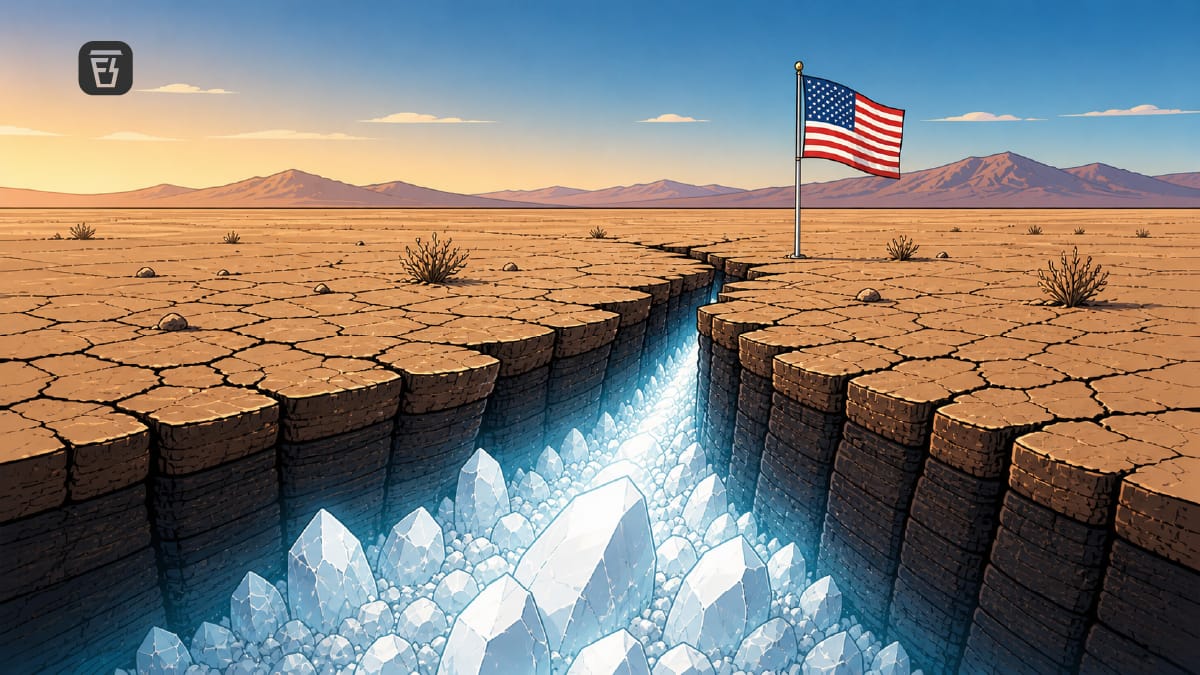
In today’s Finshots, we explain why lithium discoveries don’t immediately change much for the US.
But here's a quick sidenote before we begin. We’re hosting a free 2-day Insurance Masterclass that helps you build real financial security by understanding health and life insurance the right way.
📅 Tuesday, 5th May at 6:30 PM: Life Insurance
How to protect your family, choose the right cover amount, and understand what truly matters during a claim.
📅 Wednesday, 6th May 6:30 PM: Health Insurance
How hospitals process claims, common deductions, the mistakes buyers usually make, and how to choose a policy that won’t disappoint you when you need it most.
👉🏽 Click here to register while seats last.
Now on to today’s story.
The Story
Deep in the Appalachian Mountains, stretching across the Carolinas in the United States, lies a deposit that could power millions of electric vehicles.
The US Geological Survey has found 2.3 million tonnes of recoverable lithium deposits in the region. And it’s not just the US. A few years ago, India also made headlines after discovering lithium reserves in Jammu and Kashmir — estimated at around 5.9 million tonnes. That figure put India on the global lithium map for a while.
Similar announcements have come from parts of Europe, Africa, and South America, with Bolivia and Argentina sitting atop vast salt flats that together form what geologists call the Lithium Triangle, holding over half of the world’s known reserves.
On paper, this should change everything. After all, lithium is a critical ingredient in the lithium-ion batteries that power electric vehicles (EVs) and store energy from renewable sources like solar and wind.
So the next step feels straightforward. If more countries are finding it within their borders, the global balance of power should begin to shift. Energy independence and cleaner supply chains suddenly seem within reach.
Except that shift hasn’t really happened.
To understand why, you have to start at the beginning. Finding lithium in its raw form is only the first step — and, it turns out, the easiest one.
Lithium as an element exists in different forms, and not all of them are straightforward to extract. Which is where things start to get complicated. The most accessible deposits are brine lakes, where lithium-rich saltwater is pumped to the surface and evaporated over time.
But not every country is lucky enough to have those. Most countries have to rely on hard-rock deposits, known as spodumene, that require intensive drilling, blasting, and a lot more energy to process.
And in some cases, it gets even trickier. Clay-based deposits, like those found in parts of the American West and Appalachia, are still mostly experimental.
But extraction is only half the story. Even when lithium is mined, it isn’t ready for use. It must be converted into battery-grade chemicals like lithium carbonate or hydroxide. This process is complex, expensive and highly sensitive to impurities. Only a handful of countries can do it, and this is where the real bottleneck lies.
It’s expected that by 2035, China will process an estimated 60 to 70% of the world's refined lithium. In most cases, raw lithium mined in Australia, Chile, or Argentina is shipped to Chinese facilities, refined there, and then fed back into the global battery supply chain.
Even advanced players like South Korea and Japan depend on Chinese refiners upstream. The result is a supply chain that loops through China regardless of where the lithium is mined. That’s a dependency new discoveries cannot undo anytime soon.
But there’s another constraint that makes this even harder. Timing. Because building supply takes time. Mining projects take years just to begin. Environmental impact assessments, community consultations, land acquisition disputes, and regulatory approvals can each stretch into years on their own.
And real-world examples show just how slow this can be. The US’ Thacker Pass lithium project, first proposed in 2018, is still not in full-scale production.
Meanwhile, demand isn’t slowing down. Global EV sales crossed 17 million in 2024 alone.
Which creates a mismatch. Even countries that eventually succeed could still fall behind in the near term because they cannot move fast enough.
So what we’re really seeing is that lithium discoveries create the illusion of independence long before it arrives.
And that’s why new finds don’t immediately redraw the global map.
China's advantage does not come from having the most lithium in the ground. In fact, it doesn't. Australia and Chile hold far larger reserves. It comes from decades of state-backed investment in the entire value chain, from refining capacity and electrode manufacturing to the finished battery cells. And that kind of system is hard to replicate.
Because replicating that system takes more than policy. It requires expertise, infrastructure and time. A country that discovers lithium today cannot simply import that capability. It has to build it.
But some countries are trying to catch up. The US, through the Inflation Reduction Act, has committed billions of dollars to building domestic battery manufacturing capacity and incentivising companies to source critical minerals from allied nations.
The European Union has passed its Critical Raw Materials Act, setting targets for domestic processing of strategic minerals including lithium. These are meaningful steps, but they are early ones.
But in looking ahead, countries may be overlooking something closer to home. Every country racing to mine new lithium is largely ignoring the lithium it already has — sitting inside spent batteries.
The first wave of electric vehicles sold between 2015 and 2020 is now approaching the end of its useful battery life. According to the International Energy Agency (IEA), battery retirement volumes might rise sharply from the second half of the 2030s.
But that also means recycling is not an immediate fix. Most EV batteries last close to a decade, so meaningful volumes will only begin to show up later, as today’s EV boom eventually feeds into tomorrow’s battery retirements.
Once that happens, the impact could be significant. Modern hydrometallurgical recycling can already recover up to 95% of the lithium in a spent battery pack. By 2050, the IEA estimates that recycling could reduce global primary lithium demand by as much as 25%.
This supply also behaves differently. Recycling infrastructure can be built faster than new mines and avoids many of the delays associated with extraction.
Countries that invest early in this capacity are effectively building a domestic supply that grows over time. China is already ahead here too, controlling a large share of global recycling capacity. But this is one area where others still have a chance to catch up.
So the real path forward may look different. Instead of chasing full self-sufficiency, countries may need to cooperate on refining and manufacturing in the near term while building recycling capacity for the future.
Because until that system evolves, the lithium story remains the same. It is not about who has the most deposits, but who can turn them into batteries at scale.
Which brings us back to the Appalachian Mountains. What lies beneath them may shape the future. But only if it can be turned into something useful. Because in the global energy race, it is not the country that finds lithium that wins. It is the one that knows what to do with it.
Until then…
If this story changed how you think about lithium, share it with a friend, family member or even strangers on WhatsApp, LinkedIn and X.
Also, if you’re someone who loves keeping tabs on the world of business and finance, hit subscribe if you haven’t already. And if you’re already a subscriber, thank you! Maybe forward this to someone who’d enjoy our stories but hasn’t discovered us yet.