
The India-South Korea Partnership Explained
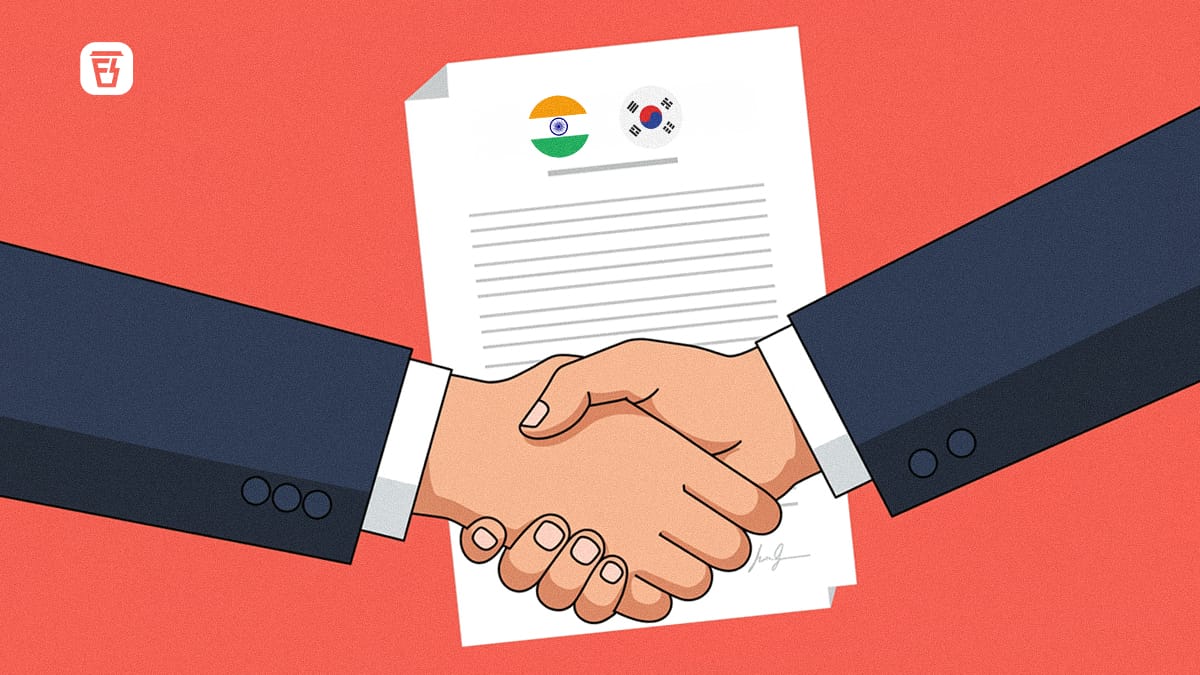
In today’s Finshots, we explain the South Korean President’s recent state visit to India and what it entails for both countries.
But here's a quick sidenote before we begin.
We’re hosting a free 2-day Insurance Masterclass that helps you build real financial security by understanding health and life insurance the right way.
📅 Saturday, 25th April at 11:00 AM: Life Insurance
How to protect your family, choose the right cover amount, and understand what truly matters during a claim.
📅 Sunday, 26th April at 11:00 AM: Health Insurance
How hospitals process claims, common deductions, the mistakes buyers usually make, and how to choose a policy that won’t disappoint you when you need it most.
👉🏽 Click here to register while seats last.
Now on to today’s story.
The Story
When heads of state visit another country, headlines usually focus on ceremonial handshakes and diplomatic symbolism. But when South Korean President Lee Jae-myung’s visit to India concluded yesterday, we can say that it was far more consequential than that. This state visit was less a ceremonial trip and more a strategic business meeting between two countries that increasingly see each other as useful long-term partners.
Because both nations announced an ambitious plan to raise bilateral trade from roughly $27 billion today to $50 billion by 2030. But trade targets, by themselves, rarely tell the full story. What matters more is where that trade comes from and what kind of economic relationship sits underneath it. And in this case, the partnership is being expanded across 15 industries, such as technology & semiconductors, shipbuilding & maritime trade, cross-border payments, energy security, and even cultural industries.
That’s what makes this partnership worth paying attention to.
It reflects a broader shift in the global economy where countries no longer want trade partners only for exports and imports. They now want trusted partners who can help strengthen supply chains and build domestic industrial capability. And in that new world, India and South Korea increasingly appear useful to each other.
You see, for India, the opportunity begins with industrial capability.
India wants to become a more serious manufacturing power. It wants to move beyond “assembly” and deepen domestic capacity in advanced sectors. It wants alternatives to overdependence on China in critical supply chains. And it wants foreign partners who can bring technology, production expertise, and world-class operating standards. South Korea fits that requirement better than most.
Because South Korea is a country that has built globally competitive industrial champions across multiple sectors. Samsung is a leader in electronics and semiconductors. Hyundai Motor Company and Kia Corporation became major global auto brands. POSCO became one of the most efficient steelmakers in the world. And SK Group developed strengths across energy, batteries, telecom, and advanced materials.
In other words, South Korea has repeatedly shown how industrial policy can be translated into globally competitive companies. That matters because India now wants to replicate parts of that success.
Take semiconductors, for instance. Building a chip ecosystem is not as simple as constructing one plant. It requires talent, advanced packaging facilities, specific chemicals, testing systems, and, more importantly, years of manufacturing discipline. South Korea already understands that ecosystem deeply. That is why both countries have announced the India-Korea Digital Bridge, which is meant to deepen cooperation in semiconductors, AI, and information technology. For India, this could eventually mean more than capital inflows. It could mean access to supplier ecosystems, knowledge transfer, and a faster route into high-value manufacturing.
The same logic applies to electronics and batteries. India wants to become a world-class producer of electronics and an EV hub. Korean firms already possess expertise in battery chemistry, displays, precision manufacturing, and consumer electronics at scale. If that capability is increasingly embedded in India, the country can move from simply assembling imported components to producing more of the value chain domestically.
Then there is shipbuilding, a sector that receives less attention than chips but is strategically vital. Ships move global trade, support naval capability, and shape maritime competitiveness. South Korea has the world’s second-largest shipbuilding industry and decades of expertise in efficient large-scale shipyards.
India, meanwhile, wants to scale domestic shipbuilding capacity. If Korean know-how flows into Indian yards, this could become one of the most important underappreciated parts of the relationship.
However, building ships requires massive amounts of steel. So if a country wants to become a shipbuilding hub, it needs to have easy access to high tensile steel. And who better than POSCO? They are one of the primary steel suppliers for the Korean shipbuilding industry. Naturally, they plan to invest roughly $1.09 billion in a 50:50 joint venture with JSW Steel to build a 6-million-ton integrated steel plant in Odisha.
This matters more because apart from shipbuilding, the railways, defence equipment, renewable infrastructure, urban construction, and machinery all depend on it. If India wants to manufacture more, it needs large volumes of efficient steel production.
Then, let’s talk about Energy security. Both India and South Korea understand the vulnerability that comes with dependence on unstable global supply chains. That is why the partnership now includes cooperation in nuclear energy, clean energy, critical minerals, and industrial raw materials. Critical minerals matter because pretty much everything from semiconductors to defence equipment requires them. Countries that secure these inputs early will hold an advantage later.
Now let’s flip the lens. Why is South Korea investing so much in India?
Well, it’s because India solves 4 strategic problems for South Korea at once.
The first is growth.
South Korea is a mature, high-income economy with slower population growth and a domestic market that cannot expand endlessly. Many of its traditional export markets are also experiencing slower growth. Earlier, China, which was a major export destination for the RoK, was a growth engine. However, it is no longer the case. Europe has also battled with high inflation, which has dampened discretionary spending. The United States, too, is politically unpredictable when it comes to trade.
India, by contrast, is one of the fastest-growing large economies in the world. It offers a rising middle class that desires consumer durables such as cars, televisions, and smartphones. That is why Korean giants such as Samsung, Hyundai Motor Company, Kia Corporation, and LG Electronics have all built meaningful positions here. India is no longer just an export destination. It is becoming a market that global firms cannot ignore.
The second is trade economics.
South Korea already enjoys a sizable trade surplus with India. Last year, it exported around $19.2 billion in goods and services while importing roughly $6.4 billion, leaving a surplus of about $12.8 billion. So when both sides talk about lifting total trade to $50 billion, South Korea understandably sees room to deepen an already profitable relationship.
The third is energy and raw material security.
South Korea imports around 94% of its energy, making it highly sensitive to disruptions in West Asia or shipping bottlenecks such as those around the Strait of Hormuz. That is one reason it has been increasing imports of naphtha from India. India already supplied roughly 8% of South Korea’s naphtha imports last year. So, India is already an energy supply partner, apart from being a major market.
The fourth is easier corporate expansion.
Both countries have discussed initiatives such as the India-Korea Financial Forum and Korean industrial townships designed to streamline investments and help Korean companies establish manufacturing operations in India.
There is also a softer but meaningful cultural layer to the story. K-pop and K-dramas have become highly popular in India, while Indian cinema and culture are increasingly visible abroad. The two countries have also spoken of cooperation in sports, environmental projects, talent exchanges, and creative industries. While this may seem secondary, over time, it often helps tourism, brand acceptance, and, at the end of the day, trust.
Of course, none of this becomes transformational automatically.
India still has areas where regulatory complexity and execution bottlenecks can frustrate investors. South Korea, meanwhile, has multiple countries competing for its capital and industrial partnerships. So, both sides will need sustained follow-through rather than headline announcements.
That said, the logic is compelling. India has labour, demand, digital infrastructure, and geopolitical relevance. South Korea has capital, advanced technology, and globally competitive industrial firms. Each side has what the other increasingly needs.
That is why this relationship matters.
It is not merely about increasing trade from $28 billion to $50 billion. It is about two “middle powers” trying to reduce vulnerabilities, diversify supply chains, and strengthen themselves in a fragmented world economy.
For India, the larger prize is not trade alone. It is the chance to use Korean partnerships to build domestic strength in semiconductors, batteries, shipbuilding, steel, electronics, and advanced manufacturing. For South Korea, the prize is securing a long-term position inside the next major growth market while reducing strategic dependence elsewhere.
If executed well, this could become one of Asia’s most important economic alignments outside the China-centric model.
Until then…
If you liked this explainer on the India-Korea partnership, feel free to share this with your friends, family or even strangers on WhatsApp, LinkedIn or X.
Also, if you’re someone who loves keeping tabs on the world of business and finance, hit subscribe if you haven’t already. And if you’re already a subscriber, thank you! Maybe forward this to someone who’d enjoy our stories but hasn’t discovered us yet.
A leading insurer is revising its health insurance premiums!
Policies issued after April 28th, 2026 (midnight) will reflect the updated premiums.
If you've already generated a quote, the premium may change once the revision comes into effect.
So, book a free call with Ditto to understand your options.