
The Dream11 pivot nobody is talking about

In today’s Finshots, we explain how India’s biggest fantasy sports platform is transforming into a data, AI, and fintech conglomerate.
But here’s a quick sidenote before we begin. We’re looking for a business writer to join Finshots’ newsletter team. If you’re someone who can tell compelling stories and explain financial concepts in plain English without drowning readers in jargon, do consider applying through the link here. Or share this with someone who might be a good fit for the role.
Now onto today’s story.
The Story
On August 21, 2025, somewhere around 10 million Indians opened Dream11 out of habit.
Some checked it before getting out of bed. Some had already been on it for hours, picking squads for the day's match. A few had also stayed up past midnight. And that morning, there was this notification waiting for them:
"In view of the recent development pertaining to 'The Promotion and Regulation of Online Gaming Bill, 2025,' we are pausing all 'Pay to Play' Fantasy Sports contests."
That was it. A legal sentence on a push notification was the effective end of a business seventeen years in the making. Over 95% of Dream11's revenue disappeared quite literally overnight. But the truly jaw-dropping part isn't even the ban.
It was about two years before this that the government had also sent Dream11's parent company a GST demand notice for ₹28,000 crore in retrospective taxes. Dream11's annual profit that year was ₹188 crore. The notice was for roughly 150x that.
For a company like Dream11, which practically built the fantasy sports ecosystem in India, this was a massive shock to the system. Their core paid-contest business, which was the cash cow that funded their massive marketing campaigns and IPL sponsorships, was suddenly staring at razor-thin margins.
But when you have over 300 million registered users, you don’t just fold your cards. You pivot. And Dream11’s parent company, Dream Sports, has pivoted in a way that very few people are paying attention to.
They are no longer trying to be just a fantasy sports platform. Instead, Dream Sports is unbundling itself into a diversified conglomerate, if you will. The group has been spun off into eight distinct, startup-like units.
You have the OG Dream11 handling fantasy sports, FanCode for sports merchandising and streaming, DreamSetGo for premium sports experiences, Dream Cricket, Dream Money, Dream Horizon, a philanthropic foundation, and perhaps the two most intriguing pieces of the puzzle: DreamStreet and Dream Sports AI.
Let’s talk about DreamStreet first.
In a surprising move, Dream11 is entering the fiercely competitive stockbroking space. Through DreamStreet, they are launching an AI-enabled investing platform aimed specifically at first-time retail investors.
At first glance, this might sound bizarre. What does a fantasy cricket app have to do with the stock market?
But what if we flip the question, and ask:
What if Dream11 was never really in the fantasy sports business? What if it were always in the business of predicting and influencing human behaviour?
Because both fantasy sports and stock trading (not boring old investing) rely on the same human emotion: the appetite for risk. And this brings us to the crown jewel of their new pivot: Dream Sports AI.
For years, people thought Dream11 was just a place to build virtual cricket teams. But beneath the surface, every time a user agonised over making Virat Kohli their captain, swapped out a bowler based on pitch conditions, or threw in ₹50 on a wildcard team combination, Dream11 was collecting data.
As a result, Dream11 has built one of India’s richest and most granular behavioural datasets. They know how millions of users think about players, match conditions, risk, and probability before a game even begins. The company itself has mentioned that they use AI, ML & predictive analytics to map user preferences, optimise costs, and deliver a highly personalised experience at a massive scale.
This sports-behavioural data is arguably more valuable than the fantasy business itself. Dream Sports AI can build prediction tools for die-hard fans, supply deep analytics products for broadcasters, and create engagement tools for brands.
They can also sell insights to real-world teams and leagues, and push out hyper-personalised sports content.
And this isn't just theoretical.
AI is already powering almost every corner of the Dream Sports ecosystem. FanCode uses machine learning to personalise sports content and merchandise recommendations, and Dream11 relies on algorithms to dynamically create and optimise fantasy contests based on live events. Meanwhile, Dream Sports AI is building products ranging from player-performance prediction to fraud detection.
But while this data is a goldmine in the sports world, it becomes incredibly sensitive the moment it crosses over into finance.
That creates a tricky situation. Can a company that mastered behavioural nudges in gaming use the same AI and data inside financial products without raising concerns about suitability, dark patterns, or encouraging excessive trading?
Because the real expertise Dream11 built over the last decade was understanding how people make decisions under uncertainty and, more importantly, keeping them engaged.
And that is where the problem lies.
When you take a behavioural engine engineered to optimise gaming and plug it into a stockbroking app, regulators start paying attention. DreamStreet is pitching itself as an AI-enabled platform with access to SEBI-registered research analysts and investment advisors.
And unlike a traditional discount broker, DreamStreet's AI assistant, Veda, is designed to simplify financial statements, analyse market data, and generate personalised investment insights for first-time investors.
On paper, that sounds good. But you also have to remember where Dream Sports' AI expertise came from. It was refined over years of understanding user behaviour and learning when people engage, what influences their decisions, and how personalisation can keep them coming back.
And market regulator, SEBI (Securities and Exchange Board of India), probably won’t mind if you use behavioural nudges to get someone to pick a different fantasy wicketkeeper. But it undoubtedly and deeply cares about how retail investors trade.
In recent years, it has been cracking down hard on the "gamification" of the stock market. They have gone after financial influencers who promise unrealistic returns, they are tightening the screws on unregulated algorithmic trading, and they are constantly warning retail investors against treating the derivatives market (F&O) like a casino.
So, where does this leave the company?
Well, Dream11 is not dead. But its original business model might be.
The company's future now depends on whether it can convert a fantasy sports user base into a much broader ecosystem spanning sports media, AI, advertising, payments, and financial services.
That won't be easy.
Free-to-play fantasy contests and creator-led watch-alongs may keep users engaged, but they are unlikely to recreate the high-margin economics of paid contests. Dream Sports AI can certainly build valuable products. Still, sports prediction tools alone won't replace the economics of fantasy gaming unless they become deeply embedded into broadcasters, leagues, teams, and fan platforms.
Sure, DreamStreet opens another avenue for growth. But it also introduces an entirely new kind of regulatory scrutiny.
The finance angle, then, is that Dream11 may no longer be best understood as a fantasy sports platform. It may be evolving into a consumer data company with a sports front end with an AI layer, and, increasingly, a fintech ambition.
Which also means its biggest risk has changed.
Earlier, the question was whether courts and governments would classify fantasy sports as gambling.
Tomorrow, the bigger question may be whether regulators trust Dream Sports to use its AI, behavioural models, and user data responsibly in markets where the stakes are far higher than picking a fantasy cricket team.
Until then…
Liked this story? Share it with a friend, family member, or even strangers on WhatsApp, LinkedIn, and X. And subscribe to Finshots, if you haven’t already. Plis!
🚨 ATTENTION: FINSHOTS FAMILY
This weekend, we’re hosting a free 2-day Insurance Masterclass that helps you build real financial security by understanding health and life insurance the right way.
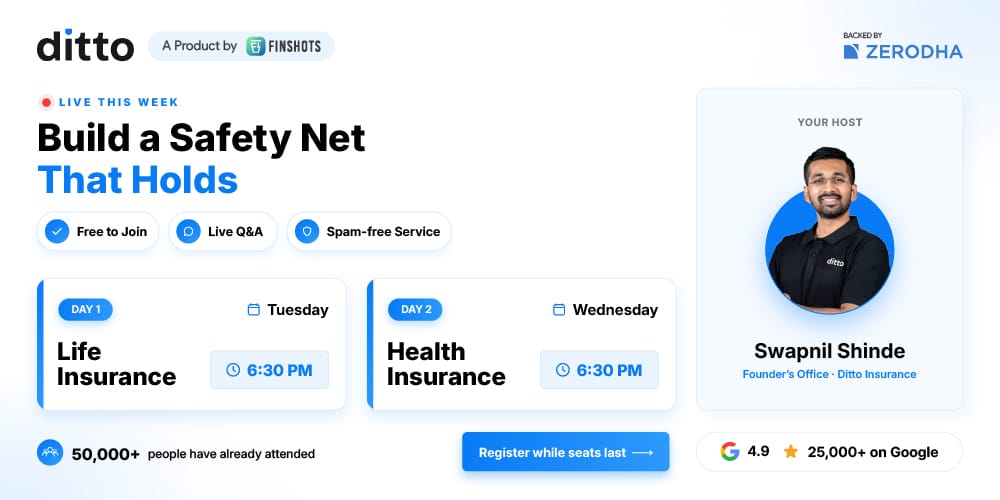
📅 Tomorrow (Tuesday), 30th June at 6:30 PM: Life Insurance
How to protect your family, choose the right cover amount, and understand what truly matters during a claim.
📅 Wednesday, 1st July at 6:30 PM: Health Insurance
How hospitals process claims, common deductions, the mistakes buyers usually make, and how to choose a policy that won’t disappoint you when you need it most.