
The Subhash Chandra saga explained
In today’s Finshots, we explain how the Essel Group’s financial crisis unfolded and why the insolvency case involving its promoter has sparked a major legal debate among Indian lenders.
But before we begin, if you love keeping up with the buzz in business and finance, make sure to subscribe and join the Finshots club, loved by over 5 lakh readers.
Already a subscriber or reading this on the app? You’re all set. Go ahead and enjoy the story!
The Story
There was a time when evenings in many Indian households followed a predictable routine. Dinner would be served just before prime time, the TV remote would mysteriously disappear into the hands of our parents or grandparents, and they would tune in to Zee TV to watch Sa Re Ga Ma or one of the countless daily soaps that were omnipresent in our living rooms for years.
Behind Zee TV's success was Subhash Chandra, one of India's most successful media entrepreneurs. He built the country's first private satellite television network at a time when cable TV itself was a novelty. And over the years, Zee grew into one of India's largest media companies.
But while millions watched Zee's success unfold on television, something else was going on behind the scenes.
A series of ambitious bets outside the media business, funded largely with borrowed money, slowly turned one of India's strongest business groups into one of its most indebted. What followed was years of asset sales, court battles, failed mergers, lender negotiations, and one of the longest corporate debt resolution stories in recent Indian history.
So, how did the man who built Zee end up fighting to save his empire?
Well, the trouble became public in January 2019, when Subhash Chandra formally acknowledged that the Essel Group (Zee’s parent, you can also call it the Zee Group) faced serious liquidity constraints. The group had accumulated approximately ₹45,000 crore in total borrowings.
This debt funded expansions into infrastructure, road construction, power transmission, and solar energy. To secure these credit facilities, promoters pledged their equity shares in Zee Entertainment Enterprises Limited (ZEEL) as collateral.
And as long as the businesses continued to perform and the share price remained healthy, this arrangement was manageable. But once the share price began falling, the entire structure came under pressure.
The immediate trigger was a report published on January 24, 2019, linking Essel to Nityank Infrapower and Multiventures, an entity being investigated by the Serious Fraud Investigation Office.
This report sent shares of Essel Group companies crashing. ZEEL fell more than 26% that day, while Dish TV (also owned by Essel) dropped almost 33%. And because the promoter had pledged his shares as collateral for loans, the sharp fall in their value meant lenders could ask for more collateral or repayment. This added to the group’s financial troubles.
What followed was essentially a race to unwind the empire built over three decades. Chandra committed to reducing debt by around ₹13,000 crore through asset sales. Essel sold infrastructure, renewable energy and other assets, while Chandra negotiated with lenders to gradually reduce the group's borrowings.
Sidebar: He now claims that the borrowing entities for which he had provided personal guarantees have repaid around ₹43,000 crore of the original ₹45,000 crore. On the surface, that might suggest the crisis was largely resolved.
But another problem would continue long after corporate debt started coming down: Chandra's personal guarantees. And this is where the story gets considerably more complicated.
When Essel Group companies borrowed money, several lenders obtained personal guarantees from Chandra. In simple terms, Chandra had effectively told the lenders that if the companies failed to repay certain loans, he could personally be held responsible for those obligations.
So even if the underlying companies were gradually reducing their debt, lenders could still pursue Chandra for amounts covered by those guarantees when loans remained unpaid.
And that is exactly what Indiabulls Housing Finance did.
In 2022, it initiated personal insolvency proceedings against Chandra under Section 95 of the Insolvency and Bankruptcy Code (IBC). In simple terms, this allows a lender to approach the National Company Law Tribunal (NCLT) and ask it to start insolvency proceedings against someone who has personally guaranteed a company’s loan.
But getting Chandra into the insolvency process was only the beginning. Once the proceedings started, the bigger question was how much he could actually be made to repay. The lenders had their claims, Chandra had his own assessment of what he owed, and the insolvency process had to determine what could realistically be recovered from him personally.
That is where the numbers became surprising, and the case has now produced a striking outcome.
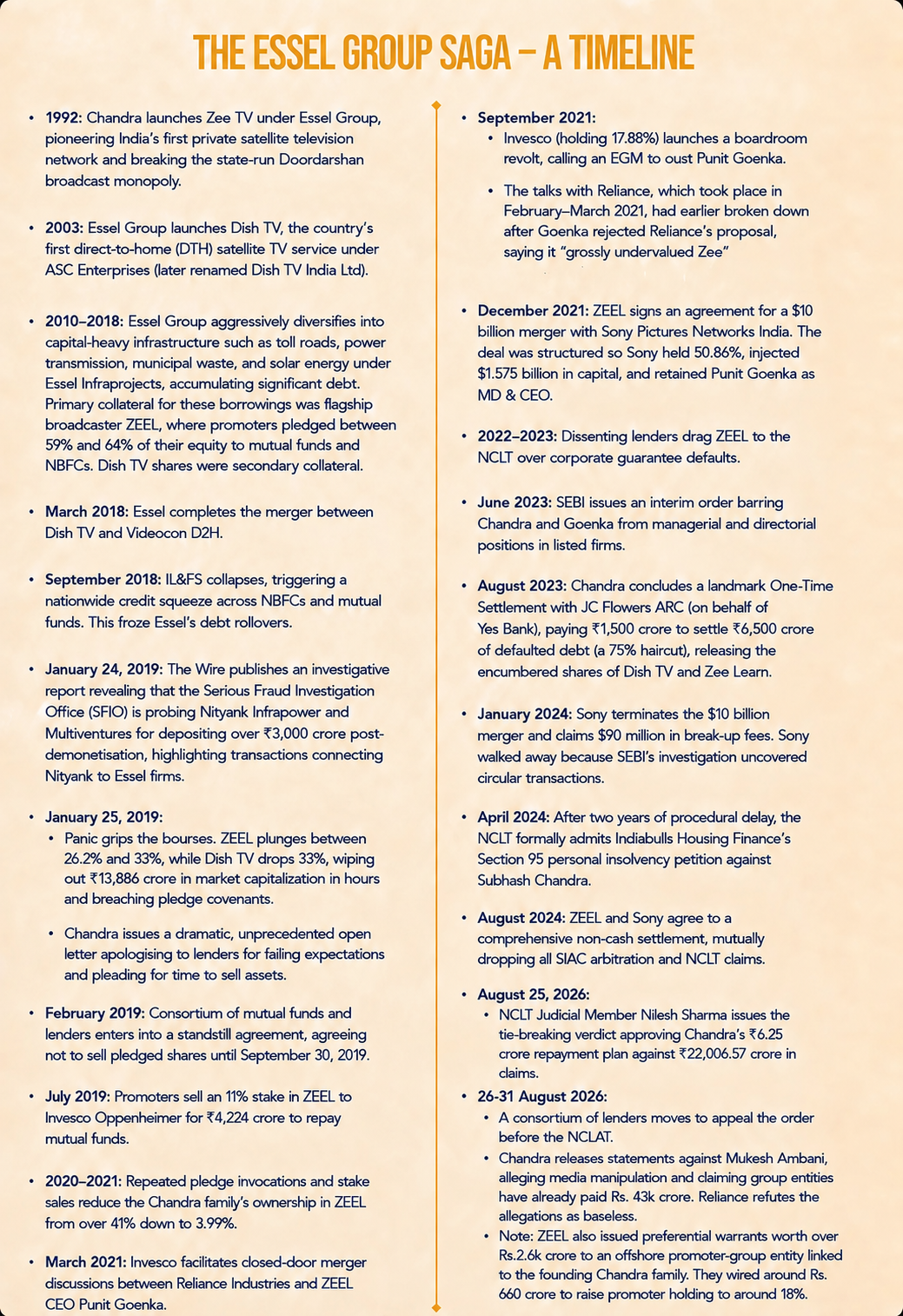
But before we get to the latest developments, here's a concise timeline of the whole saga:
A few days ago, the NCLT approved a repayment plan under which Chandra will pay ₹6.25 crore to creditors, along with another ₹25 lakh towards the insolvency process, against around ₹22,006 crore of admitted claims in his personal insolvency proceedings.
On the face of it, that works out to a haircut of roughly 99.97%. But there’s an important distinction. The ₹22,006 crore is the amount creditors claimed from Chandra personally. It doesn’t mean ₹22,006 crore of company debt has disappeared. The companies that borrowed the money still owe their creditors, and lenders can continue to recover that money from the companies and their assets.
This just means that the NCLT has settled the amount that Chandra himself has to pay as a personal guarantor, rather than writing off the entire debt owed by the underlying companies.
There is also a dispute over what the ₹22,006 crore figure actually represents. Chandra has argued that the publicly presented number does not accurately reflect the amount still unpaid because the group has already repaid most of its original borrowings.
He has also challenged the way the claims of lenders opposing the resolution have been characterised. Several creditors have objected to the repayment plan and are now moving to challenge the NCLT's decision before the NCLAT (the body that reviews decisions that the NCLT makes).
So this isn’t really the end of the Essel saga. It’s just that the question has simply changed. Earlier, the focus was on whether the group could repay its debts. Now, the debate is about how much of that debt Chandra should personally be responsible for, given that he had guaranteed some of the loans and the companies and assets involved have changed significantly over the years.
That’s important because personal guarantees are meant to give lenders additional protection. If a promoter can borrow through a company and then walk away from the personal guarantee after the business runs into trouble, the guarantee becomes far less valuable as a credit safeguard.
At the same time, forcing an individual to repay the full face value of a corporate loan may not be realistic if the underlying assets have already been sold, the business has changed hands, or the guarantor no longer has the resources to meet those obligations.
The insolvency process must therefore navigate this difficult middle ground between protecting creditors and recognising a personal guarantor's actual ability to pay.
In the end, the dilemma seems to be: If a promoter personally guarantees thousands of crores in company loans, how much should they have to repay if the companies and assets behind those loans have changed over time?
That question goes beyond Subhash Chandra and the Essel Group. And the outcome could also change how lenders think about promoter guarantees in the future.
Until then…
If you liked this story about the Essel Group debt saga, feel free to share this with your friends, family or even strangers on WhatsApp, LinkedIn or X.
🚨 ATTENTION: FINSHOTS FAMILY
Your CTC includes health insurance. It does not include peace of mind.
Most employees assume their company has them covered - until they realise corporate plans have low limits, no life cover, and vanish the day they resign. There's a whole side of insurance your employer is never going to take care of.
Our 2-day Insurance Masterclass will show you exactly what that looks like and how to fix it.
📅 Saturday, 5th September at 11:00 AM: Life Insurance
📅 Sunday, 6th September at 11:00 AM: Health Insurance
Only few seats left- 👉 Click here to save your spot.