
The Manipal Health IPO Explained
In today’s Finshots, we explain why India’s largest hospital network by bed capacity is launching a massive IPO, and whether using the funds to clear debt is the right prescription for public market success.
But here’s a quick sidenote before we begin. Your 30s and 40s are peak earning years. They’re also the years most people fly without an insurance safety net.
Between EMIs, school fees, and ageing parents, there’s always something more urgent. But one medical emergency or unexpected loss of income can unravel everything you’ve built.
Our 2-day Insurance Masterclass will help you put that safety net in place.
📅 Saturday, 1st August at 11:00 AM: Life Insurance
📅 Sunday, 2nd August at 11:00 AM: Health Insurance
👉🏽Click here to save your spot.
Now onto today’s story.
The Story
Healthcare in India is going through a massive structural transformation. As household incomes rise, health insurance reaches deeper into the population, and awareness of preventive care grows, more Indians are turning to organised hospital chains rather than small local clinics. To keep up with this shifting demand, large hospital networks have been on a relentless expansion drive.
Standing right at the top of this wave is Manipal Hospitals. Over the past decade, the company has evolved from a regional healthcare provider in Karnataka to India’s largest multi-speciality hospital network, with a licensed bed capacity of over 13,000 across its 49 hospitals.
Much of this expansion has come through acquisitions of hospital chains such as Columbia Asia, Vikram Hospital, Medica Synergie, AMRI and Sahyadri Hospitals, backed by capital from private equity investors.
The company is launching a ₹9,275 crore IPO today, comprising an ₹8,000 crore fresh issue and a ₹1,275 crore Offer for Sale (OFS). It could very well become one of India's largest healthcare listings to date.
The timing is significant. Hospital stocks have generally attracted investor interest in recent years as healthcare has shifted from a defensive industry to one benefiting from long-term structural growth.
But the big question is not whether India’s healthcare sector will continue to grow. It almost certainly will. The real question is whether Manipal deserves to be valued alongside India's most expensive listed hospital chains.
To understand this, we have to look under the hood of hospital economics.
Nearly 98% of its revenue comes directly from hospital operations, with insurance companies, third-party administrators, and out-of-pocket patients driving inpatient revenues. That means Manipal stands to gain directly as health insurance coverage expands, even if it leaves the company exposed to delayed insurance payouts and tough price negotiations with insurers.
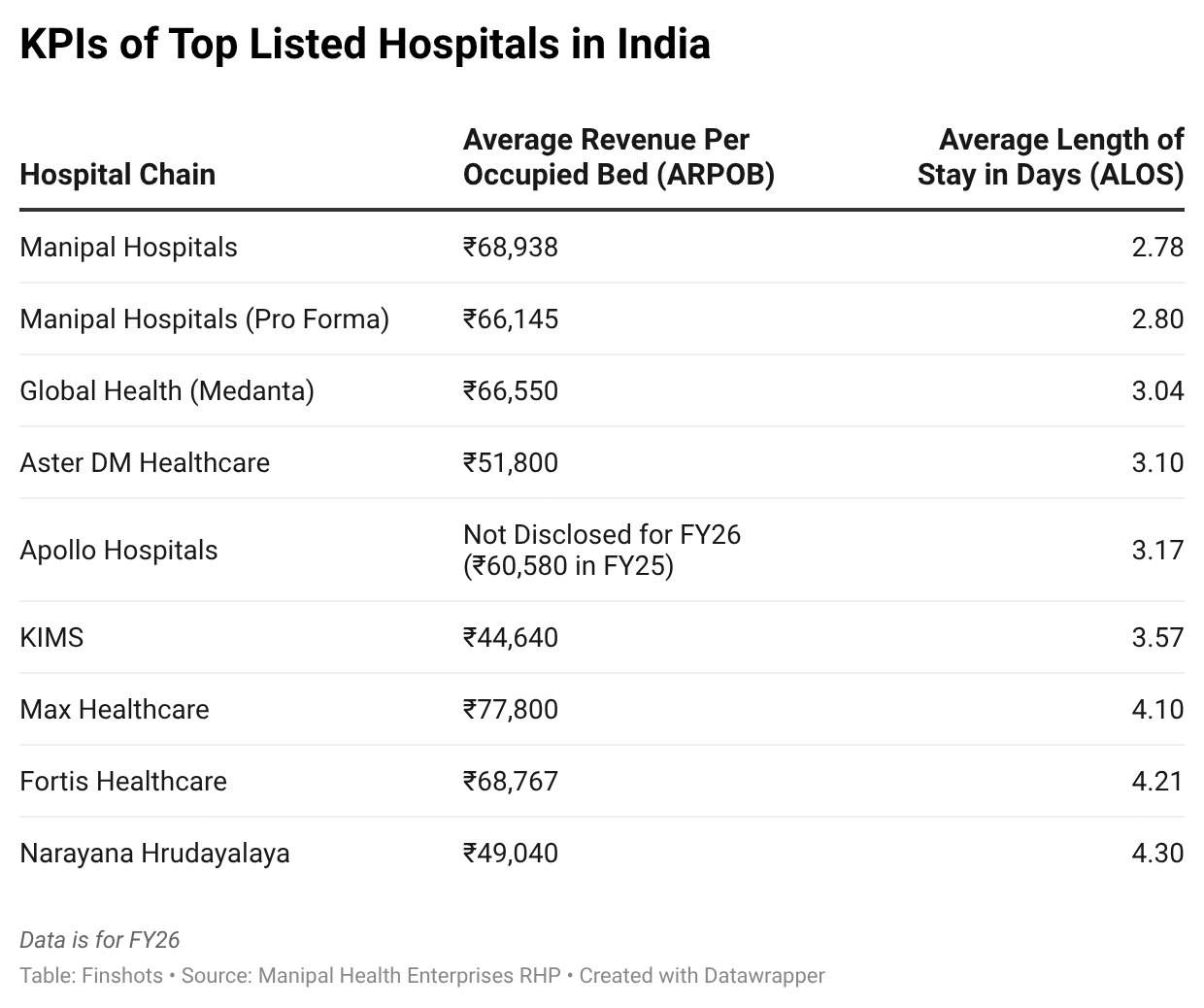
Operationally, too, the numbers seem to be good. Its facilities are at a healthy 64% occupancy, generating nearly ₹69,000 in revenue per occupied bed each day (This is the ARPOB or Average Revenue per Occupied Bed, which is arguably the most important financial metric for a hospital).
It also boasts an average patient stay of just 2.8 days (ALOS or Average Length of Stay). A shorter stay is a clear sign of clinical efficiency because it frees up expensive beds sooner, allowing the hospital to treat more patients with the same infrastructure.
But revenues and operating metrics only tell half the story. To understand whether all this translates into shareholder returns, we have to look at how hospital businesses are valued.
Hospitals are notoriously asset-intensive businesses. They invest crores of rupees in land, specialised buildings, complex medical equipment, and thousands of beds. That creates huge annual depreciation charges. Because of this, traditional metrics like the Price-to-Earnings ratio can often paint a misleading picture. Instead, we should focus on EV-to-EBITDA, which strips away depreciation and financing costs to reveal the underlying operating performance of the business.
By that measure, Manipal is seeking an EV-to-EBITDA multiple of about 32–33x at the IPO price band. That's actually lower than Max Healthcare's lofty 51x multiple and Fortis' 38x, while broadly in line with Apollo Hospitals at around 33x.
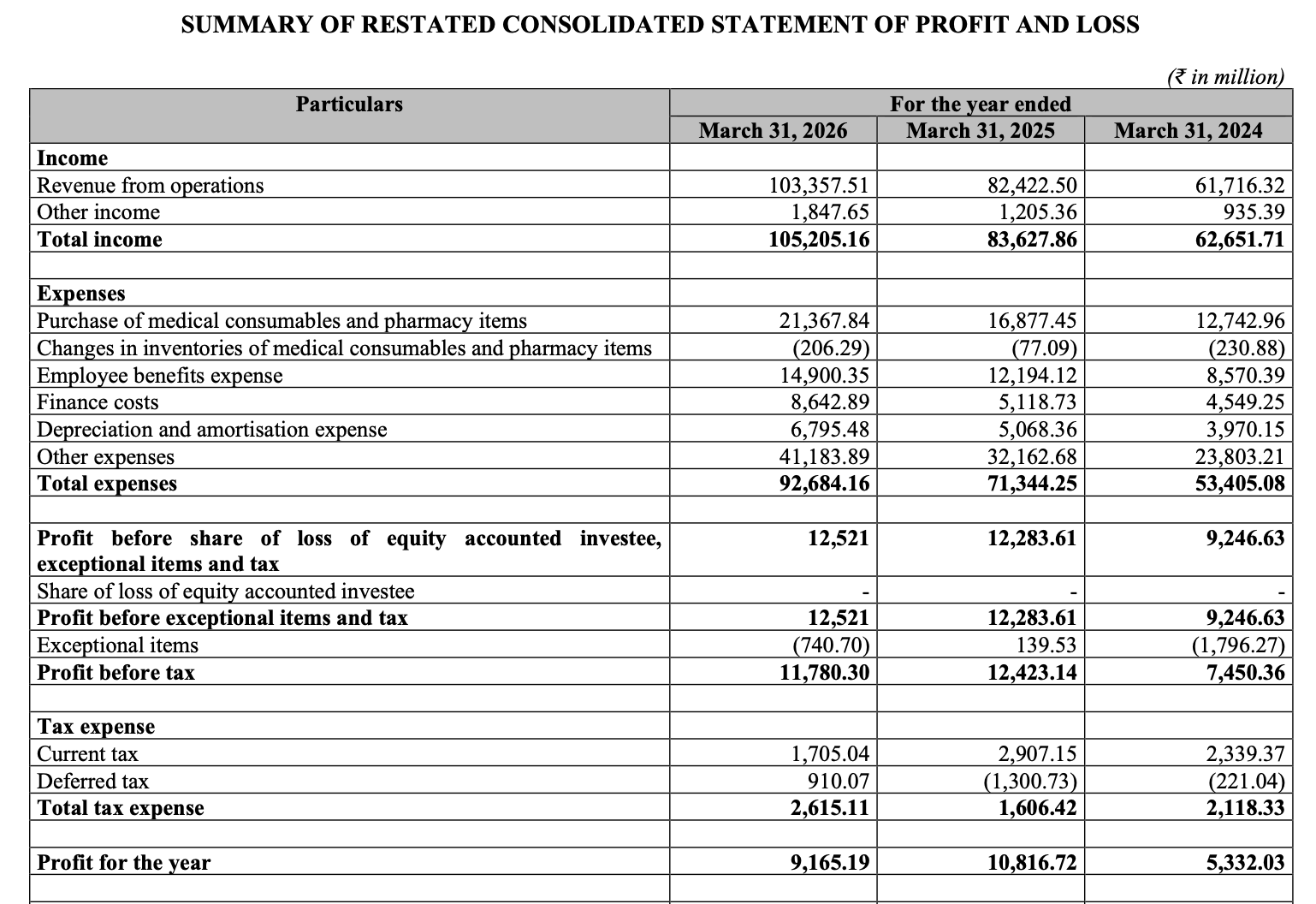
So, if the hospital’s metrics are good, why are its net profit numbers lagging behind its operational scale?
You see, buying up half a dozen major hospital chains requires an enormous amount of cash. So, Manipal borrowed heavily to fund these acquisitions, which pushed up its interest expenses alongside heavy depreciation charges. So even though top-line revenue grew well, net profits remained suppressed by financing costs.
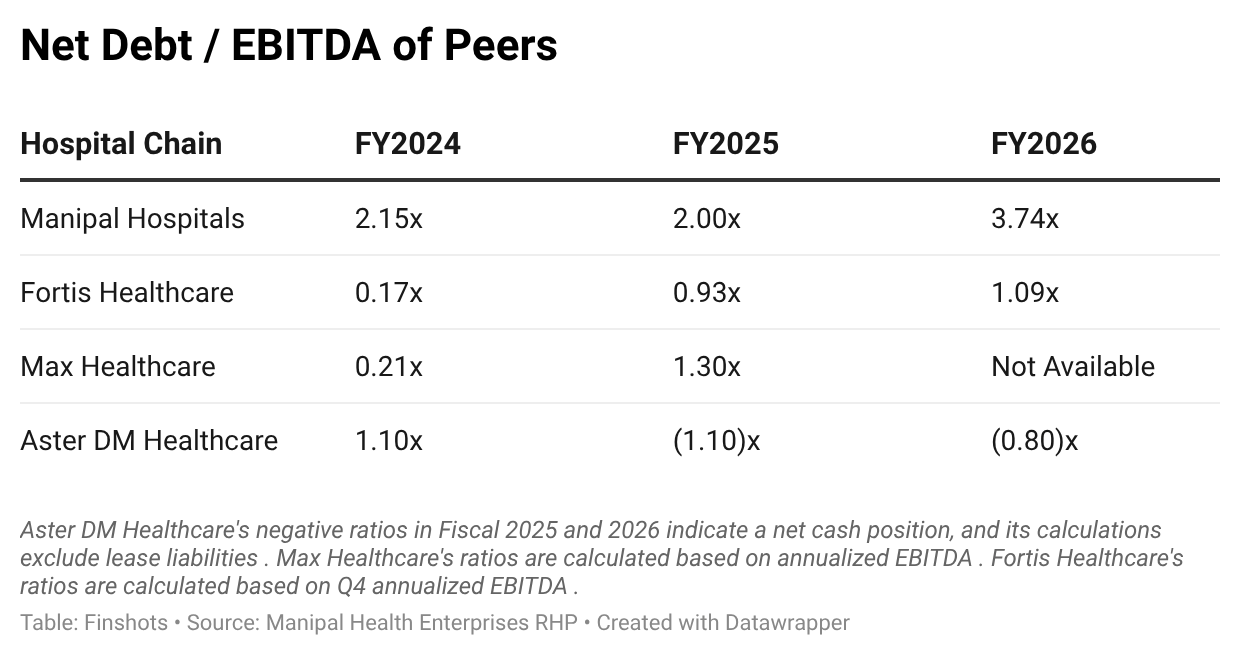
The company’s Net Debt-to-EBITDA ratio is nearly 3.7 times, significantly higher than its peers.
And that explains the structure behind this IPO.
Usually, when a growth-focused health chain goes public, it promises to use the fresh funds to build dozens of shiny new hospitals. But Manipal is taking a different path.
Around ₹5,500 crore of the fresh issue proceeds will be used to repay acquisition-related debt and around ₹574 crore to buy out the remaining minority stake in Sahyadri Hospitals. Meanwhile, several early private equity investors are using the Offer for Sale window to partially exit after years of backing the company.
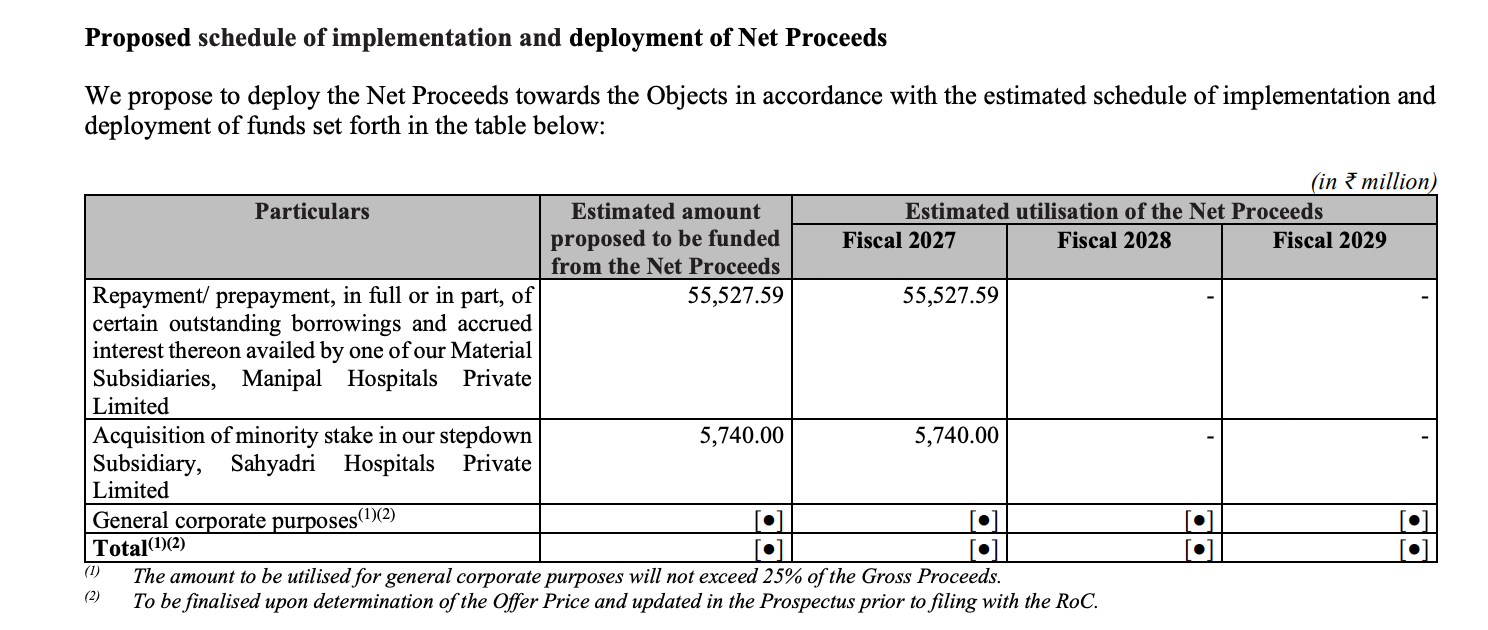
So, this is not a traditional expansion IPO. It is fundamentally a balance sheet repair job.
That said, Manipal has plenty of tailwinds working in its favour. A rapidly ageing population, rising health insurance penetration, and a growing affluent class spending more on premium healthcare provide a steady long-term runway.
Moreover, Manipal has reduced its geographic dependence on Karnataka, bringing that state's revenue contribution down from nearly 60% in FY24 to around 46% today.
Still, real challenges remain. Private hospitals operate under constant public and regulatory scrutiny. Government price caps on medical devices, insurance reimbursement rules, and strict healthcare regulations can quickly squeeze operating margins. On top of that, integrating multiple acquired hospital chains with different corporate cultures, medical teams, and operating systems is always a complex task.
That leaves investors with a crucial trade-off to evaluate.
On one hand, a company using IPO money to pay off debt might sound far less exciting than one promising aggressive new expansion. On the other hand, if that debt was used to acquire high-quality, revenue-generating assets, paying off the loans today could instantly boost tomorrow’s net profit by eliminating heavy interest burdens.
So, the success of the Manipal Hospitals IPO ultimately hinges on whether its acquisition strategy delivers the long-term returns management expects once the debt burden is lifted.
That said, the broader shift toward organised, professionally managed hospital networks in India is undeniable. But as retail investors, we cannot just bet on a rising industry. We have to ask whether Manipal’s combination of scale, acquisition-driven growth, and balance sheet repair justifies paying top-dollar valuations alongside the industry's premier chains.
Because once the bell rings on listing day, leadership in bed capacity will not be enough on its own. Manipal will have to prove that its scale can translate into sustainable net profits for public shareholders.
Until then…
If you liked this story on the Manipal Health Enterprises IPO, feel free to share it with your friends, family or even strangers on WhatsApp, LinkedIn, and X.
Also, we’re looking for a business writer to join Finshots’ newsletter team. If you’re someone who can tell compelling stories and explain financial concepts in plain English without drowning readers in jargon, do consider applying through the link here. Or share this with someone who might be a good fit for the role.