
Can Starlink win India’s internet war?
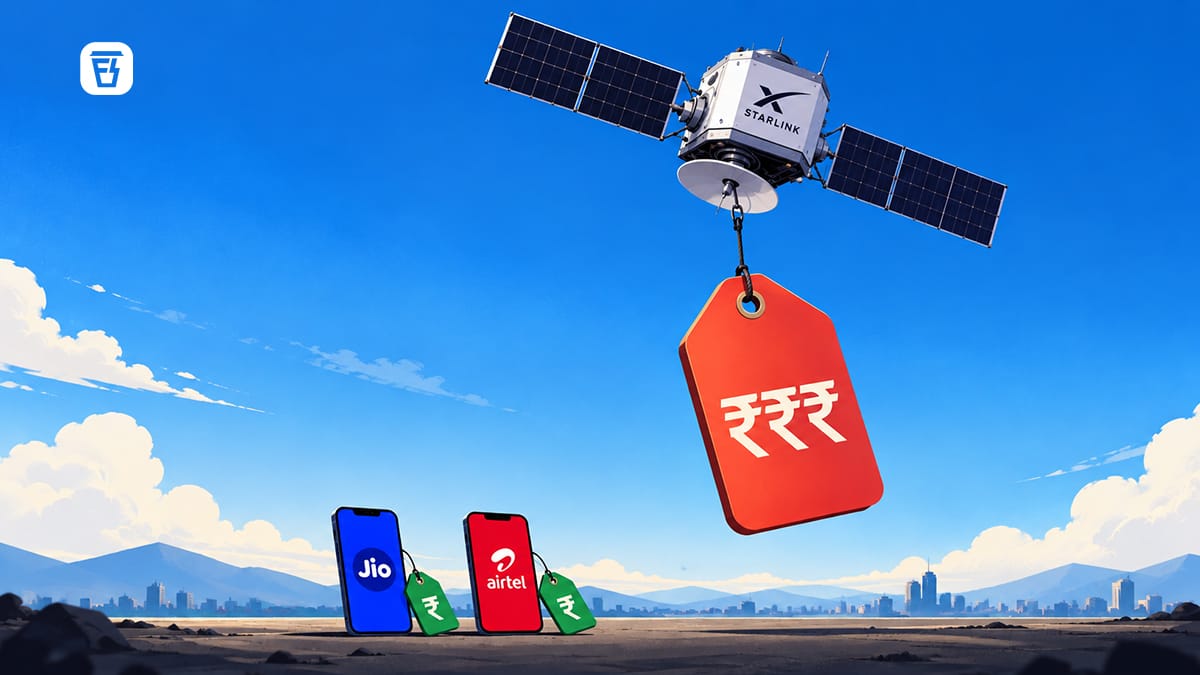
Elon Musk says Starlink will be “affordable”. But in a country where internet data costs next to nothing, can it compete with the likes of Jio? That’s what we explore in today’s Finshots.
Before we get into today’s story, a quick note from the Finshots team!
Ditto is hiring a Performance Marketing Executive. If you have hands-on experience running campaigns on Meta Ads and Google Ads, and enjoy working on campaigns that drive measurable results, we’d love to hear from you.
Think this sounds like you? Click here to apply.
Now, on to today’s story.
The Story
Of late, you may have seen Elon Musk making a barrage of frustrated comments about the Indian government and domestic corporates, particularly Mukesh Ambani.
If you haven’t, here’s some context. Musk isn’t happy with how the Indian government is handling Starlink’s final approval to launch its satellite internet service in India.
For the uninitiated, satellite internet delivers connectivity through satellites orbiting the Earth, rather than fibre optic cables or mobile towers. And Starlink uses thousands of small satellites orbiting relatively close to Earth to provide this service.
But there’s a catch. Unlike regular broadband, where providers can expand capacity by laying more cables or setting up more mobile towers, satellite internet has limited capacity that must be shared among customers in the same coverage area. Adding more satellites isn’t an easy solution either because that takes a considerable amount of time and money.
Now, Starlink has already signed agreements with Indian telecom operators Jio and Airtel to bring its services to India. But it also wants to enter the market with its own offering, while domestic players are preparing to launch their own.
But before they can begin commercial operations, these companies need government licences, regulatory and security clearances, and spectrum allocation. Right now, three operators — OneWeb India, Jio Satellite Communications and Starlink, have secured the licence, but other clearances and spectrum allocations are yet to be finalised for everyone.
And despite being at a similar stage in the approval process, Musk strongly believes that “oligarchs” like Ambani are lobbying the Indian government to create hurdles for Starlink’s entry into India.
Now, this debate is as much about politics as it is about business. So let’s put the political drama aside for a while and look at the business side of things. If Starlink and the domestic players eventually get the green light, can a foreign operator actually compete in a market like India, where internet is already dirt cheap?
The answer might not be straightforward. But there’s one thing we all know. Competing with Jio and Airtel on price could be extremely difficult, particularly in cities and towns where these companies already have a strong presence. Sure, Musk has said that Starlink’s service will be “affordable”. But the company hasn’t announced its official Indian pricing yet.
So, to get a sense of what customers might have to pay, let’s look at its pricing in neighbouring Bangladesh. There, a Starlink connection costs roughly ₹3,295 a month for speeds of around 200 Mbps. Customers also have to pay about ₹20,800 upfront for the hardware. That means the total expense in the first year would be roughly ₹60,000.
That’s about 2 to 4 times Jio and Airtel’s regular broadband plans offering similar speeds, without requiring customers to make a similarly large upfront investment in hardware. In a price sensitive market like India, that could make it difficult for Starlink to attract customers who already have access to affordable broadband.
There’s another problem. India could end up with more satellite internet capacity than customers willing to pay for it. To put that in perspective, research firm Analysys Mason estimated that demand would grow from 44 Gbps in 2023 to over 3 Tbps by 2032. But the capacity proposed by various operators seemingly exceeds this. If that happens, companies could end up fighting over a limited pool of customers, which could force them to cut prices and eventually force some players out of the market.
But let’s just assume for a moment that Starlink decides to price its services reasonably to win customers. After all, Musk has deep pockets and could try the same strategy Jio used to shake up India’s telecom market. Would competing be easy then?
Well, maybe not. Because you see, the biggest advantage Jio and Airtel have is their existing customer base. They’ve also made their broadband plans more attractive by bundling internet with entertainment subscriptions and other digital services. That makes the package more valuable and gives customers fewer reasons to switch providers.
Starlink may struggle to match that value when it first enters the market. If you’re wondering why, telecom companies have already invested heavily in fibre optic cables, especially in cities and towns. Once those cables are in place, connecting another household costs relatively little. This allows providers to offer fast internet with generous data allowances at affordable prices. Satellite providers, on the other hand, have limited network capacity to share among customers. That makes it harder to offer similarly generous data plans at comparable prices while also bundling a wide range of other services.
And finally, there’s one more hurdle Starlink will have to deal with: the number of customers it can serve. The government has said that Starlink can have a maximum of 20 lakh customers in India, with speeds of up to 200 Mbps. The official reason for this limit is Starlink’s existing network capacity, which must be shared among customers within its coverage areas. In other words, Starlink cannot keep adding customers indefinitely with its current capacity without potentially affecting service quality.
But there could be another unofficial and alleged reason behind the cap. The government protecting domestic players.
See, Starlink’s biggest opportunity could lie in places where Jio and Airtel have limited coverage. Places like rural and remote areas where laying fibre optic cables or setting up mobile towers may not make commercial sense.
But these are also areas where BSNL and Jio have a significant presence. So the customer cap could also be viewed as a way of protecting BSNL and private telecom operators from competition. That’s not us saying this, but something that PTI and other media reports suggest.
Either way, this customer cap is a challenge for Starlink as it will have to focus on those who have no other reliable internet option, or urban customers who wouldn’t mind paying a premium. Or there could also be demand from hilly and border areas, islands, coastal regions, and businesses and government institutions that want satellite internet as a backup to their existing connections.
Bangladesh offers a glimpse of what this could look like. Starlink had just 1,862 customers four months after launch. By May 2026 or roughly a year later, that number had grown to 5,389, most of them corporate users who mainly used it as a backup connection.
But this small pool doesn’t mean that Starlink can’t make money in India. According to The Washington Post, capturing even 1% of India’s broadband market could translate into $1 billion in annual revenue. And if a significant chunk of that comes from business customers like banks, ships, airlines, defence establishments and businesses in remote locations, Starlink could have a better shot at profitability, as these customers may be willing to pay more for reliable connectivity, making them potentially more lucrative than individual households.
But yeah, we’ll only have to wait and see how this battle which Elon Musk seems to be treating like a war, eventually plays out. If this is what things look like before Starlink even begins operations, we can only imagine what it’ll be like when it finally enters the market and local telecom operators launch their own satellite internet services.
All we can say is, fingers crossed. Hope another telecom or internet company doesn’t bite the dust.
Until then…
Don’t forget to share this story on WhatsApp, LinkedIn, and X.
And if you’re someone who loves keeping tabs on the world of business and finance, hit subscribe if you haven’t already. And if you’re already a subscriber, thank you! Maybe forward this to someone who’d enjoy our stories but hasn’t discovered us yet.
Trust Finshots for Finance? You'll love Ditto for insurance.
Built by the same four friends behind Finshots, Ditto is here to make insurance simple. No spam, only honest advice to help people make smart insurance decisions.
✅Backed by Zerodha
✅Rated 4.9 on Google (34,000+ reviews)
✅Over 7 lakh customers advised