
Can India truly kill red tape?

In today’s Finshots, we talk about the Draft Digital Trade Facilitation Bill 2026.
But before we begin, if you’re someone who loves to keep tabs on what’s happening in the world of business and finance, then hit subscribe if you haven’t already. If you’re already a subscriber or you’re reading this on the app, you can just go ahead and read the story.
The Story
India has spent the better part of the last decade trying to improve its ease of doing business environment. And these improvements have come in waves. First, company incorporation was simplified through the Companies Act, 2013. Next, insolvency rules were tightened under the Insolvency & Bankruptcy Code, 2016. And in 2017, various indirect taxes were unified under GST.
All of this led to one thing: An increased ease of doing business in the country.
Yet some businesses complain that the everyday friction of operating in India still remains stubbornly high, and surprisingly old-fashioned.
We’re not talking about corruption scandals or sweeping policy failures but what usually lies in the day-to-day operations of some industries. One of them being moving goods across the border.
You see, when an Indian exporter prepares a shipment, the physical logistics may be ready within a few days, but the administrative logistics often take longer. This is because trade is also about documentation as much as it is about the actual cargo.
If you want to import or export goods from India, you need specific documentation. And a lot of it. Here are some examples:
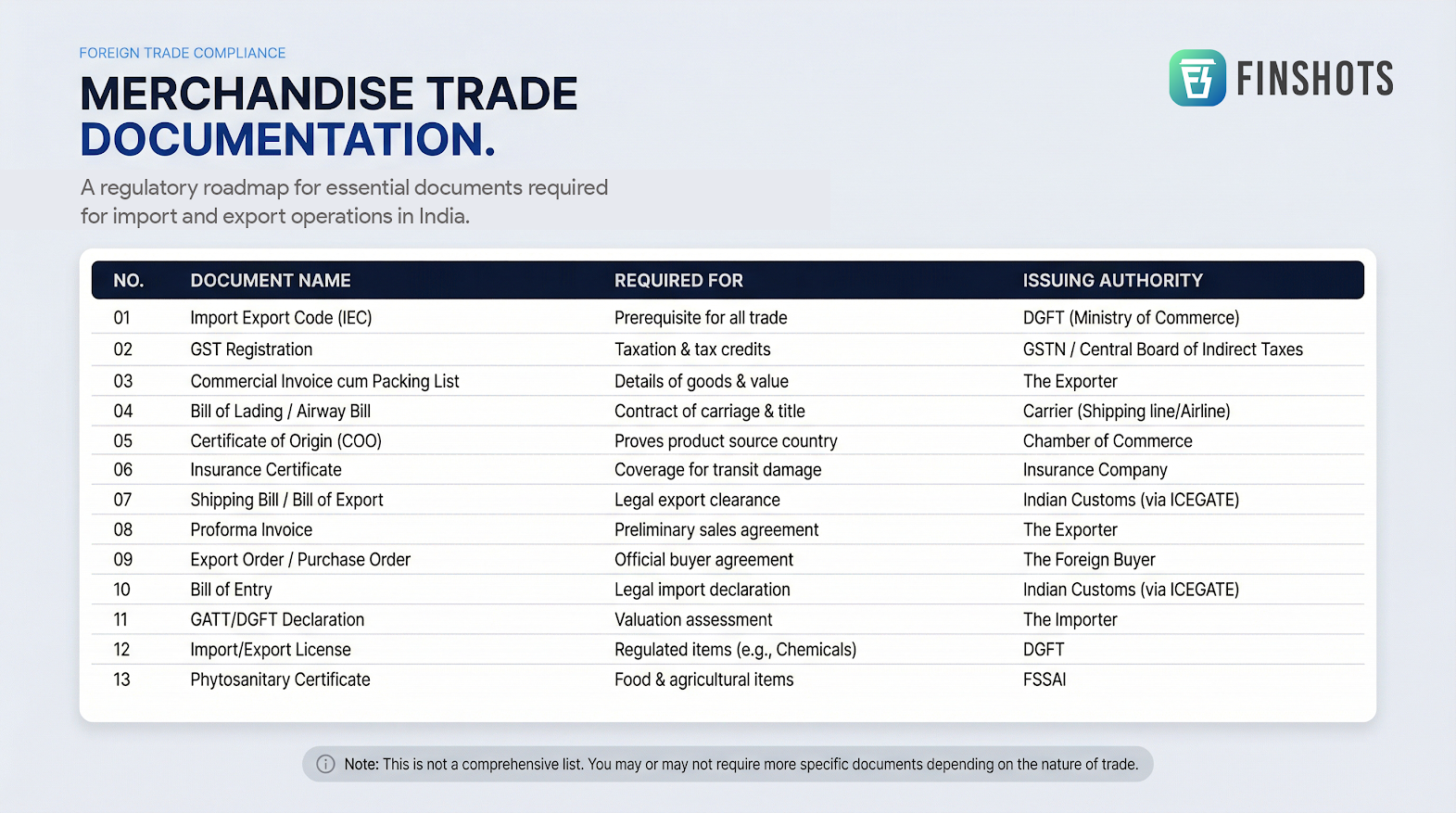
You need a Bill of Lading to prove the shipment exists and has been loaded. An Import Export Code to legally engage in cross-border trade. A DGFT (Directorate General of Foreign Trade) declaration to confirm compliance with India’s foreign trade policy. An export order outlining commercial terms between the buyer and seller.
Add to this the commercial invoices, certificates of origin, customs declarations, and much, much more. Each document serves a regulatory or commercial function. And together, they form a compliance structure that can slow transactions even when the goods themselves are ready to move immediately.
Take the Bill of Lading. At its core, it is a receipt issued by the shipping line confirming that goods have been loaded onto a vessel. But it is also a document of title, meaning whoever holds it can claim the goods. That makes it a legally powerful and sensitive document.
Then, there is the DGFT declaration, which ensures that the transaction aligns with India’s foreign trade policy. Certain goods are restricted, some require licenses, and others may qualify for incentives. This declaration brings the shipment within that policy framework.
Now imagine these documents being issued digitally abroad. Suppose a certificate of origin is generated overseas or a shipment document carries a foreign digital signature.
Currently, that does not automatically guarantee acceptance by Indian authorities. And if our legal frameworks do not recognise the authenticity of those foreign digital credentials, businesses may be required to recreate the document domestically, secure fresh attestations, or even revalidate signatures under Indian systems.
That’s a huge headache!
And this is precisely the bottleneck the Draft Digital Trade Facilitation Bill 2026 is attempting to address.
The Union Budget 2026 once again highlighted how ease of doing business is central to India’s growth. Alongside tax certainty, litigation reduction, and investor access, digitisation was highlighted as a structural lever.
But digitisation without legal backing has limits. This is because a document created electronically does not meaningfully reduce friction if the law still privileges its paper equivalent. The Draft Digital Trade Facilitation Bill focuses exactly on correcting that imbalance.
Its proposal is straightforward: electronic trade documents should have the same legal standing as their paper counterparts. If an electronic bill of lading, certificate of origin, invoice, or customs declaration satisfies defined reliability standards, it should not require a parallel physical version merely for formal validity.
This matters because trade documentation operates on trust. Historically, this trust was established through physical possession, ink signatures, and official stamps. But the Bill shifts that logic toward digital assurance.
It proposes a framework for recognising electronic signatures, digital identities, and accredited trust service providers (government-recognised organisations that issue and manage digital signatures and electronic certificates). In practical terms, this means that authenticity would be determined through cryptographic validation online rather than physical inspection.
One of the more consequential elements of the draft is its approach to cross-border recognition. If a foreign-issued electronic document or digital signature meets standards comparable to India’s reliability thresholds, it may be recognised without requiring duplication within the country. This addresses the structural problem that currently forces businesses to regenerate or revalidate documents simply because they originated abroad.
It is also worth noting that we are not starting from scratch. Section 19 of the Information Technology (IT) Act, 2000 already lets the Central Government recognise foreign certifying authorities, provided their “reliability standards” are comparable to those of India’s.
So, in theory, this means foreign digital signatures can be accepted within India. But in practice, this provision does not create a sector-specific, operational framework tailored to trade documentation.
Recognition under the IT Act also requires formal notification, and it does not automatically integrate with the customs department. So, while the IT Act establishes the legal possibility of cross-border digital trust, it did not build the institutional coupling required for trade recognition.
The Draft Digital Trade Facilitation Bill fills that gap by creating a separate system or rules that clearly define what “trust” means in the trade ecosystem and makes sure that countries formally recognise each other’s digital documents.
The emphasis here is not on eliminating regulation, but on eliminating red tape. Each document will still serve its regulatory purpose. And customs authorities will still verify compliance. What changes is the mechanism of verification. Instead of treating digital documentation as a convenience layered on top of paper systems, the Bill attempts to make digital documentation the primary legal instrument.
In theory, this allows clearance processes to become less dependent on manual verification steps. As a result, working capital cycles shorten when goods spend less time waiting for documentation alignment.
That was about the draft that’s currently under discussion. But we took it a step further and thought about how its goals could be made more practical using distributed ledger technology (a shared digital record system that isn’t controlled by one single authority). For instance, smart contracts (self-executing agreements written in code) on a blockchain (a type of distributed ledger that stores data in secure, linked blocks) could potentially act as a complementary layer to digital trade documentation.
When a bill of lading is generated, for instance, it would be time-stamped, hashed (converted into a unique digital fingerprint that proves it hasn’t been changed), and recorded immutably. Any amendment would create a visible audit trail rather than overwrite the original record. Customs officials, banks financing the shipment, insurers, and port authorities could access the same verified version in real time, eliminating the need for repeated submissions or manual cross-checks.
Another advantage is that if no single party can retrospectively amend records without consensus, the space for “informal intervention” narrows considerably (in simple terms, what we’re trying to say is that smart contracts can reduce corruption).
India has already experimented with blockchain-based solutions in public infrastructure, including efforts to improve access to clean water. Applying a similar architecture to trade documentation could reduce disputes, enhance transparency, and build confidence across trading partners. The Draft Bill does not mandate such systems, but its recognition of digital trust frameworks creates space for them to evolve.
Ultimately, the Draft Digital Trade Facilitation Bill should be viewed as foundational reform. It addresses one of the oldest sources of friction in Indian trade: the bias toward paper. If passed and implemented effectively, the Bill would align India’s trade processes more closely with our Digital India ambitions. But for now, this is just a draft, and we’ll have to wait and see how it moves forward after public consultation.
Sure, it may not resolve every procedural challenge immediately. But there’s no denying that it has the potential to remove one of the most persistent and avoidable obstacles in India’s trade ecosystem, bringing day-to-day commerce closer to the realities of a digital economy.
Until then…
Don’t forget to share it with your friends, family, or even strangers on WhatsApp, LinkedIn, and X.
A quick sidenote for NRIs.
Did you know many Indians abroad end up paying 2–3x higher premiums for life insurance overseas?
But buying term insurance from India isn’t as straightforward as it sounds. There are country risk lists, medical requirements, income documentation rules, and repatriation nuances most people miss.
So we put together a no-nonsense guide on Term Insurance for NRIs in India…
…including premium comparisons and which insurers actually make NRI applications smoother.
If you live abroad or plan to move, this might save you some trouble and money.