
An exciting announcement, Met Gala's economics, and more...

Hey folks!
This isn’t your usual Sunny Side Up because we actually have something exciting to share with you.
Now, we know some of you were probably waiting for this in your inbox yesterday. But an unexpected technical glitch completely flopped our plans of making this big announcement via email. So here goes.
We’re trying something new.
Starting next week, we’re launching a new series where we take a few carefully picked economic ideas and show you how they play out in real life.
Because we read about economic theories all the time. But no one really tells us how to use them. So we thought we’d fix that.
Introducing Finshots Pocket Economics — a new series where we break down one idea every week and show you how it can help you make better decisions in everyday life. Whether it’s your career, relationships, spending, or saving.
So yeah, think of it like an economics textbook, just pocket-sized, and actually useful.
We hope you enjoy reading it as much as we enjoyed working on it.
We’ll see you next Saturday in place of the weekly wrapup. And yes, your usual Markets edition will now come out on Friday mornings while this series is on.
That also reminds us... the technical glitch we mentioned earlier meant that some of you may not have received the link to our latest Markets edition on Electronic Gold Receipts (EGRs). So if you missed it, you can check it out here.
Here’s a soundtrack to put you in the mood…
Ee Janumave Aha by Ilaiyaraja and Kailash Kher
You can thank our reader Namdev Shenoy, for this lovely recommendation and its mouth-watering lyrics.
What caught our eye this week
The economics of the Met Gala
It’s that time of the year again when the world’s biggest celebrities spend months preparing for the Met Gala, only for the rest of us to sit in our pyjamas at 2 a.m. wondering, “What is she even wearing?”
But why are we at Finshots even talking about it?
Well, because the grand event happened on Monday and, being the curious bunch we are, we were keen on understanding the economics behind it. And honestly, the numbers are even more jaw-dropping than the outfits on the red carpet.
For the uninitiated, the Met Gala began in 1948 as a fundraiser for the newly founded Costume Institute at the Metropolitan Museum of Art in New York. Back then, it was basically a dinner event hosted by fashion publicist Eleanor Lambert, with tickets priced at just $50.
But today, it’s a completely different beast.
A big reason for that transformation is Anna Wintour, the former editor-in-chief of Vogue and one of the most influential people in fashion. Over the years, she turned the Met Gala into both a global pop culture moment and a massive revenue machine for Vogue and its parent company, Condé Nast, which now co-organise the event.
Every year, the gala revolves around a theme. It could focus on a designer, a historical era, or a broader concept. Guests are expected to dress accordingly, and that’s what actually sets the stage for some of the most elaborate looks of the year.
The theme essentially acts as a creative brief for designers. This year’s theme, for instance, explored fashion through the lens of art and the dressing the body across history (If you saw Karan Johar and Manish Malhotra’s looks, you may have already gotten a hint. Vir Das’ meme about it probably helped too. 😂) Designers then create elaborate outfits around that idea, showing off both their creativity and technical skill.
Meanwhile, the museum gets something equally valuable — intellectual credibility that helps maintain the Costume Institute’s status as a serious academic institution.
And with that status comes money.
First, through ticket sales. This year, a single ticket reportedly cost $100,000, roughly 30% more expensive than last year. And if you wanted a table for 10 guests, prices started at $350,000. Many of these tables were bought with tech money. Companies like Amazon, Meta, OpenAI, and Snapchat sponsored tables, while Jeff Bezos and his spouse alone were said to have spent $10 million on sponsorships.
Then there’s advertising. And for that, the Met Gala uses its most valuable asset — the red carpet.
Vogue sells advertising slots around the event and runs livestreams and liveblogs that attract huge global audiences. Last year, for example, Vogue sold two advertising spots during its livestream for $1 million each. And if you think that’s expensive, think again because the value rises even further when celebrities and influencers amplify the event across platforms like Instagram.
But arguably, the biggest advertisements are the celebrities themselves as luxury brands often buy seats at tables and invite celebrities as their guests. They fly these celebrities in, custom-design their outfits, arrange hotels for them to stay at, and handle styling — all in exchange for one thing: a viral red carpet moment. Designers essentially lend out outfits for free because the red carpet moments live forever on the internet. And that generates massive media value, even though nobody is directly buying those designs or costumes.
To put this in perspective, a 2023 analysis by software company Launchmetrics estimated that the Met Gala generated nearly $1 billion in media impact value, which apparently even surpassed that of the Super Bowl. By 2024, that number had jumped to $1.4 billion! And this year’s event reportedly generated nearly $250 million in media value within just hours of the red carpet opening, reaching over 523 million users.
The most fun bit though, is that the economic impact doesn’t stop with fashion brands or the museum.
The event creates work for photographers, makeup artists, hairstylists, event managers, security personnel, and technical crews. Local businesses like caterers, florists, hotels, and transport services also benefit. And with guests and staff flying in from across the world, the event also creates a spike in tourism revenue for New York.
So yeah, the Met Gala may look like a glamorous fashion parade. But behind the curtain, it’s also ironically a charity fundraiser, a giant advertising platform, a media spectacle, and a global marketing machine — all rolled into one evening on the steps of a New York museum.
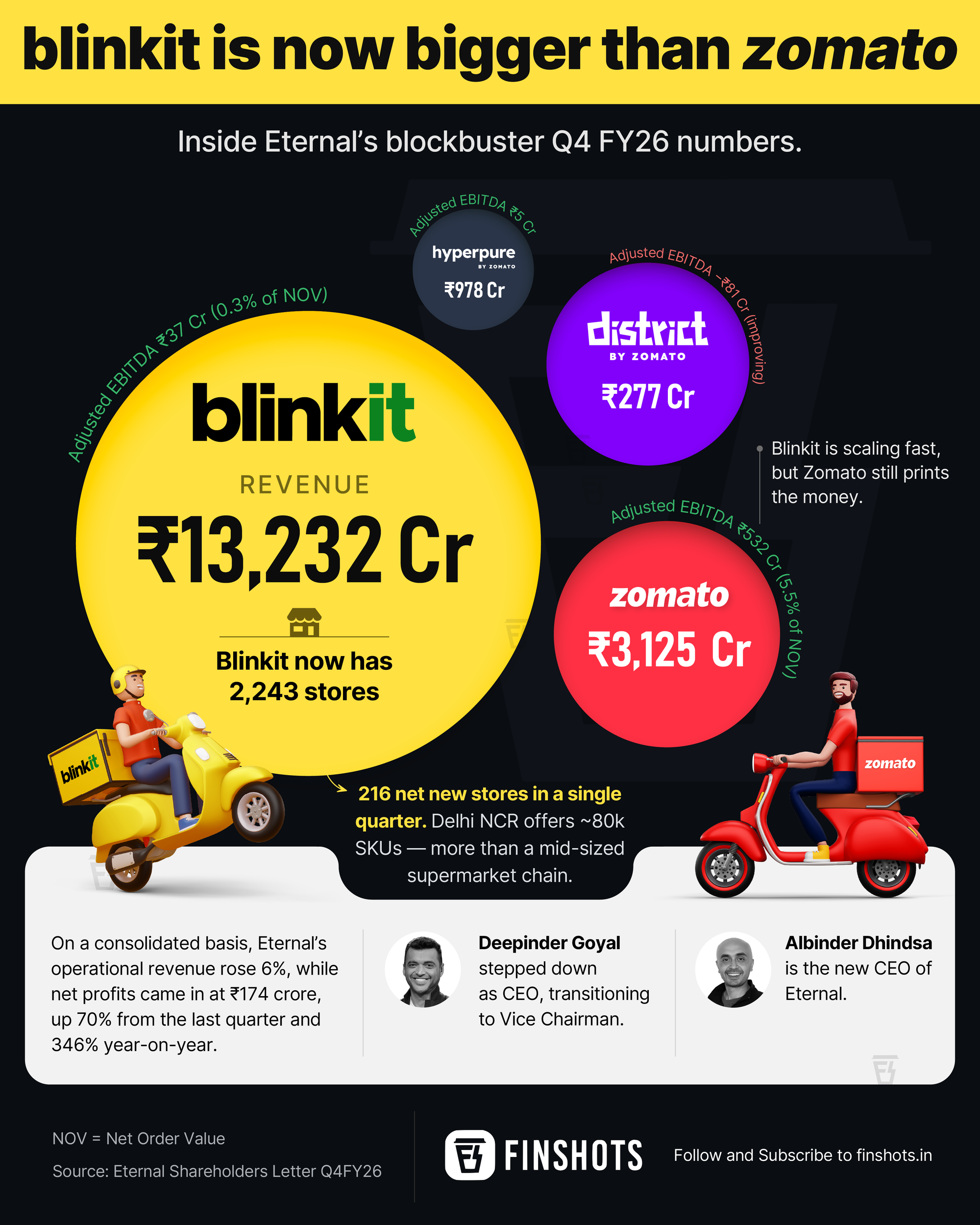
Infographic
Eternal just released its year-end numbers a few days ago, and they seem to show some strong improvements. The management also hopes to touch $1 billion in operating profit (adjusted EBITDA) by FY29.
But here’s the thing. It took the company 16 years to become operationally profitable for the first time, which only happened back in 2024.
So do you think it can achieve its $1 billion ambition in the next three years?
Readers Recommend
This week, our reader Pavani Chopra, has a rather interesting and unique recommendation for us. She suggests picking up The Egg by Andy Weir.
It’s a very short philosophical story about a man who dies and meets God, only to discover that every human who has ever lived is actually the same soul living different lives across time.
And here’s what Pavani has to say about it:
It’s only about a thousand words long, but it really hits hard. It completely changes your perception of the world and makes you look at life through an entirely new lens. I loved this story because it expanded the way I think, and it’s definitely worth two minutes of your day.
Thanks for the recommendation, Pavani!
That’s it from us this week. We’ll see you next Sunday!
Until then, send us your book, music, business movies, documentaries, or podcast recommendations. We’ll feature them in the newsletter! Also, don’t forget to tell us what you thought of today's edition. Just hit reply to this email (or if you’re reading this on the web, drop us a message at morning@finshots.in).
Don’t forget to share this edition on WhatsApp, LinkedIn and X.