
India’s Social Stock Exchange just got a hat-trick IPO
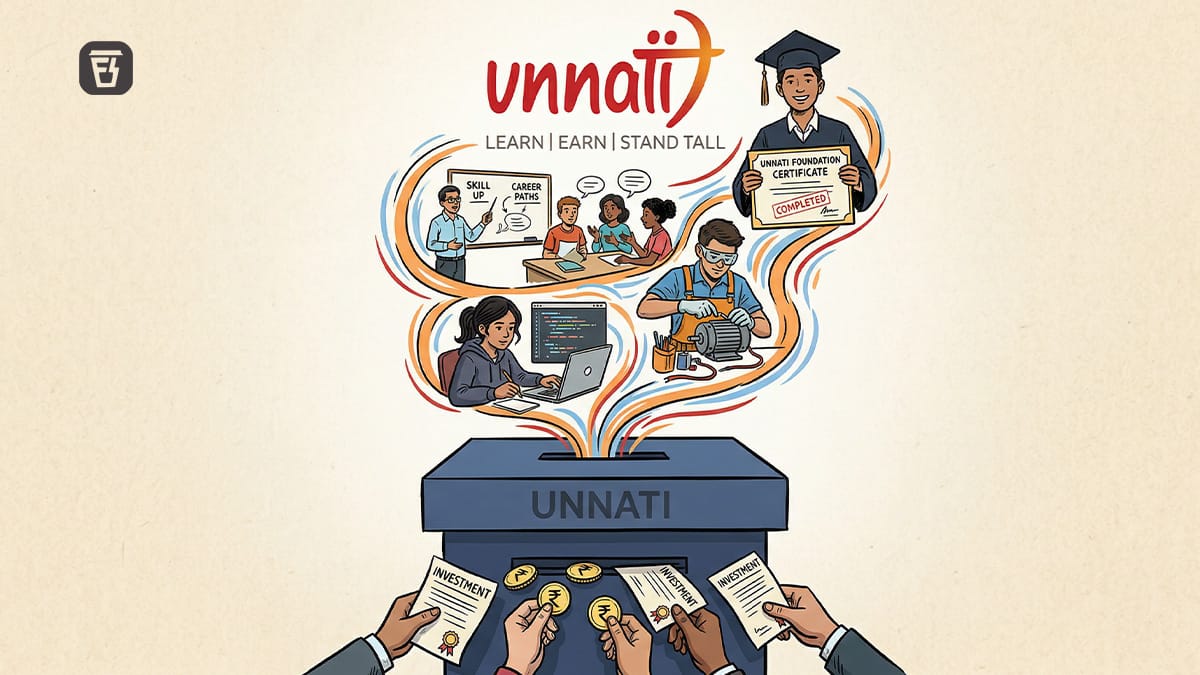
In today’s Finshots, we break down the Unnati Foundation Social Stock Exchange IPO, which opened for subscription last week and closes on 9th March 2026 (Monday).
But here’s a quick sidenote before we begin. This weekend, we’re hosting a free 2-day Insurance Masterclass that helps you build real financial security by understanding health and life insurance the right way.
📅 Tomorrow (Saturday), 7th March at 11:00 AM: Life Insurance
How to protect your family, choose the right cover amount, and understand what truly matters during a claim.
📅 Sunday, 8th March at 11:00 AM: Health Insurance
How hospitals process claims, common deductions, the mistakes buyers usually make, and how to choose a policy that won’t disappoint you when you need it most.
👉🏽 Click here to register while seats last.
Now onto today’s story.
The Story
Today’s Markets edition isn’t a regular one. It’s about an IPO, but not one that will make you any money.
That’s because we’re breaking down the Unnati Foundation Social Stock Exchange IPO. In simple terms, we’re talking about a non-profit organisation raising money through the stock market.
But before we get into that, you might need a quick primer on the Social Stock Exchange (SSE) and why organisations choose to go this route.
An SSE is essentially a platform on the NSE and BSE that allows For-profit Social Enterprises (FPEs) and Not-for-profit Organisations (NPOs) to raise funds through the stock exchange for specific social causes. This process of raising money is what’s called listing on the SSE.
But here’s the twist. When investors participate in these IPOs, they don’t get tradeable shares. Instead, the organisation releases an offer document explaining why it wants to raise money and what kind of social impact it hopes to create.
If you decide to invest, you receive something called a ZCZP, or Zero Coupon Zero Principal Bond. And although this sits in your demat account, unlike shares or regular bonds, it doesn’t generate financial returns. You can’t trade it and you don’t get your principal back either.
You could say that it’s a donation routed through the stock exchange. The only return you get is the social impact your money helps create. But like most donations, you can claim a tax deduction under Section 80G.
Which might make you wonder — if that’s what it is, why bother going through the SSE route at all?
Well, from an investor’s perspective there is one clear benefit. Sure, you could simply donate to any organisation or programme of your choice outside the stock exchange. And yes, you could still claim a deduction under Section 80G for those donations too. But the problem is that it’s often hard to figure out what impact your money is actually creating. You rarely know whether the donation was used for the purpose it was meant for.
The SSE tries to solve that problem. Organisations that raise money through this route must publish SEBI-mandated impact reports. They also disclose how much money was raised, who it came from, and where it was spent. When all of this information is out in the public eye, you as an investor can feel a lot more confident about where your money is going.
And then from the organisation’s perspective, listing on the SSE offers something else — reach. For many social organisations, their visibility is often limited to a few local areas. An SSE listing acts as a supplementary way to raise funds and also helps them reach larger donors like companies, foundations and philanthropists who may otherwise never have heard of them.
With that context out of the way, let’s talk about Unnati Foundation, the organisation that now intends to raise money on the NSE for the third time since 2023. Yes, Unnati Foundation is attempting a hat-trick of fundraises via the SSE. Because clearly, something about this route seems to be working.
To put things into perspective, Unnati Foundation (officially SGBS Unnati Foundation or SUF) is based in Bengaluru and runs vocational training programmes that help underprivileged young people secure stable jobs in the corporate sector.
It was also the first entity to ever list on India’s SSE, both on the NSE and BSE. And this time, it wants to raise ₹50 lakh by issuing ZCZPs worth ₹1 each in lot sizes of 1,000, to train up to 2,867 graduating youth from government colleges through its UNXT programme and support their eventual job placements.
Just to shed some light on what Unnati Foundation already does, it mainly runs three programmes.
First is the Unnati Programme, also called the Vocational Training Programme. This is its original flagship initiative for underprivileged and unemployed youth aged roughly 18–25, including school dropouts and those without formal qualifications. Participants undergo about 300 hours of training in spoken English, life skills, basic computer skills and a specific vocation. The training broadly leads to two roles: Business Associate for domestic voice/BPO and back-office jobs, and Retail Associate for retail and sales roles. And since Unnati has tie-ups with companies such as PVR INOX, Starbucks, IDFC First Bank, Westside, Fabindia, and more, its placement partnerships are fairly well spread out. This helps ensure that the youth who are trained can find jobs at reliable workplaces, often moving from earning as little as ₹10,000 a year to ₹20,000–₹25,000 a month.
The programme runs across about 55 centres, often in partnership with other NGOs. In these partnerships, Unnati provides the trainers, curriculum and placement support. The training lasts about 35 days and is positioned as a programme that leads to a “guaranteed job”. Fees are also nominal — roughly ₹1,000 per trainee, or about ₹5,000 in Bengaluru including food and accommodation. For those who can’t afford it, the fee can be partially or fully waived, with the gap covered through donations.
Then there’s the Sugam Programme, an entrepreneurship accelerator programme for rural and non-urban women who either run or want to start small income-generating businesses. It was launched as a pilot in 2023 and runs as a 7-day residential programme at Unnati’s Bengaluru centre. The programme covers life skills, communication, digital tools, pitching, proposal writing and financial literacy, all aimed at helping women scale their micro-enterprises. It focuses on sectors like agriculture, healthcare and energy, and includes mentoring and funding support through partnerships like the National Rural Livelihood Mission (NRLM).
And finally, there’s the UNXT Programme, which is the one Unnati is raising money for right now. This is a one-month employability programme designed for final-year students in government colleges and ITIs (Industrial Training Institutes) who often struggle to land jobs after graduating.
Around 80% of participants come from economically and socially disadvantaged backgrounds. The programme focuses on life skills like money management, stress management, communication and workplace etiquette. It also covers employability skills such as resume building, interview preparation, leadership and work ethics.
In total, students complete about 165–180 hours of learning through classroom sessions and self-learning on Unnati’s LMS app via courses and videos.
But that raises the next question. How do you evaluate whether putting your money into this cause is actually worth it?
Well, it’s fairly simple. Unnati Foundation has already raised money twice before, and its impact assessment reports offer some meaningful insights.
Take the first fundraiser for instance. The foundation raised ₹1.8 crore from investors such as Infosys’ Govind Iyer, investor Ashish Kacholia, NABARD and Zerodha*. The plan was to raise ₹2 crore and train about 10,000 youth under the UNXT programme. But despite raising ₹20 lakh less than planned, the foundation actually trained 11,376 youth — exceeding its original target. That gives you a sense of how the funds translated into real outcomes.
The second fundraiser tells a slightly different story. This time, the goal was to raise ₹50 lakh to train 3,000 youth under the same programme. However, the foundation managed to raise only ₹39.85 lakh and had to scale down its target, eventually training 2,183 youth.
Still, the impact seems fairly visible when you look at the feedback from participants. Nearly 77% of students rated the programme as good or excellent, and the overall programme received a rating of 4.14 out of 5. That suggests that the training may have been quite useful and effective for the youth who went through it.
But that said, there are a few things you need to know too.
For instance, to keep these programmes running, Unnati Foundation has to attract and retain trainers willing to work across 25 districts in 9 states. Many of these regions are relatively underserved, and finding trainers who are both capable and willing to stay, especially for work that may not be very financially rewarding, can be a challenge.
And while Unnati Foundation seems to have managed this well so far, the future is never entirely certain.
So yeah, that’s your rough metric to gauge whether the money you might want to put into this IPO, if you choose to that is, could actually create meaningful impact. Over the years, listings on the SSE have certainly created some impact, but not quite at the scale many had initially imagined. At least not yet.
For context, an unofficial estimate says that since 2023, there have been fewer than 20 listings on the platform, raising a combined total of just about ₹44 crore. Part of the reason may be the listing requirements themselves. Organisations have to bear the costs of the issue, pay auditors for impact assessment reports, and comply with several regulatory requirements. For smaller but equally impactful organisations, these costs can feel a bit too heavy, even if the SSE could potentially give them a wider fundraising platform.
But despite this slow pace, where this experiment eventually goes, is something we’ll have to wait and see.
Until then…
*Zerodha, through its fund Rainmatter, is an investor in Finshots.
If this slightly different Markets edition helped shine light on a unique IPO and its perspective, why not share it with others on WhatsApp, LinkedIn and X? Who knows the kind of impact (pun intended) it might create? 🙂