
YouTube versus Netflix, biodegradable milk packets, and more...
Hey folks!
When you make your morning coffee or chai, you probably spend less than five seconds tearing open a milk packet.
But there’s something about that milk packet you probably don’t pay enough attention to amid the comfort of your morning cup. Every day, India throws away around 100 to 120 million milk pouches. Most of them end up in landfills because multilayer plastic is notoriously difficult to recycle. That’s also why some brands specifically tell you not to completely separate the little piece you cut off from the packet. Because that tiny bit of plastic can get lost in the trash, making it difficult to recycle and potentially contributing to harmful microplastics that could hurt undersea animals.
And some folks like Mother Dairy noticed this exact problem and decided to do something about it, spending four years redesigning the humble milk packet.
The result is India's first naturally degradable milk pouch. Once discarded, it breaks down into a bioavailable wax that soil microbes can consume, all without making milk more expensive.
Meanwhile, scientists at IISc Bengaluru are tackling the same problem from the opposite direction. Instead of designing better pouches, they’ve developed a way to turn discarded milk pouches into high-strength engineering plastic that can be recycled repeatedly and even used for 3D printing.
Pretty cool, right?
But this isn’t just happening in India. Across the world, packaging has become one of the biggest innovation races in business. For instance, Kimberly-Clark, the company behind brands like Kleenex and Scott, has spent years developing an entirely new plant-based paper fibre that could change how paper towels and tissues are made. If this scales, it could mean that paper towels can be made without actually cutting down trees.
This tells you how even the smallest daily habits can be harmful to the planet, and how the solution isn’t always wind turbines or solar farms.
Sometimes, it could be as simple as reinventing the packaging we use every day so that it disappears long before the planet has to deal with it.
Here’s a soundtrack to put you in the mood… 🎵
Main tera ho gaya by Karneas, Riya, and Simon Vikram
You can thank our reader, Arnav Patil for this lovely recommendation.
Also folks, keep your music recommendations coming. We’d love to feature them in our Sunday editions, especially gems from underrated Indian artists many of us haven’t discovered yet. Can’t wait to hear them!
What caught our eye this week
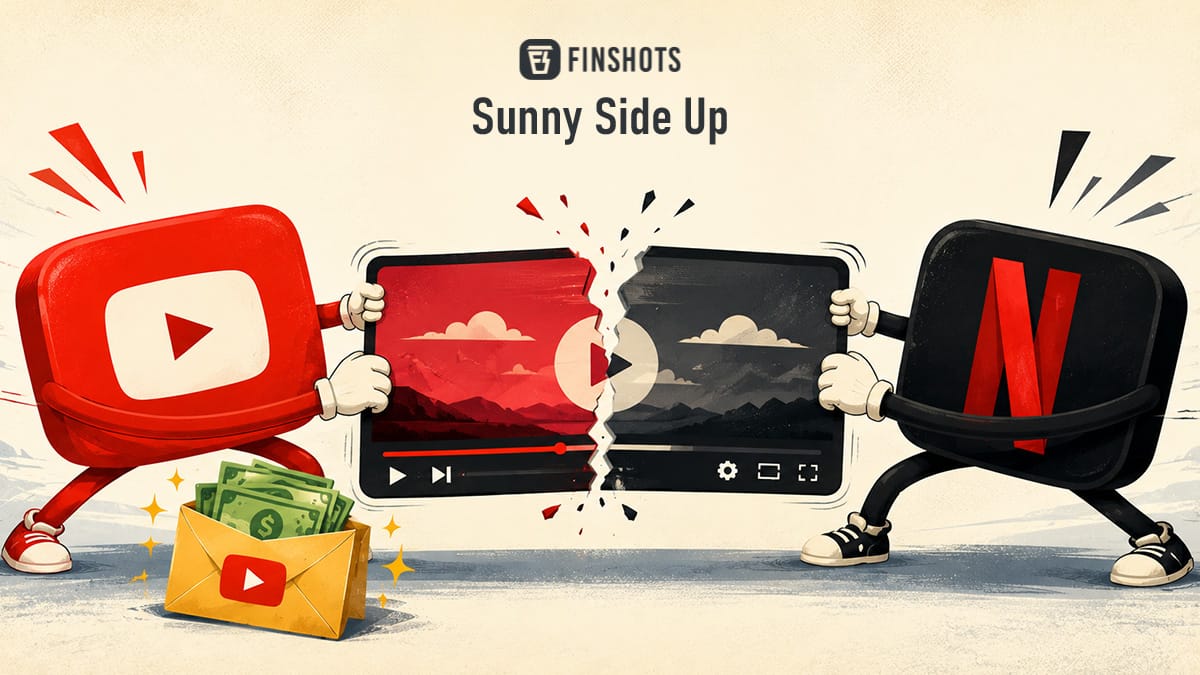
YouTube has a fight to pick with Netflix
When stand-up comedian Samay Raina’s India’s Got Latent returned for another season after the whole “joke gone wrong” fiasco, its distribution was one of the most interesting parts of the comeback. The show was set to stream on both YouTube and Netflix, with episodes being released on both platforms at the same time.
That got everyone talking not just about how the comedian bounced back, but also about this unusual simulcast model.
Afterall, it’s a great strategy for Netflix because commissioning fresh content and hoping that audiences like it is much more expensive than partnering with creators who already have a loyal following. Netflix gets access to an established fan base without having to spend as much time and money building an audience from scratch.
And it’s a no-brainer for creators too because they get extra money for content they’re already making, along with exposure to Netflix’s base of more than 325 million subscribers.
But this model has now turned into a full-blown platform fight between YouTube and Netflix.
Netflix, it seems, is pursuing deals with several popular YouTubers, including creators such as Alan Chikin Chow and Nick DiGiovanni, paying them to post the same videos on both platforms simultaneously.
And as you can imagine, YouTube isn’t exactly liking this “sharing is caring” approach. It is reportedly offering millions of dollars to popular channels and creators to keep their content exclusive to YouTube for a certain period. In other words, YouTube wants creators to stay away from Netflix deals that would make their content available on both platforms at the same time.
The reason?
YouTube believes that cross-posting can hurt viewership on its platform.
But this also makes you wonder. YouTube is free if you’re willing to sit through ads, while Netflix requires a paid subscription. So why is YouTube so worried about Netflix that it’s willing to throw millions of dollars at creators to keep their content away from the streaming giant?
Well, you see, YouTube has spent the last few years trying to become a serious competitor to traditional TV. And it has actually overtaken Netflix in the amount of time people spend watching it on their TV screens. According to Nielsen, YouTube accounts for about 13% of total US TV viewing, compared with just 9% for Netflix.
So if YouTube’s biggest creators start putting their shows on another TV platform, it could lose the very audience it is trying to capture.
And this audience, as you know, is very important because YouTube’s business ultimately runs on views and watch time. So every minute a viewer spends watching a creator on Netflix instead of YouTube is a minute YouTube can’t sell ads against.
Think about it. Many YouTube viewers are also Netflix subscribers. If the same show is available on Netflix without ads, they might simply choose Netflix out of habit and convenience, even though the exact same episode is available for free (but with ads) on YouTube. YouTube then loses the opportunity to monetise that viewer’s attention.
There’s another problem too. If a show is available on Netflix at exactly the same time, YouTube has less of a case to make to advertisers that its inventory is exclusive or difficult to replicate. That could weaken its negotiating power on advertising rates and brand deals around that content.
So yeah, that explains why YouTube is willing to pay its biggest creators to stay loyal, at least during the initial period when the content is still fresh and generating the most views and ad revenue. Once the content gets old enough and has been monetised enough, YouTube can afford to let it go.
And now it’ll be interesting to see what Netflix does next to make sure its creator-led strategy doesn’t get derailed by YouTube’s very deep pockets.
Infographic
Readers Recommend
This week, our reader Lajpat Shah recommends reading The Art of Strategy by Avinash Dixit and Barry Nalebuff.
The book explains how game theory can help you make smarter decisions when your choices affect, and are affected by, other people’s choices. It uses simple examples from business, politics, negotiations and everyday life to show how to anticipate what others might do and choose strategies that work in your favour.
Thank you for the rec, Lajpat!
By the way, this recommendation also reminded us of Finshots Pocket Economics — a series we did not too long ago on how you can use economics to make better decisions in everyday life. We did an edition on game theory too. You can check it out here. And if you like it and want to catch up on the entire series, you can read it here.
That’s it from us this week. We’ll see you next Sunday.
Until then, send us your book, music (preferably from underrated Indian artists), business movies, documentaries, or podcast recommendations. We’ll feature them in this newsletter! Also, don’t forget to tell us what you thought of today’s edition. Just hit reply to this email (or if you’re reading this on the web, drop us a message at morning@finshots.in).
Don’t forget to share this edition on WhatsApp, LinkedIn and X.