
Why PVR INOX let 4700BC go
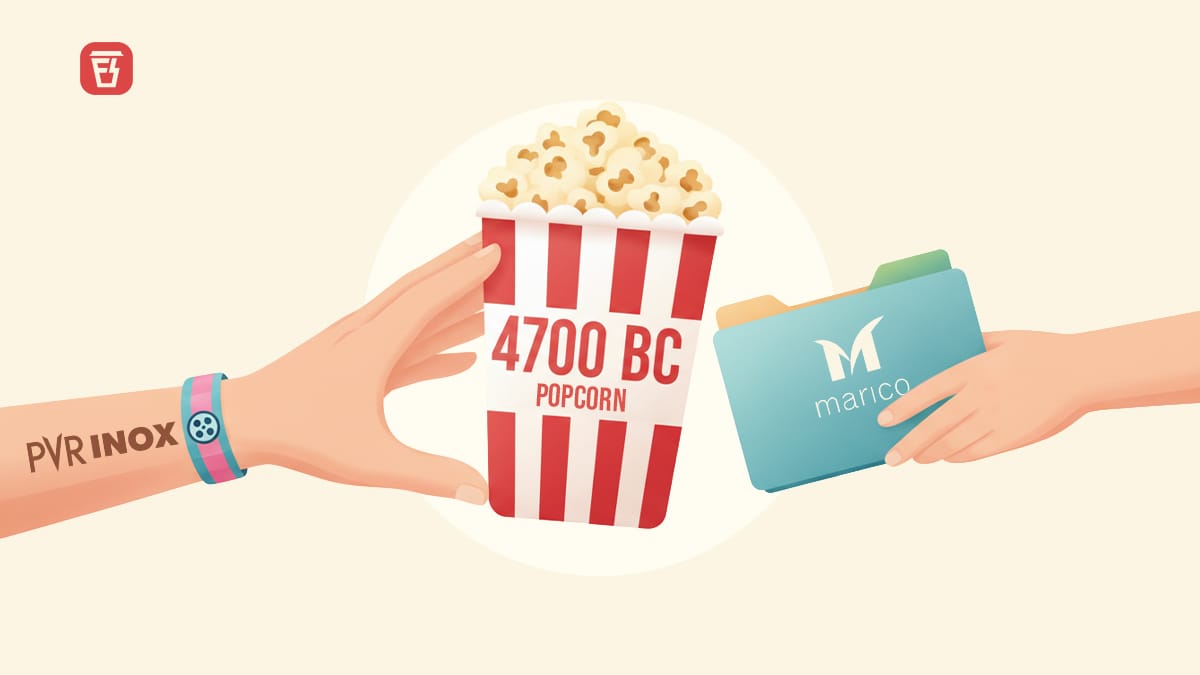
In today’s Finshots, we explain why PVR INOX sold 4700BC, its in-house popcorn brand, to Marico Ltd.
But here’s a quick sidenote before we begin. This week, we’re hosting a free 2-day Insurance Masterclass where we’ll walk you through simple rules to pick the right insurance plan and the common mistakes you should avoid.
📅 Friday, 30th Jan ⏰at 6:30 PM: Life Insurance
How to protect your family, choose the right cover amount, and understand what truly matters during a claim.
📅 Saturday, 31st Jan ⏰at 10:00 AM: Health Insurance
How hospitals process claims, common deductions, the mistakes buyers usually make, and how to choose a policy that won’t disappoint you when you need it most.
👉🏽 Click here to register while seats last.
Now onto today’s story.
The Story
Whether you paid ₹800 for Avatar or ₹450 for Dhurandhar, you probably walked into the theatre thinking the same thing:
‘These tickets are already expensive. I’m not buying anything else.’
Especially not the popcorn.
You promise yourself you won’t buy it. And that ₹450 for popcorn is robbery. But just five minutes later, you’re holding the largest tub available — because the movie hasn’t even started yet. And like any other movie-goer, the munchies kick in even before the opening credits start rolling.
Honestly, you’re not alone. The theatres know this all too well. So much so that they don’t mind losing money on every ticket sold, only to make it back in food & beverage (F&B) sales during the run-time of the movie.
Cinemas have survived because of a simple truth. The tickets might get people in, but the popcorn pays the bills. Which is why it once felt obvious that PVR would own a popcorn brand.
You see, back in 2015, PVR (earlier PVR and INOX were two separate companies) bought a 70% stake in Zea Maize, the parent company of 4700BC for just ₹5 crores. It was at a time when gourmet popcorn wasn’t a mainstream idea. 4700BC was still a local brand serving gourmet popcorn options to a few premium theatres across Delhi.
Now, you might be wondering how popcorn, of all things, can be positioned as premium. After all, it’s just corn kernels that puff up into something mildly addictive during a movie.
That’s where premiumisation comes in. Inside a theatre, a regular tub of popcorn can sell for anywhere between ₹350 and ₹700, depending on the format and toppings. Add flavours, mixes, and branding to the same base ingredient, and suddenly popcorn stops being a filler and starts looking like a differentiated snack. It’s no longer just something to munch on. It’s something that can be priced higher, justified by fresh flavours and perception.
On paper, this looked like a perfect fit. A cinema chain owning a premium popcorn brand seemed like vertical integration done right. After all, who better to run a premium movie snack brand than a nationwide cinema chain?
But a decade after the deal, the numbers told a very different story.
The problem was that cinema popcorn and FMCG popcorn are two completely different businesses.
Inside theatres, popcorn thrives in a controlled, monopoly-like environment. It’s an impulse purchase with no real substitutes. Portion sizes, pricing, and options are entirely dictated by the venue. Even if you want to buy snacks elsewhere, you can’t.
Outside the theatre, though, that advantage disappears. In the FMCG world, popcorn is a low-involvement snack competing for shelf space against cheaper, heavily discounted alternatives — often including unbranded players. So what works in a captive environment doesn’t automatically translate to a supermarket aisle.
Premium pricing was acceptable in theatres. But at home, it became a liability. Consumers compared prices ruthlessly, and few formed habits around popcorn as a daily snack.
So from its inception in 2012 to today, 4700BC became less like an extension of cinema F&B and more like a brand with its own place.
Now, essentially an FMCG startup under the PVR INOX umbrella, it required heavy spending on marketing, distribution, inventory, and discounts. Yet despite strong brand recall and differentiated flavours, the business remained largely loss-making.
For context, in FY25, 4700BC made about ₹102 crores in revenue, a huge leap from ₹15 crores in FY21. But that top line growth didn’t translate into profits. Despite the parent company infusing ₹44 crores into the brand in FY25, its losses only widened from ₹7 crores in FY24, to ₹16 crores in FY25. And when you add the fact that 4700BC contributed just about 2% of PVR INOX’s overall revenue and less than 10% of its total F&B sales of ₹1,827 crore, it forced the company to ask an uncomfortable question: should it continue funding an FMCG popcorn brand at all?
That’s why the timing of the sale matters. Even today, cinema halls haven’t returned to their pre-pandemic revenue levels. PVR and INOX, once fierce competitors, had to merge to survive a period when screens were shut, footfalls collapsed, and fixed costs kept mounting.
Footfalls remain uneven, content cycles are unpredictable, and the business continues to carry the fixed costs of screens, leases, and staff. Against that, PVR INOX has been steadily working to reduce debt and simplify its balance sheet. Between FY23 and the first half of FY26, PVR INOX has brought down net debt from ₹1,430 crores to ₹618 crores.
Keeping that in mind, it made little sense to continue funding a loss-making FMCG brand. Even if they wanted to scale 4700BC, it would mean years of marketing, expansion and distribution costs all while there were no guarantees of profitability. And for a cinema company still rebuilding after COVID, it was a luxury it just couldn’t afford to carry ahead.
Selling 4700BC solved multiple problems at once. It allowed PVR INOX to exit a non-core, loss-making business without disrupting its most profitable activity — selling popcorn inside theatres. The company didn’t need to own the brand to keep earning high margins on in-cinema snacks. That economics was already locked in.
The exit also brought in immediate certainty. The all-cash deal with Marico was valued at ₹226 crore, giving PVR INOX liquidity at a time when capital flexibility mattered more than long-term optional bets. It turned a decade-old ₹5-crore investment into a clean exit without tying up management bandwidth or future capital.
More importantly, it moved 4700BC into the hands of a company that is actually built to run an FMCG brand. For Marico, scaling a popcorn business means leveraging existing distribution, marketing muscle, and category experience. For PVR INOX, it would have meant continuing to learn an entirely different business while carrying the risk on its own balance sheet.
In that sense, the sale of 4700BC wasn’t a retreat from popcorn. It was a return to first principles. PVR INOX didn’t walk away from what makes cinemas profitable. Rather it walked away from a business that felt like a misfit in its balance sheet.
The irony is that popcorn still pays the bills inside movie theatres. It just doesn’t need to sit on the books anymore. The proceeds from the sale can now be used to reduce debt and double down on the core cinema experience, while Marico takes on the long, expensive task of turning 4700BC into a mass premium snack brand.
And if you’re wondering what this means for your next movie outing, don’t worry. 4700BC popcorn isn’t going anywhere. It will still be sold inside cinemas, just as it always has been.
The only difference is that the popcorn will continue to make money at the snack counter, without sitting on PVR INOX’s books.
Until then….
Note: An earlier version of this story stated that 4700BC contributed only 1% of PVR INOX’s F&B revenue. This was an oversight on our part, and the error has now been corrected.
Liked this story? Share it with someone who keeps ranting about cinema hall popcorn prices on WhatsApp, LinkedIn and X.
Also, if someone recommended Finshots to you, why not subscribe to our newsletter? We cut through the jargon and deliver crisp financial insights straight to your inbox. Just one email every morning. Promise!