
Why Meta is betting on CRED
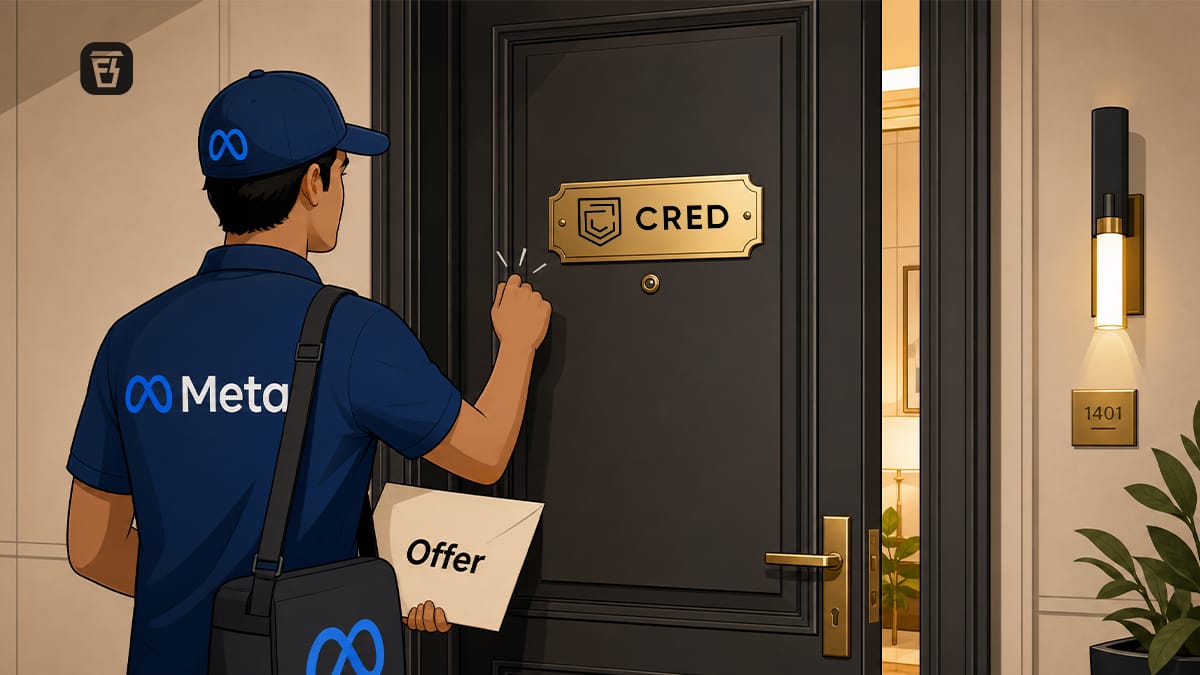
In today's Finshots, we explain why Meta is the last Big Tech company yet to crack India's payments market and what it's doing about it.
But here’s a quick sidenote before we begin. We’re looking for a business writer to join Finshots’ newsletter team. If you’re someone who can tell compelling stories and explain financial concepts in plain English without drowning readers in jargon, do consider applying through the link here. Or share this with someone who might be a good fit for the role.
Now onto today’s story.
The Story
For years, CRED has occupied a strange place in India’s startup ecosystem. It’s one of the country’s most recognisable fintech brands, commands a fiercely loyal user base, and has steadily expanded from credit card bill payments into lending, UPI, rent payments and wealth products.
Yet every conversation about the company circles back to the question: How exactly does CRED make money?
And it’s a fair question. Because for all its popularity, CRED remains a company that’s still figuring out the economics of its business. While revenue has grown steadily over the years, profitability is yet to catch up.
But despite being loss-making, investors haven’t stopped backing the company. In fact, the list of believers may have expanded this week to include one of the biggest names in technology.
According to reports, Meta is set to invest around $900 million in CRED at a valuation of roughly $3.5–4 billion. That’s well below the company’s peak valuation of over $6 billion but still among India's most valuable fintech startups.
Much of this capital is expected to go directly into CRED, giving the company fresh capital to expand.
Which is where the story gets interesting. Because the bigger question isn't why CRED wants Meta's investment. It's why Meta wants CRED.
Let us explain.
Meta isn't short on users. It owns Facebook, Instagram and WhatsApp, which are three of the world's largest consumer platforms. In India alone, WhatsApp reaches hundreds of millions of people. And, it even has its own payments product, WhatsApp Pay.
So why look outside, you ask? If payments are already built into WhatsApp, why invest in another fintech? Why buy a company that's still chasing profitability?
Well, the answer begins with a simple fact. While Meta may own one of India's biggest messaging platforms, it has never managed to dominate payments.
In fact, Meta was one of the earliest big tech companies to bet on India's UPI revolution. It launched WhatsApp Pay in 2018, hoping to turn the country's most popular messaging app into its next payments platform.
But things didn't quite go according to plan. India's payments regulator, the National Payment Corporation of India (NPCI), didn't want any single app to dominate UPI. To keep the ecosystem competitive, it proposed a 30% market-share cap on UPI transactions. In WhatsApp Pay's case, it imposed separate onboarding limits.
That meant WhatsApp Pay could initially onboard only one million users. The limit was later raised to 20 million and eventually 100 million users, before being removed altogether in late 2024.
But by the time those restrictions were finally lifted in late 2024, the race had already been won.
Google Pay and PhonePe had become the default way millions of Indians paid for everything from groceries and cab rides to utility bills and restaurant meals. Together, they now account for more than four out of every five UPI transactions. WhatsApp Pay, meanwhile, processes less than 0.4% of the country's UPI transaction volume, as of June 2025.
Which leaves Meta with an unusual problem… It owns one of India's largest digital platforms, but it still doesn't own one of India's biggest digital habits. And in today's internet economy, that may matter more than the number of users you have.
Which brings us to another important question: Why does Meta care so much about payments in the first place?
Well, because, once you become someone's preferred way to pay, you have a much better chance of becoming their preferred place to borrow, invest or manage money.
Think about the last time you ordered food or booked a cab. You didn't just make a payment. You paid, earned rewards, stored your card, maybe bought insurance, and perhaps even used a buy-now-pay-later option—all without leaving the app.
That's called embedded finance.
The idea is simple. Instead of treating payments as the end of a transaction, companies use them as the starting point for a much larger financial relationship. Once people trust an app with their money, it becomes easier to introduce adjacent products such as loans, insurance, investments, subscriptions and shopping, all within the same ecosystem.
And that’s what makes payments so strategically valuable. The companies at the centre of these transactions don't just process payments—they build long-term financial relationships. That creates opportunities to offer loans, insurance, investments, commerce and other financial services from the same platform.
Over time, these insights can become the foundation for an entire financial ecosystem. Which explains why nearly every major technology company has spent years trying to secure a foothold here.
Google built Google Pay from scratch, and it's now one of the top two UPI apps in the country. Walmart acquired PhonePe as part of the Flipkart deal, and it's the single largest UPI player. Amazon has Amazon Pay. Even Apple is actively negotiating with banks to bring Apple Pay to India.
However, Meta remains the notable exception despite owning one of India’s most widely used consumer platforms.
India now processes over 18 billion UPI transactions every month. The companies that dominate these transactions don't just move money — they own some of the most valuable consumer relationships in the digital economy. Every year Meta is absent is another year its rivals deepen those relationships and strengthen their position.
That may also explain another part of the deal. Alongside the investment, CRED founder Kunal Shah has confirmed that he's moving to WhatsApp. If the investment aligns Meta with one of India's strongest fintech ecosystems, Shah brings something equally valuable: first-hand experience building it.
Which brings us back to CRED. Today, it has about 10 million users, making it one of the largest communities of high-credit-score consumers.
Unlike WhatsApp Pay, CRED isn't trying to convince people to trust it with their money. It already has that trust. CRED only accepts users with a credit score above 750. These are affluent, high-spending users who also use CRED to make UPI payments, pay rent, access loans and increasingly manage other parts of their financial lives. They’re also the kind of customers that banks, insurers and premium brands spend years trying to acquire.
In fact, nearly half of CRED's active users now use at least three different products on the platform. Collectively, they processed over ₹8.5 lakh crore worth of payments through CRED in FY25.
More importantly, they've built a habit, and habits are incredibly difficult to create.
People don't switch payment apps the way they switch social media apps. Once they're comfortable paying through a particular platform, they tend to stick with it. That's one reason PhonePe and Google Pay have remained so dominant despite intense competition.
And that's what makes Meta’s interest in CRED so interesting. In FY25, the company reported operating revenue of ₹2,735 crore while narrowing its net loss to ₹1,457 crore. It's certainly moving in the right direction. But it's still a company that's losing money. Which makes Meta's interest all the more intriguing.
But here's the part that often goes unnoticed. Meta's core business isn't payments. It's advertising. In 2025, advertising alone generated $196 billion. That is about 98% of Meta's total revenue.
That doesn't mean this investment gives Meta access to CRED users' financial data—it doesn't. But it could give it a strategic foothold in one of India's fastest-growing fintech ecosystems. That means closer ties with merchants, financial institutions and a platform that has already earned the trust of millions of affluent consumers.
So perhaps Meta isn't interested in CRED because it could be profitable. Perhaps it's because CRED has already built something Meta couldn't: a trusted financial relationship with millions of valuable users.
And importantly, that relationship remains with CRED. Reports suggest Meta's investment would not give it access to users' financial data, but it would still align the company with one of India's most valuable fintech ecosystems.
For years, Big Tech competed for our attention. But attention was never the end goal. It was simply the first step toward building a deeper relationship with us.
The next frontier is finance. Because once a company becomes your preferred way to pay, borrow, invest, or manage money, it becomes far harder to leave its ecosystem. Payments create habits. Habits create trust. And trust creates opportunities to sell everything else.
That is why Meta's interest in CRED matters.
The deal isn't just another funding round. It will be a sign that the battle for India's digital economy is no longer about who captures the most attention. It's about who owns the financial relationship that follows.
And in India, that battle may have already begun.
Until next time…
Liked this story? Share it with someone who keeps talking about credit scores on WhatsApp, LinkedIn and X.
🚨 ATTENTION: FINSHOTS FAMILY
This week, we’re hosting a free 2-day Insurance Masterclass that helps you build real financial security by understanding health and life insurance the right way.
📅 Thursday, 25th June at 6:30 PM: Life Insurance
How to protect your family, choose the right cover amount, and understand what truly matters during a claim.
📅 Friday, 26th June at 6:30 PM: Health Insurance
How hospitals process claims, common deductions, the mistakes buyers usually make, and how to choose a policy that won’t disappoint you when you need it most.