
What GameStop sees in eBay
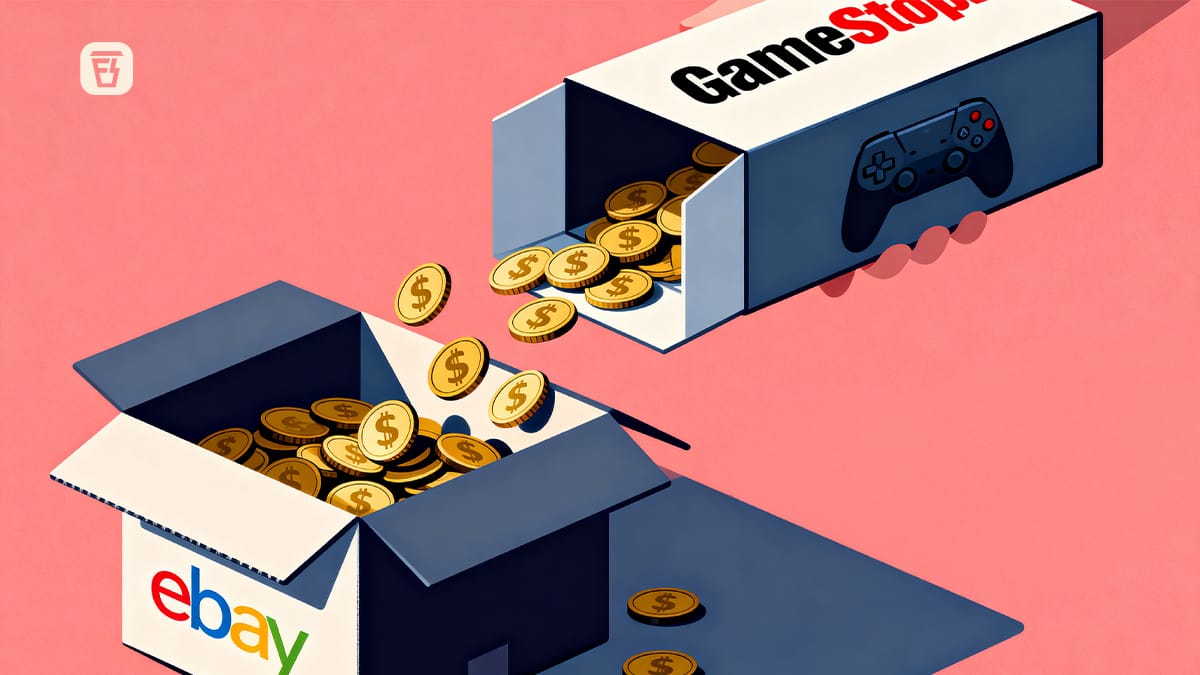
In today’s Finshots, we talk about why GameStop believes eBay could help reinvent its business model.
But here’s a quick sidenote before we dive in. We’re hiring a Content Writer at Ditto Insurance. If you like turning messy, complex topics into clear, helpful content that actually ranks (and gets read), and enjoy going beyond surface-level research, this might be for you. Check out our careers page for more or share it with someone who’d be a great fit.
Now on to today’s story.
The Story
What happens when one of Wall Street’s most chaotic companies tries to buy one of the internet’s oldest marketplaces?
Well, that’s essentially what’s happening with GameStop and eBay.
GameStop is a videogames and gaming merchandise retailer and is best known today for the meme-stock frenzy of 2021. A meme stock is a stock that suddenly becomes popular among retail investors because of social media hype rather than changes in the company’s actual business. We’d written about it here.
eBay, meanwhile, is a global online marketplace that still generates billions of dollars in revenue every year, and effectively four times GameStop’s size.
So the obvious question is why would GameStop even think about buying a company that’s several times bigger than itself?
To answer that, we first need to understand what exactly GameStop is and what it’s trying to become.
See, a few years ago, GameStop looked like a dying business. Its stores still relied heavily on selling physical video game discs even as the gaming industry rapidly moved online. Players were increasingly downloading games directly through platforms like Valve Corporation’s Steam or through digital stores on gaming consoles. Fewer people were walking into stores and buying physical discs was slowly starting to feel outdated.
Then came 2021.
A bunch of folks influenced by a subreddit (Reddit community) called r/WallStreetBets began heavily buying GameStop shares to take on large institutional investors who were heavily shorting the stock (basically, betting that GameStop’s stock would fall because of its failing business model). That triggered one of the wildest stock market episodes in recent history, sending GameStop’s stock price soaring and suddenly turning it into one of the most talked-about companies on Wall Street.
Now, the important thing here is that its business itself didn’t magically change overnight. GameStop didn’t suddenly reinvent retail or discover a breakthrough new strategy. But the stock surge gave the company something incredibly valuable: attention, cash and, most importantly, time.
Even Ryan Cohen, the company’s CEO, has admitted that GameStop probably should have gone bankrupt multiple times over the years. Which tells you how uncertain the company’s future still is.
And that uncertainty is exactly what makes eBay suddenly look interesting.
To understand why, it helps to understand Ryan Cohen himself. Before joining GameStop, Cohen co-founded Chewy, an online pet supplies company that challenged large retailers without depending on massive physical storefronts. Instead, Chewy focused heavily on logistics, online relationships and recurring digital demand before eventually being sold for billions.
So when Cohen looks at GameStop today, he probably doesn’t just see a struggling video game retailer. He likely sees a company trapped in an obsolete business model. And that’s where eBay enters the picture.
Now eBay isn’t some struggling business waiting to be rescued. Founded in 1995, it became one of the internet’s earliest online marketplaces where people could buy and sell everything from comic books and sneakers to second-hand electronics and collectibles. Unlike traditional retailers, eBay usually doesn’t own the products sold on its platform. Instead, it simply connects buyers and sellers and takes a cut from each transaction.
And strangely enough, that overlaps more naturally with GameStop’s business than you might expect.
For years, GameStop made money by buying used games from customers and reselling them at a markup. In many ways, that’s just a tightly controlled version of what eBay already does at internet scale.
So that overlap is probably what seems to be driving this acquisition idea.
GameStop has reportedly proposed acquiring eBay in a deal valued at roughly $56 billion. But what makes the proposal unusual is that GameStop itself is worth only a fraction of that amount. On paper, eBay is actually large enough that it could theoretically turn around and buy GameStop instead.
And yet, Ryan Cohen wants to do the opposite. And this isn’t some random idea that appeared overnight, but something driven by two big reasons.
One, reports suggest that GameStop had already been quietly buying eBay shares since February and now owns roughly 5% of the company. According to the proposal, the combined company could become a much larger player across e-commerce, collectibles and resale markets.
And two, GameStop quite aggressively appears to believe that eBay can be reshaped because Cohen thinks the company has become bloated.
For example, eBay spent roughly $2.4 billion on sales and marketing in FY25. Yet despite all that heavy spending, its active buyer base grew by less than a measly 1% that year to just 135 million users.
So GameStop now claims it could cut nearly $2 billion in annual costs within a year of completing the deal. Around $1.2 billion would supposedly come from reducing sales and marketing expenses, another $300 million from cutting product development costs and another $500 million from combining functions like HR, finance, legal, IT and real estate across the two companies.
On paper, those savings look enormous. Besides, GameStop even claims that eBay’s earnings per share (or a company’s profit divided across all its shares) could jump from $4.2 to $7.7 in the very first year purely because of these cost reductions.
But there’s one massive problem hanging over all of this. GameStop obviously doesn’t have $56 billion sitting in the bank.
So the proposal depends heavily on debt financing, outside investors and GameStop stock itself. And that’s where the story becomes even stranger because GameStop’s shares were inflated during the meme-stock frenzy years ago. Which means the same retail-investor mania that once helped save the company may now help finance one of the most unusual takeover attempts in modern corporate history.
Still, the vision behind the deal goes beyond just cutting costs.
GameStop believes its roughly 1,600 stores across the US could become physical infrastructure for eBay itself. Instead of functioning purely as retail stores, those locations could potentially handle seller intake, fulfilment and even live commerce experiences for a much larger resale marketplace.
That’s a radically different vision for GameStop.
Instead of trying to become a better video game retailer, it may be trying to reinvent itself around second-hand commerce, collectibles and marketplace transactions.
But that’s also why investors remain sceptical.
Running a retailer and running a marketplace are two very different businesses. Retail depends on stores, shelves and inventory. But a marketplace depends on reputation, payments, sellers and keeping millions of users engaged in an ecosystem that mostly runs itself.
And analysts are questioning everything from whether GameStop could realistically integrate a company as large as eBay to whether the financing behind the proposal is even practical. Because if this acquisition actually happens, it could become one of the most heavily leveraged and unconventional deals in modern tech and retail history.
So yeah, the bottom line seems to be that this may not just be GameStop trying to buy eBay. It may actually be GameStop trying to escape the business it was originally built on by becoming the kind of internet marketplace that made physical game stores feel obsolete in the first place.
Until next time…
Liked this story? Share it with a friend, family member or even strangers on WhatsApp, LinkedIn, or X.
Don't miss this Insurance Masterclass series!
This week we’re hosting a free 2-day Insurance Masterclass that helps you build real financial security by understanding health and life insurance the right way.
📅 Friday, 8th May at 6:30 PM: Life Insurance
How to protect your family, choose the right cover amount, and understand what truly matters during a claim.
📅 Saturday, 9th May 10:00 AM: Health Insurance
How hospitals process claims, common deductions, the mistakes buyers usually make, and how to choose a policy that won’t disappoint you when you need it most.