
What went wrong with Sugar Cosmetics?
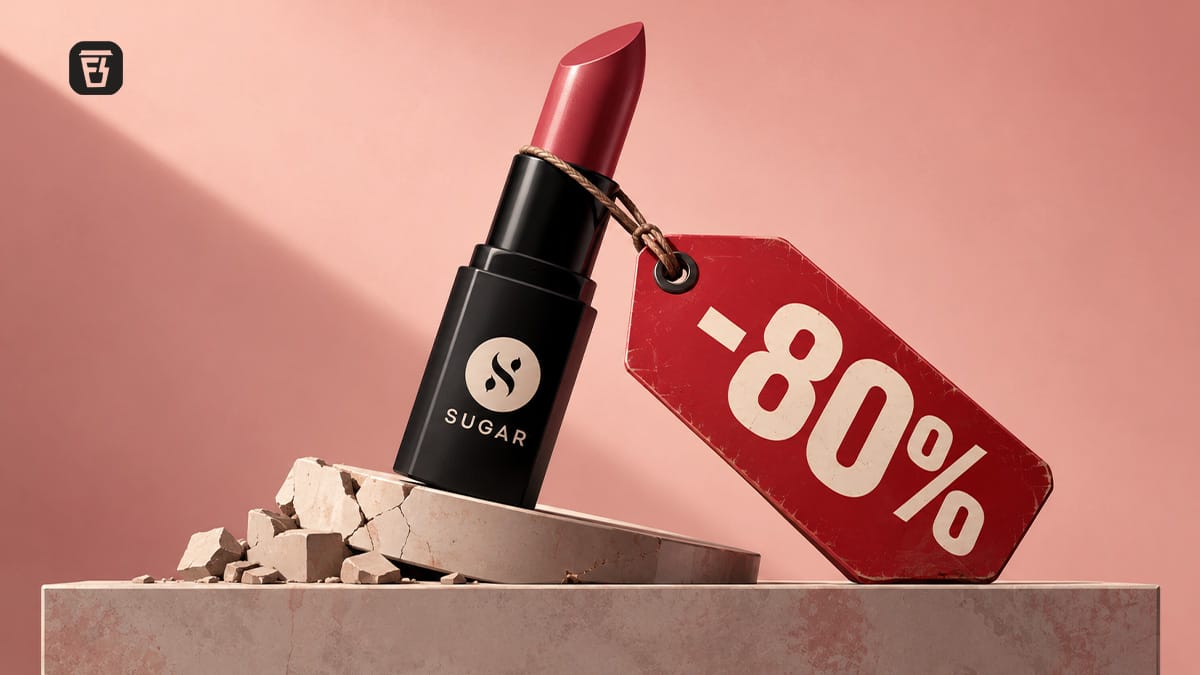
In today's Finshots, we explain what Sugar Cosmetics’ 80% valuation drop reveals about the economics of India's D2C beauty market.
But here's a quick sidenote before we begin. If people depend on your income, you need to read this.
Most first-time earners skip insurance entirely - or buy the wrong thing because someone sold it to them. Both are expensive mistakes.
That's why we're running a 2-day Insurance Masterclass to help you get it right from the start.
📅 Tuesday, 8th September at 6:30 PM: Life Insurance
📅 Wednesday, 9th September at 6:30 PM: Health Insurance
Only 300 seats remaining. 👉🏽 Click here to reserve your spot today.
Now, on to today’s story.
The Story
A few years ago, Sugar Cosmetics looked like the perfect example of India's D2C revolution. The brand was built for young Indian consumers, particularly millennials and Gen Z, with products designed around Indian skin tones and a marketing strategy centred on social media, influencers and digital-first distribution.
Investors too loved this idea, and in 2022, the company raised money at a peak valuation of around ₹2,700 crore, making it one of India's most prominent homegrown beauty startups.
However, the beauty market has changed considerably since then.
Last week, Sugar completed its latest funding round, raising around ₹145 crore from A91 Partners. But the bigger headline was the valuation. The company is now reportedly valued at just ₹550–600 crore, down 80% from its peak valuation. And the deterioration isn't just on paper. In fact, Sugar's operating revenue plunged 20% to ₹404 crore in FY25, while its net loss nearly doubled to ₹135 crore.
And this is primarily because India's beauty market has become fiercely competitive, with Nykaa, Lakmé, L'Oréal, Maybelline, Mamaearth, Kay Beauty, and a growing army of Instagram-first brands all fighting for the same consumers.
So how did a company that once looked like one of India's top consumer startups end up losing so much of its value?
Well, the problem is that building a popular beauty brand is much easier than building a profitable beauty business.
You see, Sugar's original playbook made perfect sense for a Gen Z crowd. They leaned heavily on influencers to build awareness, then kept launching new products to increase how much customers spent.
But the problem was that almost everyone else figured out the same strategy. As competition intensified, acquiring customers became more expensive, and brands had to spend more on advertising, discounts, and influencers just to stay visible, while beauty products aren't necessarily high-frequency purchases.
In fact, industry estimates put the average paid customer-acquisition cost for a D2C company around ₹1,850, while the average order value was only about ₹890. In other words, a brand could potentially spend more than twice the value of a customer's first order just to convince them to buy.
So the entire business model depends on getting that customer to come back again and again, because the first transaction alone may not cover what the company spent to acquire them.
A customer might love a ₹900 lipstick, but he or she isn’t going to buy one every month or even every 2 or 3 months. That makes it hard to recoup a high customer-acquisition cost quickly.
Which brings us to the next problem: brand loyalty in cosmetics can be surprisingly fragile. Consumers can switch between brands relatively easily, especially when competitors constantly launch new products, offer discounts, and work with their favourite influencers.
D2C brands also initially had an advantage because they could bypass traditional retail and sell directly to consumers. But as these companies grew, they eventually needed physical shelves.
But once a brand enters stores and quick-commerce platforms, it has to compete for shelf space against companies that have spent decades building these networks. And unlike a website, a physical shelf has limited space. Every slot given to a Sugar product is one that cannot go to Lakmé, Maybelline, or another brand.
All of this means Sugar cannot simply acquire a customer once and assume they will remain loyal forever. It has to keep giving consumers a reason to come back, which means continuing to spend on marketing and product launches. The same social-media machinery that helped Sugar build its brand can therefore become a recurring expense rather than a one-time investment.
And Sugar wasn't just trying to sell more of the same products. Over time, it expanded into skincare through Quench Botanics, launched teen-focused Sugar Play, introduced the mass-market Sugar POP brand and acquired ENN Beauty. The logic was that if one customer is already buying makeup, why not sell them skincare, fragrances or products from another price segment too?
But every new category brings its own products, inventory, marketing requirements and competitors. Instead of concentrating its resources on becoming the dominant cosmetics brand, Sugar ended up spreading itself too thin.
Eventually, all these problems started showing up in its balance sheet.
That's important because the valuation collapse didn't happen in a vacuum. Investors weren't simply deciding that beauty startups were less fashionable. They were looking at a company whose revenue had fallen by a fifth while its losses had almost doubled. When a business is growing rapidly, investors can tolerate losses because they are betting that today's spending will create a much larger and more profitable business tomorrow. But when revenue starts shrinking while losses widen, that bargain becomes much harder to defend.
During the startup boom, investors were willing to pay huge multiples for revenue growth because they believed today's losses would eventually turn into tomorrow's profits. But both public and private markets have become much more demanding, especially as the era of easy money is coming to an end. So, growth without a credible path to profitability no longer commands the same premium it once did.
That is what makes Sugar's 80% valuation decline so interesting. This doesn't mean India's beauty opportunity is disappearing.
In fact, the opposite is probably true. India's beauty and personal-care market continues to expand as millions of consumers enter organised retail and spend more on discretionary products. What is changing is who gets to capture those profits.
The D2C revolution made it possible to launch a beauty brand without owning factories or thousands of stores, but it also lowered the barriers to entry for everyone else. And once dozens of brands could use the same playbook, competition intensified.
But here's the interesting part. Not every D2C beauty brand followed the same playbook. Take Minimalist, for instance. While Sugar expanded across categories and price points, Minimalist kept its product portfolio, well, minimal, focusing on science-backed skincare and transparent formulations. It also invested in its own manufacturing capabilities rather than relying entirely on third-party suppliers. That gave the company greater control over costs and product development.
And this difference shows up in the numbers. Because HUL acquired a 90.5% stake in Minimalist for ₹2,955 crore in 2025, giving the young skincare brand an exit at almost the same valuation Sugar commanded at its peak. Minimalist had also reached profitability, with revenue of ₹347 crore and profit of about ₹10.8 crore in FY24.
So Sugar's valuation collapse offers a useful lesson for India's consumer-startup ecosystem. A great brand isn't necessarily a great business, and revenue growth isn't necessarily valuable if every ₹1 of sales requires another ₹2 of marketing spend.
So the next phase of India's beauty boom may therefore belong less to the brands that can acquire customers the fastest and more to those that can keep them, sell them more products over time and, most importantly, make money from them.
Until then...
If you liked this story about Sugar Cosmetics, feel free to share this with your friends, family or even strangers on WhatsApp, LinkedIn or X.
Also, if you’re someone who loves keeping tabs on the world of business and finance, hit subscribe if you haven’t already. And if you’re already a subscriber, thank you! Maybe forward this to someone who’d enjoy our stories but hasn’t discovered us yet.