
Should India worry about money flowing overseas?

In today’s Finshots, we look at why Indian companies are increasingly investing abroad and how this affects the broader Indian economy.
But before we begin, if you’re someone who loves to keep tabs on what’s happening in the world of business and finance, then hit subscribe if you haven’t already. We strip stories off the jargon and deliver crisp financial insights straight to your inbox. Just one mail every morning. Promise!
If you’re already a subscriber or you’re reading this on the app, you can just go ahead and read the story.
The Story
You probably know what foreign direct investment (FDI) is. It’s when a company invests in a business in another country, either by setting up a new operation or acquiring an existing one. For instance, when a Japanese carmaker sets up a factory in India, that’s inward FDI from India’s perspective. But when an Indian company does the same abroad, that’s outward FDI. And the difference between the two is called net FDI.
Now, over the years, India’s net FDI has been falling. For context, in the five years since FY21, it has dropped from $43.9 billion to just $6.7 billion in FY26. Sure, one reason is that inward FDI has been somewhat shaky over the years. But another reason is that Indian companies are investing overseas more than ever before. Over the same five-year period, India’s outward FDI jumped from $18 billion in FY21 to a record $49 billion in FY26.
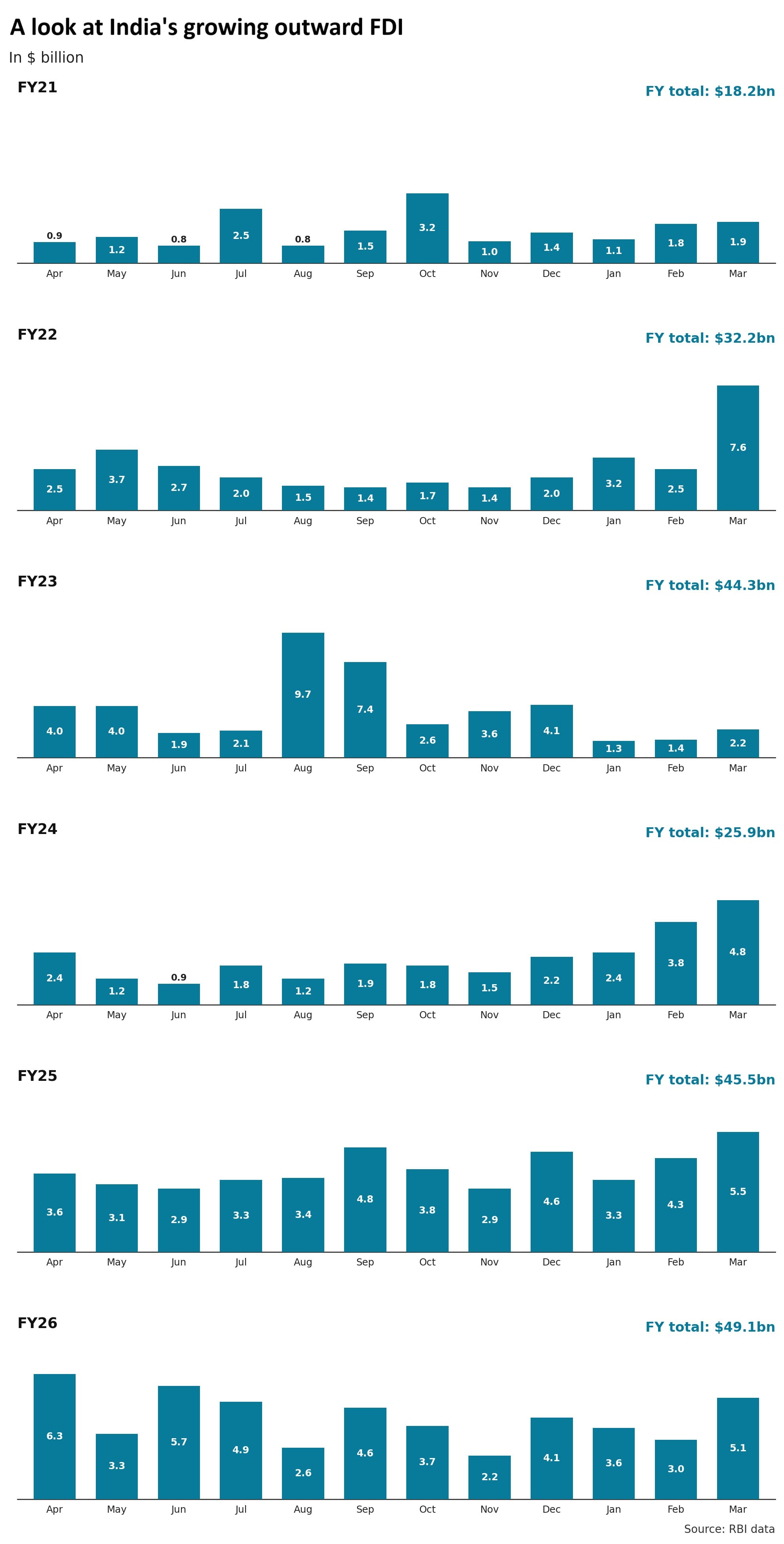
Which makes you wonder, does taking money abroad mean India is becoming less attractive for investment, and should we be worried about it?
Well, that actually depends on how you look at it. If you look at what overseas expansion does for companies, you’ll see that Indian businesses have some pretty good reasons to invest abroad. For starters, it gives them market access. Setting up subsidiaries abroad helps Indian companies reach foreign customers and establish distribution networks. This is particularly useful for industries like pharmaceuticals and automobiles.
The second reason is acquiring capabilities. Building technology, brands and distribution networks from scratch can take years. But buying an established foreign company gives Indian businesses immediate access to these capabilities.
Take a couple of recent examples. Sun Pharma’s proposed $11.75 billion acquisition of Organon will give it access to an established women’s healthcare portfolio and a wider global commercial network. Similarly, Tata Motors’ $4.5 billion acquisition of Italian truckmaker Iveco could strengthen its commercial vehicle operations and international reach.
And these two benefits can lead to a third, more indirect one: domestic spillovers.
You see, expanding overseas can actually benefit a company’s operations back home. Research suggests that Indian companies investing overseas tend to increase their spending on research and development (R&D) and technology domestically. That’s because access to overseas markets and capabilities can create opportunities to develop more sophisticated products and improve operations back home.
There’s also the export potential this creates for the economy. Just think about it. An Indian manufacturer exporting through someone else’s distributor earns a thin margin and has little control over sales. But owning an overseas sales or distribution company allows it to sell Indian made products directly to customers. These overseas units can also buy components, ingredients and services from the Indian parent company.
So, outward FDI isn’t necessarily money leaving India for good. It can also help Indian companies become globally competitive and eventually bring back profits and business opportunities.
But there’s another side to this story. As we said earlier, it all depends on how you look at it. That’s because the benefits we just discussed aren’t automatic.
Some overseas investments may simply create financial structures that help companies shift profits to countries with lower taxes. One indication of this comes from RBI data, which shows that Singapore, the UAE and the US were leading destinations for outward FDI, with more than half of India’s outward FDI going to these countries.
There’s also the impact on foreign exchange. Every dollar invested abroad has to be bought with rupees. So outward FDI increases the demand for foreign currency and can put pressure on the rupee, especially when other inflows are already weak.
And did we mention round-tripping?
This is when Indian money is sent abroad and then comes back into the country disguised as foreign investment. Basically, the money simply passes through a foreign entity, usually a company in a tax haven or low-tax hub like Singapore or Mauritius, before returning as foreign investment. This can help the company get tax or regulatory advantages.
So, when you look at both sides, the real concern isn’t that Indian companies are expanding globally. It’s whether these investments are generating enough economic value back home.
And we’ve seen a few reasons why they could. A Harvard-published study, for instance, examined a few US companies and the concern that investing abroad could take away jobs, investment and tax revenue from the home country. But its conclusion was that firms expanding abroad also expanded at home. That’s because their foreign operations often need inputs from the home country, including physical goods and intellectual property.
Perhaps this explains why India has become fairly lenient when it comes to making overseas investments easier over the years. And it could also be one reason why outward FDI figures have continued to rise.
For instance, in 2022, Indian companies outside the financial services sector were allowed to invest in foreign brokerages, asset managers and credit card businesses without prior approval. The limits were also revised to allow companies to invest up to four times their net worth (the value of a company’s assets minus its liabilities) abroad each year. But there’s a catch. These investments must go into genuine businesses.
And the RBI has recently started paying closer attention to this due to the growing pressure to conserve foreign exchange. Which means it has started looking at how Indian companies’ overseas businesses are performing, why they’ve chosen a particular country, whether there are holding companies in between and how they plan to bring their profits back home.
So yeah, growing outward FDI isn’t automatically a reason to worry. The real challenge is striking the right balance and more importantly to ensure that when money leaves the country, it brings something valuable back home.
Until next time…
If you liked this story, feel free to share it with your friends, family, or even strangers on WhatsApp, LinkedIn, or X.
Trust Finshots for Finance? You'll love Ditto for insurance.
Built by the same four friends behind Finshots, Ditto is here to make insurance simple. No spam, only honest advice to help people make smart insurance decisions.
✅Backed by Zerodha
✅Rated 4.9 on Google (36,000+ reviews)
✅Over 7 lakh customers advised